
Living in a Land of Abundance
Published: 2026-03-31
I live in a land of abundance. It just took moving half way around the world for me to fully appreciate it!
Let me share the moral of my story up front: With some patience and a gatherer’s mindset, you can save money, improve your life, and be kind to the environment.
For context, last year my husband and I relocated from Australia back to Canada. And, as it turns out, shipping stuff 18,000 km is pretty freakin expensive. Thus, we were faced with the brutal decision of what to leave behind. Even though we moved to Oz with a very modest amount of stuff and rented furnished apartments, we still had to sell or give away the accumulation of three years of living before we returned home. Ultimately, we returned to Canada with just a few mementos: our clothes, board games, roller derby gear, and computers. (Actually we returned several months before our stuff, which took another six months to arrive by sea!)
We turned a page to begin a whole new chapter as we settled in a new city with no furniture or furnishings. In many ways we were starting from scratch.
What a cool opportunity.
We could have easily rushed to buy everything we “needed” brand new on day 1. But we didn’t want to spend a tonne of money while we were finding our feet. So, we decided to rebuild slow. We chose to take our time to source most of what we needed second hand.
And, wow-zah, did the world provide! One major benefit to living in a big city is that there are plenty of people with more stuff than they know what to do with.
These are the places we found free stuff:
- Freecycle
- Kijiji Free posts
- Online community sites (for example, our roller derby league has a Slack channel for members to exchange free stuff)
- “Free Stuff” left at the end of driveways
- Friends and family
And here are items that we found for free!

- Coffee table
- End Tables (used as bedside tables)
- TV cabinet
- Computer Desk
- Piano bench seat
- Two dressers (both of which we ended up giving away)
- Kitchen table & four chairs
- Dining table & six chairs
- Ceramic bowl
- Serving Bowls
- Sauce pot
- Bicycle
- A full set of chef knives
- Brie ceramic baking pot with lid and a cute little bamboo paddle knife (I love it so much!)
- Place mats and cloth napkins
- Several small baskets
- Laundry hamper
- Two small garbage cans with swinging lids
- Bathroom garbage can with foot pedal
- Kitchen garbage can
- Kitchen step stool
- End table lamp
- Floor lamp
- A fancy wine corkscrew
- Two 23L glass carboys
- Around 60 wine bottles
- A set of very fluffy towels, still new in packaging
- An iron
- Garden hose winder
- Plant pots
- Art supplies
- Sewing supplies
- Knitting supplies
- Weighted work out vest
- Glassware & mugs, including wine and martini glasses
- Wood salad tongs
- Paint
- Broom with dust pan
- Snow shovel
- Hanging file folders
- Ink jet printer with scanner
- Glass bread pan
- Metal bread pan
- Stone rolling pin (which we also gave away, along with a few boxes of other misc kitchen stuff)
- An adorable apron with lots of huge pockets
- Electric sandwich press & grill
- Ikea shoe cabinet
And probably some other items that I’ve forgotten about.
We also frequented thrift stores, The ReStore, and Kijiji to buy second hand items like these:
- Coffee maker
- Coffee grinder
- Bread knife
- Slow cooker
- Glass casserole dishes
- Clothes
You do need to be patient to follow this approach. You also need to be willing to deep clean items and sometimes mend them. I find giving items a second life and saving them from a landfill extremely rewarding. Often second hand items are basically as good as new and would have become trash if they hadn’t been rescued.
You also need a sense of humour or maybe a dose of humility. You need to find the joy in the moment and be grateful for what you have rather than begrudging what you don’t. My husband and I enjoyed a few weeks of dining cross legged at coffee table before we found tables and chairs. I actually found it kinda romantic. We wouldn’t have had such a memorable time if we had just run out to buy furniture. We’re still searching for a decent kettle, which means I’m currently boiling water for my tea in a pot. And that’s okay. It’s really not a big deal and, when we do find a kettle we like, we will appreciate it all the more!
We feel very fortunate to have found so many useful things. We didn’t need to spend heaps of money and we didn’t need to go into credit card debt. We just needed to take our time while living in a land of abundance.
If you enjoyed this post, please subscribe to the weekly MWM email.
Life of Pie: Housing
Published: 2026-03-25
You may have read my previous posts Building Your Financial House, which gives you a high level picture of healthy finances, and then I’m Ready Now What?, which gets you prepped for today’s post. If you haven’t read both of those, I recommend that you jump back to them now before proceeding.
We’re going to talk about pie – not the yummy dessert like my Grandmother used to bake; Rather, we’re going to check out a pie chart to give you perspective on your spending at a glance, proportionally speaking.
Portion Control
It’s important to note that pie, both the baked kind and the chart kind, are finite. When you cut a large slice for one plate, there is less pie for every other plate. The money you have to spend every month is the same idea – you only have so much to go around. We don’t depend on credit (because, if we do, we are sinking!), so we can only portion out our pie based on the planned incoming cash we earn on a monthly basis.
Over the course of the next few weeks, we’ll look at the (up to) five pieces you should cut your pie into for a balanced financial life. For each slice, I will give you a target percentage. But let’s be real for a moment. Life is squishy, and your pie will likely never be 100% perfect. You can always make trade offs. You might make one slice smaller so that you can make another slice bigger. The important part is that you are being intentional and you understand the impact of your choices. Targets can help you understand why you might feel like you can’t get ahead with your money. If you are spending a lot more than your target, odds are life is going to feel impossibly tight. The MWM spending targets offer a balanced life that’s designed for long term success; comparing your spending to my model will show you focus areas to consider life changes.
How Big is your Pie?
In step 2 of the MWM Homework Day 0 you gathered your net income. Your net income is the size of your pie.
Grab that number. Make yourself a copy of the MWM Budget Tracker (available from my website’s resources section) and add your number to the Spending worksheet in the Income table.
Taking your First Slice
Our first slice of pie is housing. I like to start with housing because it’s a fundamental need for everyone and your monthly costs should generally stay fairly consistent, unless you’ve moved.
Housing: Your monthly spending target is 35%
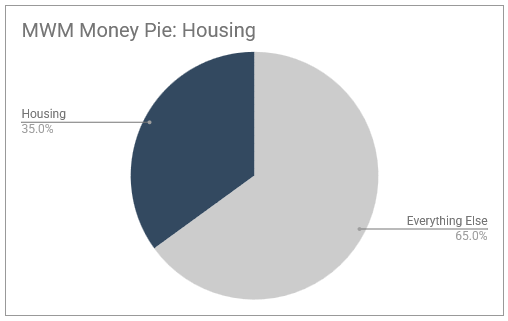
Within this category, you must capture all monthly housing costs related to dwelling:
- Rent or Mortgage
- Tenant or Home Insurance
- Utilities
- Electricity / Hydro
- Natural Gas
- Water
- Internet service to the home
- Property Taxes (if you own)
- Condo or Homeowners Association (HOA) Fees
- Home Maintenance
You will have already gathered your numbers for items 1 – 5 as part of your MWM Homework Day 0 prep work. Too easy! Grab those values and update your copy of the MWM Budget Tracker to the Expenses table of the Spending worksheet.
Item #6 is a bit trickier. You have some control over the timing of maintenance. It’s also generally only applicable to a property owner. You might choose to undergo home improvements that are partially maintenance but also are for personal preference (i.e. upgrading to stone counter tops). For now, if you are responsible for home maintenance, I recommend that you use this formula for your monthly target:
Value of Property * 1% / 12 = Your Monthly Maintenance Target
For example, if you own a home valued at $600k, here is how to calculate your target monthly maintenance budget.
$600,000 * 0.01 = $6,000 a year
$6,000 / 12 = $500 a month
Note: If you have an older dwelling or expensive tastes or just purchased a property, the 1% rule may not be enough. Consider adjusting your calculation up to 2% or 3%, depending on what feels right for your situation.
Finally, let’s take the numbers that you’ve gathered and check them against your target using this calculation:
{Sum of all Monthly Housing Costs} / Your Monthly Net Income * 100 = Your total housing percentage
Example:
Monthly Net Income: $6000
Expenses: Rent $1850, Tenant Insurance $30, Utilities with Internet $220 = $2100
$2100 / $6000 * 100 = 35%
Check In: How Did you Do?
You can now check your first slice against the MWM model budget. How did you make out?
I don’t have any housing costs – Perhaps you don’t have housing costs yet, for example if you live with your parents. You might save 35% of your net income into a high interest savings account and this will be your “move out” money. Starting to put that amount away now will make it easier to keep the habit of living within your means later.
I am on target – Is your percentage at or under 35%? Congratulations, you are on target! If your percentage is less than target, you have more money to direct to other pieces of your money pie.
I am over target :/ – Is your percentage over 35%? As I mentioned earlier, this is not necessarily a reason to panic. It is an invitation to think critically about why your housing costs are higher than the MWM model target. Are there changes you might make to bring down your housing costs? Do you need to consider making more money to get your pie back in balance? Is sharing costs with a roommate an option? Keep your Housing slice in mind in future weeks as we carve out the rest of your money pie. Some of those other slices will need to be slimmer to accommodate a larger slice for dwelling.
If you enjoyed this post, please subscribe to the weekly MWM email.
Why Blog
Published: 2026-03-21
I have a book in the works but finding the motivation to write down everything that’s floating in my head is tough. And frankly, sharing my story in such a personal way is a bit scary.
But I don’t want to wait for a perfect book draft to reach people. I always seem to have a lot to say and I’m always keen to share knowledge. Starting this blog means that I don’t want have to wait for one major publication to share tips and insights with you. Through posts, I can share information in bite size pieces, which I hope you will find easy and enjoyable to read (and useful!).
As I move through the world and talk with people, they ask me questions and I share what I can. In turn, this motivates me to post and share with more people, who may have the same questions. My hope is that through blogging and other socials, I can continue to grow the conversation. The more people I talk to, the more exciting it is to connect with more people and hopefully help them improve their lives.
So please keep motivating me with your questions and comments! Ask me anything – there are no silly questions – when you see me or via email or socials. If you’re curious and want to know more about building wealth and taking control of your money, please get involved and support me. A really easy way to stay connected is by subscribing to this blog and you’ll get an email every week with links to new posts.
Thank you!
If you enjoyed this post, please subscribe to the weekly MWM email.
I’m Ready! Now What?
Published: 2026-03-16
Cool, you just read my last blog post building your financial house and you’re ready to “get better at money”! But what now?
Rest assured, we will dive into our first pillar, which is our spending plan, in due course. Before we deep dive into that topic, let’s set you up for success. Here are a few tips and a little bit of homework so that when we start building our spending plan, you will really be ready to go.
Set Yourself Up for Success
Your calendar is a reflection of what matters to you. If you care about fitness, you will have dedicated time for activities that make you sweat. If you care about your friends, you might have a standing monthly brunch meetup. The same is true for money. If you want to get serious about your money, you’re going to start setting aside time to deal with it.
Prep Work
- Block out 1 hour of focus time
- Pick a time when you will have the energy to focus and a place to work that is distraction free.
Pro Tip #1: When planning focus time, be realistic and be intentional. Planning to dive into money stuff at 8pm on Thursday night after an exhausting day is not ideal.
Pro Tip #2: Commit to focus time. Set your phone to do not disturb and shutdown your email. I have a timer on my phone called “Focus Time” which helps me remain dedicated to the planned task and pulls me out when my time is up. - Pick a location. Choose a quiet spot where you can truly focus. If you can access most of you financial information from a personal laptop or your phone, you might go to the library for an hour. Or, consider heading into work early one day. Or simply find a room at home where you can shut the door. The key is to find a distraction free location, just know that you will need access to your financial accounts and bills.
- Book it in. Now let’s make it official and add it to your calendar. Call it “MWM Homework Day 0”. Do it now. I will wait.
- Pick a time when you will have the energy to focus and a place to work that is distraction free.
MWM Homework Day 0 – Gathering Intel
You did it! You dedicated time to “get better with money”. Don’t forget to set your focus timer and let’s begin.
- Create a worksheet. Either on a piece of paper or create a new spreadsheet.
- Create a section for Income
- Write down your monthly net income.
- If you get a salary with a relatively stable pay cheque, you just need a recent pay-stub. Or check deposits made to your bank account.
- If you have a variable income (tips, gig work, varying hours), I recommend that you grab your last 12 months of income (pay stubs, invoices, income transactions from your bank account). Add up the 12 months and divide by 12. This gives you a reasonable number to expect on a monthly basis.
- You know your situation best. Your goal is pick a reasonable monthly income that you can safely expect to earn every month.
- If you are in a household with multiple earners, jot down the income for each person separately. If you don’t know what their income is, make a follow up action item for yourself. You need to gather this information to make a spending plan for your household.
- For many people, income from employment may be their only source. If you have other income streams (dividends from investments, rental income, government grants or programs, spousal support, etc.) add entries for these as well. If these are not regular monthly amounts, you can add up what you would have received over the past 12 months and divide by 12 to give you a monthly estimate to work with for now.
- Write down your monthly net income.
- Below is the list of information you are going to gather. This is a generic list, so skip any information that is not applicable to you. For example, if you don’t own a car, you will skip “Car Insurance”. You will find this information in physical documents or digital copies.
For each item in this list, add an entry on your worksheet with the monthly value. If something is paid annually, either make note of that or use the divide by 12 trick to estimate your monthly expense.
- Monthly rental or mortgage payment (you likely can jot this down off the top of your head, but if you’re unsure, check your bank transactions)
- Condo or Homeowner Association (HOA) Fees
- Home or Tenant Insurance Bill
- Automobile Insurance bill
- Car loan(s) (either from a monthly statement, your original loan schedule, or the per-authorized transaction from your bank transactions)
- Other transportation costs. For each of these ones, total up your bank transactions from the last 3 months and divide by 3.
- Transit Costs (bus, Uber, train, metro, taxi, Lyft, Uride, etc)
- Fuel or EV charging costs )
- Tolls
- Parking Fees
- One recent utility bill for Water, Hydro/Electricity, Gas, and household Internet
- Your last statements for all your credit accounts. Remember to include
- Credit cards (Visa/Mastercard)
- Retail store charge cards
- Pay day loan statements
- Medical debt payments
- Personal loans (jot down the total amount you owe and what you pay back monthly)
- A list of any buy now, pay later outstanding balances. (BNPL, Pay in 4, Afterpay, Klarna, Affirm, Sezzle, Zip)
- A recent mobile phone bill
Stop the clock, you’re done! Give yourself a HUGE pat on the back for the amazing work! I’m very proud of you. That was a lot of deep dive work and I know gathering all that information can be daunting. Keep worksheet intel handy; we’ll be using them to build a spending plan to check if your money life is in balance.
If you enjoyed this post, please subscribe to the weekly MWM email.
Build Your Financial House
Published: 2026-03-08
If you want to build an awesome life, you need to build an awesome house. Financially speaking.
Let’s think about your financial house from a bird’s eye view. Let’s fly way way way up and then turn to peer down at the ground. Can you see your house? I can. It’s a beautifully carved marble building on a lush field of green and yellow. It’s sturdy and strong and secure. It’s built to last the ages. And it’s based on four pillars.
The pillars of your financial house are:
- A Spending Plan – Live within a spending plan that allocates a healthy balance of money for housing, transportation, life, future, and, if needed, debt busting.
- Emergency Savings – A multi layer safety net to protect yourself from unforeseen events that risk bringing down your financial house.
- Zero Debt – Debt is an anchor that drags you down. You need to bust all high interest consumer debt as quickly as you can. Save yourself!
- Investments – Buy a diversified portfolio – as much as you can afford, every month, without fail, into boring stuff that has low management fees. We’ll talk about knowing what you can afford in a future post!
These four focus areas are your building blocks for financial security.
Zooming out paints the picture of what you want and creates the blueprint of what you need. With your blueprint in hand, your next steps will be to zoom in and start building from your plan. In future posts, I’ll help you construct each pillar, methodically and systematically.
But, for now, don’t over think it! Enjoy the view and know that once all these pieces are in place, you will have put your financial house in order.
As a closing thought, let me mention that, on top of our four pillars, stands financial independence (FI). People reach FI when their investments provide more income than their projected expenses. If they accomplish this surplus before the generally accepted age of retirement, they can retire early (RE). This is the basis for FIRE, an extreme personal finance movement, which marries FI with RE. Online discussions concerning FIRE include big feelings and heated debates. The great news is that you don’t need to choose right now if you want to pursue FIRE. By building your financial house based on the pillars I’ve listed above, you’ve created a foundation for FIRE, should you ever want to pursue it! The only difference is that you would adjust your spending plan to focus more on the future to make investing a priority over spending.
If you enjoyed this post, please subscribe to the weekly MWM email.
First Post!
Published: 2026-03-02
Ahhh, the blank page of a fresh new blog site. It’s like opening a paper notebook for the very first time; the smell of promise is as distinct as it is unmistakable.
The idea for this site has been percolating within me for about a year. First and foremost, I want to support people who want to be intentional with their money. My goal is to reach audiences who typically shy away from financial topics. This is a no judgement space where I can share how to build personal wealth in a simple and straight forward way.
Over the past three decades, my husband and I have built a fantastic life together. We started as teen parents, living below the poverty line, and raised two amazing kids while working as one team towards our dream of early retirement (Freedom 45, baby!). I love sharing what we learned along the way that allowed us to make money work for us, rather than having to work for money.
To be clear, you don’t need to be pursuing early retirement or financial independence to get value from this site. The foundations of money management are the same for everyone. You have the power to decide how fast you will go, what dreams you’ll to pursue, and what provides a wonderful life. I can help you keep the power of money in perspective and nudge you towards living a balanced intentional financial life.
So welcome, friends! I’m so glad you’ve found me here and I’m looking forward to sharing thoughts, inspirations, and ideas!