
Confidence
Published: 2026-09-25
It takes a certain amount of confidence to make big money decisions.
I recall discussing retiring early with my husband, who looked me square in the eyes and said “Just don’t make me become a Walmart greeter, k?”. By which he meant, make sure your plan is rock solid and we won’t screw our future selves.
Gulp. Cool, no pressure, right?

His fear was that our plan would fail and we would have to go to back to work doing something we hate. My fear was that we would live a life of austerity but then not save up enough fast enough to retire early in a significant way. I did not want to live a life restricted in my 30s and 40s only to realize I only shaved 5 years off of my retirement date.
A Progression of Planning
I’ve used different systems over the years to motivate and guide our big money decisions. Having a plan that is mapped out by way of a spreadsheet has been my guiding light and essential to achieving our money goals.
The Debt Busting Years
In our debt repayment years, I was obsessed with Microsoft Money. This product no longer exists, but it was fantastic! Not only did it track our budget, it graphed all our debt repayment schedules over time, making it easy to see at glance exactly when we would be debt free. It also let us run scenarios, like what would happen if we upped our mortgage payment by $50 a week.
Having the ability to run scenarios made it easy to build a plan with my husband. Seeing the impact from paying off debt faster in terms of saving time and interested charges was very motivating. We were happy to lock in a spending plan that got us to our goal faster.
Want to build your own debt busting plan? Check out my Debt Busting section on my Handy Links page for online tools to track and run scenarios on paying down debt. Drop me a comment if you try it and let me know your impression.
The Saving Years
After our debt was handled, we transitioned to our saving years. I built a simple spreadsheet to project at what age we would hit our “number”.
If you are into FIRE (Financial Independence, Retire Early), you might already have a “number” that you are working towards. In FIRE, your “number” is a target amount in savings (a.k.a your nest egg) that is big enough to to cover your daily expenses from your investment gains.
In our debt busting years, we followed the Life of Pie method, meaning we had been saving 10% along side paying down debt with at least 15% of our net income. This meant we had a small nest egg already accumulated. This was my “ground zero nest egg” and which become seed money for my spreadsheet calculation. I then mapped for every year how much we would have based on 7% investment growth with a monthly savings rate of $2250. Our safe drawdown rate is 4% of our nest egg. After setting up our base case, I copied the table and made versions that showed how much faster we would reach our number with a savings rate to $3000, $4000, etc.
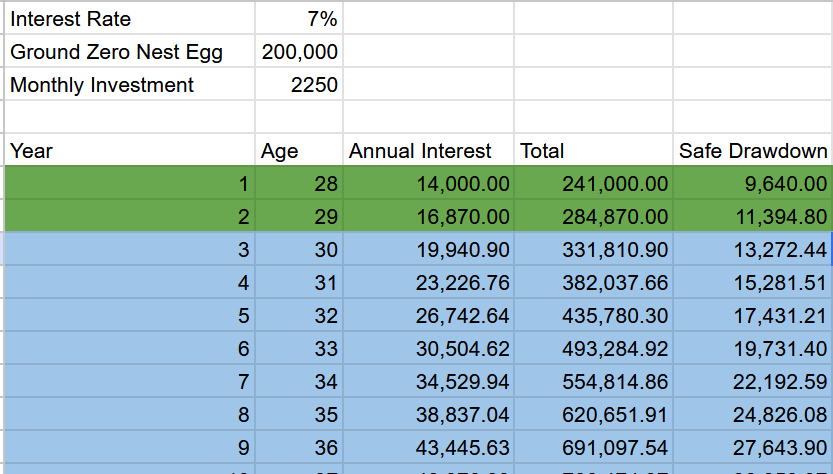
Seeing the year we should theoretically be able to leave our day jobs was very motivating! It still didn’t feel real, but we knew the numbers on the page couldn’t lie.
It’s worth noting that in our saving years, we adjusted the Life of Pie method and accelerated our savings rate, sometimes as high as 50% of our income. If you don’t care about retiring early, this is not something you need to worry about at all! Just follow the Life of Pie method, and you will be totally fine with a pretty fantastic life. But if you are FIRE curious, I highly recommend reading The Shockingly Simple Math Behind Early Retirement by Mr Money Mustache. This blog post changed my life! Then go ahead and devour the rest of his blog. It’s well worth the read!
Now a days there are much more sophisticated tools online that make my simple little spreadsheet look basic. If you are interested in trying some out, see an investment calculator called Smartasset, linked under my Handy Links under Investing, or the web app Projection Lab, linked under my Handy Links under Wealth Management. While these are very cool, you could also keep it basic like we did, and just build yourself a tidy little spreadsheet.
The FIRE Years
We are now in our FIRE years. We’ve retired early and now we need to manage and protect the nest egg so that it lasts into our traditional retirement years and beyond.
This is the probably the most nerve wracking phase. In order to pull the trigger and leave our day jobs, we REALLY needed to see the numbers mapped out.
To help us, about 3 or 4 years before we planned to retire at 45, I built an uber spreadsheet, which I will call our Projections spreadsheet. We still use it to this day to make big (and scary) money decisions.
Our Projections file maps out our annual income and expenses from the current year until we’re 95 years old. It also maps out our annual net worth, tracking assets and liabilities over time. Our expenses increase every year based on value for inflation, which we’ve set at 3%. Our investments grow annually based on a value for ROI (return on investment), which we’ve set at 7%. It also shows us the impact, over time, of drawing from our investment accounts, which will give us income now that we don’t have day jobs.
Our file is both simple and not simple, at the same time. It’s evolved heavily over the years, especially as we came closer to leaving our jobs. For us, it’s a guiding light that lets us know we’re gonna be okay. It’s also a tool that we call on when we have to make big life decisions. For example, when we returned to Canada, we used it decide where we could live and keep on budget. In this past year, we used it help us decide how much we could afford to spend on travel. We can’t account for everything in our monster of a spreadsheet, but we can get pretty darn close. That being said, FIRE is not for the faint of heart! If you want to FIRE, you need to know your numbers inside and out.
Bone Shaker
Last week we received some impactful news. Our tenant, who was renting out our “forever” home while we were in Australia, has given their notice. When we returned to Canada, we made a big life decision not to evict them immediately and continue renting while we spent time in another part of the country. Losing renters means that we are losing a revenue stream that helped offset some (not all) of the carrying costs for us to keep that property. In our dream scenario, our tenants would have stuck around for another year. With the big news, we need to re-assess our life plans going forward.

Queue the panic alarms? Actually, not at all. Sure, the news is a bit stressful, mostly as an interruption in the status quo of our lives. But we have a baseline plan, and now we just need to review and adjust accordingly. So we dusted off our trusty Projection spreadsheet and mapped out what this means for us financially, based on what we know today. And guess what? We should be okay. Our Projections have given us the confidence to know that we don’t need to rush into any panic based decisions. We will want to make some adjustments over the next 5 to 10 years and next year we won’t plan a big vacation like this year, but that doesn’t feel like a great sacrifice right now.
Confidence (Question Mark)
Where does confidence come from? To be clear, even with our spreadsheets and our life planning, it’s not all smooth sailing all the time. We still can get queasy stomachs about what the future will hold. But all we can do is make the best decisions we can with what we know today. That’s all any of us can do, really. For us, confidence comes from being organized, disciplined, and based on real numbers that make sense.
What’s Your Take?
Have you had to deal with a big financial change? Did you have a system in place? Were you able to lean on an emergency fund? Drop me a comment or an email, I would love to hear what you would do!
If you enjoyed this post, please subscribe to the weekly MWM email.
Oh the places you will go
Published: 2026-09-18
We travelled a lot this year. So far, I’ve taken eleven trips. These have all been within the province and the budget for each has varied. I have one more local trip I’m taking this weekend and then we will end our year with la pièce de résistance: a trip to Sweden where we will watch the WFTDA roller derby championships!
As I am writing this, thirteen trips sounds extreme to me. It’s certainly the most I’ve ever travelled in one year for personal entertainment. I suspect we will calm down our travel plans next year, but who knows! This year we focused on doing a lot of roller derby activities which kept us busy most weekends over the summer season.
How to Think About Vacations
Vacations shouldn’t take you by surprise and you shouldn’t take on debt for travel. You are in charge of deciding how many trips you take, where you go, and how much you will spend.
Here is how we approach vacation spending.
- We allocate vacation spending in our monthly budget This has been our system for the past 30 years. In our traditional earning years, we would move a budgeted amount, for example $200 a month, to a separate account that I lovingly referred to as our “slush fund”. Now a days, we work a little differently, but for most people, I highly recommend a separate spot to stash earmarked cash. Our slush-fund account held house money intended to pool over time for large expenses like vacations, annual insurance bills, and Christmas. How much we had sitting in each “pot” of our slush fund was tracked within our budget. This system gave us predictability, stability, and an upper limit to what we could spend.
Predictability: We transferred money every month, without fail from our joint daily spending account to our slush fund account. It was a “bill” that we paid ourselves. If we didn’t spend it all in one year, it would roll into the next year to give us a bit more spending power, if we wanted it. Our system kept our money management simple and boring (which is the goal!).
Stability: Our monthly transfer meant a slow and steady drip of money into our pool. The monthly amount was decided once a year, during a money talk. We reviewed our income and expenses and set out all our planned spending for the upcoming year. The amount we allocated to vacation was based on what our household could afford monthly and it fit within on our total life expenses of 25% net income.
A Ceiling: Our system made it very easy to know when we could afford a trip, if ever. Instead of making life “exciting” and just deciding we deserved a vacation as we felt like it, our system insulated us from making choices based on FOMO. We did not “stretch ourselves” and there was no “we will figure it out later” mental gymnastics. We had the money that we had and it would only go so far. If we could afford $200 a month for vacations, the math was simple, that’s a max of $2400 a year for vacation spending. - We set special budgets for special occasions At a monthly money talk last last year, well before the travel season was upon us, we decided together that we wanted to dedicate more to travel this year. It was our first year together as retired and we wanted to spend more time focusing on roller derby events. So we looked at what we felt we could afford and allocated two extra pots of money. These are considered one time “special spending” budgets. The money was from surplus cash, rather than our monthly budgeted vacation amount.
Pot 1:France TripLocal Derby Travel
I wanted to attend MRDA championships in France. It ticked the box in which we like to double up derby destination travel with fun experiences and going to France is on my bucket list. So, I pencilled a special budget line item for a trip. However, as we approached the travel season and during one of our monthly money talks, my husband had a counter proposal: rather then blow so much money on one trip, we should spread our budget over a lot more short and local trips, giving us a heck of a lot more derby experiences. I came around to the plan and I figure we are simply deferring a France trip to a future adventure.
Pot 2: Sweden Trip
This will be a ten day trip that we are both looking forward to! We are gong to the 2026 WFTDA Roller Derby Championships and padding a few extra days for sightseeing. Would I have thought to go to Sweden otherwise? Probably not, but that’s the fun of bundling travel with derby. We see corners of the world we would not otherwise have visited. I had assumed that because we no longer had day jobs, it would be “easy” to spend several weeks overseas. But two things worked against us: 1) vacationing is not cheap! For a multi week trip, I think I would need to be more creative to try and live like a local rather than a tourist 2) somehow we are still really busy! We have life stuff happening at home which didn’t lend itself for us taking a longer trip.
The Best Vacation is One You’ve Already Paid For
I like planning stuff and we both really like tracking stuff.
- Set your budget ceiling. Either from your pooled vacation money or from a special pot of “extra” funds that you already have on hand.
- Build your budget! Planning the trip is (for me) the super fun part. I build a spreadsheet that lays out your itinerary, when you depart and return, which calculates your total days of travel.
I always include a few standard categories:
EV Charging (if driving) or Flights – based on how many times we figure we will need to supercharge our car or a google flight search
Accommodations – I use a guesstimate rate for accommodations, based on a somewhat educated guess as to where we are going, and times it by the total days. In the example below, I assumed $100 per day for hotel or an airbnb.
Food & Drink – Similar to accommodations, I assume a daily rate of $75
Events & Attractions – For a short / targeted trip, you might only have one event you are attending. You can either build your budget around that (i.e. the cost of a pair of tickets to the event) or, if it’s a trip where we want to sight see, I’ll just set a daily rate of $50-$100 (best guess) to have something to stay within.
Land Travel – Typically required for sightseeing trips. This might be a rental car, local transit, or ride services.
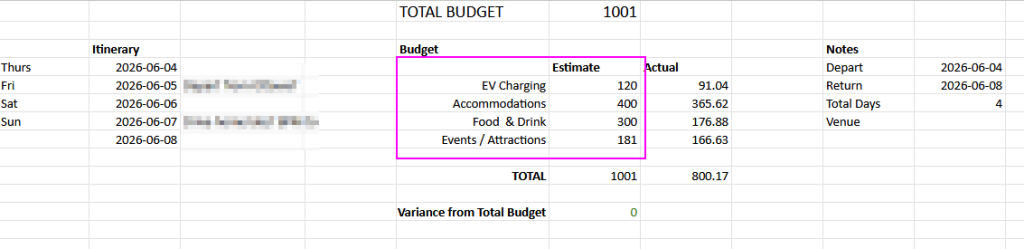

3. Decide if you can afford it. This is a big one and you must not skip it. At this point, we have not yet committed to taking the trip. Will the projected budget for the trip fit within our budget? For example, maybe flights are really expensive. If you are working from special budget of extra money, maybe you can allocate some of your vacation to cover the gap. Otherwise, the trip is probably a no go. And that’s okay! It’s far better to realize if you can afford a trip before you start booking stuff, rather than dealing with a debt hangover afterwards!
4. Book Stuff! Once you know you can afford it, you have the green light to book stuff! I like to copy past links and screen shots of my flight and accommodation booking into my spreadsheet so everything is in one place. As you pay for stuff, track your actual spending. Being over budget in one category is not a big deal, as long as it fits your total trip budget.
5. Let the count down begin! Now that everything is booked, you get to sit back and anticipate how much fun your next adventure will be!
6. Enjoy your fully funded guilt free trip! There is nothing as good as guilt free travel. Having everything paid for ahead of time means you will enjoy being in the moment, without a foreboding feeling of a looming debt hangover.
7. Post trip stuff – As I mentioned, we like to track stuff. So we do keep track of our travel spending. After a trip, we ensure the money we spent during travel is tracked in the Actual column of our budget sheet, so that we can keep ourselves accountable. Tracking our spending also helps us with our guesstimates for planning future trips.
Rinse and Repeat
And that’s how we plan all our trips! It’s a simple system and it’s easy to replicate. It also keeps us within a spending limit. And sometimes, it helps us feel good about turning down opportunities. Even with so much travel this year, I did turn down three other travel opportunities, solely because it wasn’t in our plan and I couldn’t afford it. And that’s totally okay! We all have limited funds and we all have the power to choose what we do with them.
If you enjoyed this post, please subscribe to the weekly MWM email.
Investing ABCs: Investment Accounts Part 2
Published: 2026-09-11
This Investing ABCs series is for anyone who wants to start investing, but doesn’t know the first thing about how to begin. You don’t need to read this series in order, but you should read and learn all the ABCs before venturing forth to buy investment products.
This is a continuation of my post Investing ABCs: Investment Accounts
Why This Stuff is Important
One of the biggest barriers to managing your own investments is all the acronyms floating around. All those letters (TFSA, RRSP, FHSA) are confusing, overwhelming, and intimidating. It’s not easy or intuitive to understand the different types of investment products or how they help you. I am here to tell you that it’s definitely not you, it’s the financial system.
I can’t say that the confusing nature of the financial system is by design, per say. However, it certainly keeps you dependent on “financial experts”. Unfortunately, there is a big lack of transparency from everybody. Most “experts” are actually salespeople who have incentives and an unspoken agenda that is not obvious or disclosed. Banks offer a service, but they also want to increase their profits. Financial platforms, like Robinhood , Questrade, and Wealthsimple, offer similar services as well as incentives, but they also want to sell you their products to increase their profits.
The best I can do is arm you with knowledge. A little bit of knowledge will help develop your “gut”. My mother used to tell me when I was growing up: “Always trust your gut!”. I think it was pretty sound advice.
And here is my advice to you: Never do anything with your money that you don’t understand!
A Quick Recap
Here’s a quick review the four types of investment accounts we’ve already introduced.
- TFSA – Tax Free Savings Account. You put in money you’ve already paid taxes on but you never pay income tax again on that money or the money earned inside your TFSA. You are only allowed to contribute when you are 18 or older and only up to your total contribution allowance, which increments annually and is tracked by the CRA.
- RRSP – Registered Retirement Savings Plan. You put in money you’ve already paid taxes but then the CRA gives you tax money back through your income tax return, so you have actually contributed pre-tax money. The total amount you can contribute each year is based on a percentage of your income and is tracked by the CRA. Every dollar you contribute reduces your taxable income for the current year. Money invested inside your RRSP ideally grows over time until you decide to retire and need to start withdrawing your money. Those withdrawals are taxable income. Typically you will be in a lower income tax bracket when you are retired. You no longer have employment income. Since you are making a lot less when retired, you should be in a lower tax bracket than when you were working. By contributing to an RRSP, you can reduce the total income tax you’ll have to pay over your life time while squirrelling away money for the future.
- RESP – Registered Education Savings Plan. You contribute to an RESP for someone else, typically your kid or a grandkid. The Canadian government will match a percentage of your contributions with grants. The withdrawn funds may only be used to pay for eligible education expenses.
- Non Registered Account – These accounts are not registered with CRA and have no contribution limits. They do not give you any tax advantages or refunds. You are always investing with after tax money. You typically only want to open a non registered account after leveraging registered accounts, as registered accounts provide financial benefits, each in their own special way.
Even More Investment Account Types
Yup, there are EVEN MORE Investment Account types. Many of these are less talked about but it’s beneficial to be familiar with them.
Remember, these are just account types. They are not investment products. After you open an investment account, for most of these, you still then need to buy investment products using your contributed money.
| Account Type | Description | Requirements | Pros | Cons | How To Use |
|---|---|---|---|---|---|
| FHSA | First Home Savings Account Tax-free savings account for a first home | • Canadian resident • First-time home buyer • Age 18–71 | • Contributions are tax-deductible • Qualifying withdrawals are tax-free • Unused funds can transfer to an RRSP | • Annual and lifetime contribution limits • Must be used for a qualifying home (scroll to Qualifying Home here) | • Contribute and invest • Withdraw tax-free for an eligible home purchase |
| Pension Plan through an Employer | Retirement plan funded by an employer and/or employee | • Must work for a participating employer • Follow the plan’s eligibility rules | • Employer contributions • Regular retirement income • Possible investment and tax advantages | • Limited investment control • Benefits may be restricted when leaving the job • Contributions reduce take-home pay | • Enrol through your employer • Make required contributions • Receive a pension or transfer the value when leaving |
| LIRA | Locked-In Retirement Account Locked-in account holding money transferred from an employer pension | • You don’t open an LIRA directly, you convert a Pension Plan into an LIRA (for example when you leave a company) • Cannot normally make new contributions | • Tax-deferred growth • Control over investments • Pension funds remain protected for retirement | • Withdrawals are locked in • Limited early-access options • Must eventually convert to a LIF or annuity | • Transfer eligible pension funds into a LIRA • Invest until retirement • Convert to a LIF or annuity |
| RRIF | Registered Retirement Income Fund Account that converts retirement savings into income | • You don’t open an RRIF directly, you convert an RRSP into an RRIF • Must be opened by the end of the year you turn 71 | • Flexible withdrawals • Tax-deferred growth • No maximum annual withdrawal | • Annual minimum withdrawals are required • Withdrawals are taxable • Large withdrawals may increase tax or affect benefits | • Transfer RRSP funds to a RRIF • Withdraw at least the required minimum each year |
| LIF | Life Income Fund Retirement-income account for locked-in pension funds; similar to a RRIF | • You don’t open an LIF directly, you convert an LIRA into an LIF • Must follow provincial or federal pension rules | • Tax-deferred growth • Investment choice • Provides retirement income | • Annual minimum and maximum withdrawals • Withdrawals are taxable • Rules vary by jurisdiction | • Convert a LIRA to a LIF at retirement • Withdraw within the permitted annual limits |
| Annuity | • Insurance contract that provides regular income, often for life | • Purchase with a lump sum • May use RRSP, RRIF, or locked-in pension funds | • Predictable income • Can provide lifetime payments • Reduces investment-management responsibility | • Limited access to the original money • Less flexibility than investment accounts • Inflation may reduce purchasing power • Payments may be taxable | • Use retirement savings to purchase an annuity • Choose lifetime or fixed-term payments • Receive regular income according to the contract |
Clear as Mud
Congratulations on making it this far! I know it’s a lot.
Remember, your goal is not to be a financial expert (yet!). You do not need to memorize all this stuff. The first step is to just be familiar with the menu of different investment account types. Over time you will grow into a better understanding of what each account type is and how you can use them to boost your net worth over time.
We have now reviewed ten different investment account types. You won’t need to use them all. However, savvy Canadians will use a variety of these within their lifetime to reduce their income tax burden and increase their wealth.
I want to here from you
I want some honest feedback. Leave me a comment. Did you learn anything from this post? Or did it all fly over your head?
If you enjoyed this post, please subscribe to the weekly MWM email.
Clarification
Published: 2026-09-04
Clarification means providing more details or an interpretation to clear up confusion. It means to make something more clear. When something becomes more clear, we have clarity.
I owe you all a clarification. In my last post Milestones, I spoke to how my husband and I have evolved our approach to celebrating our anniversary from a more conventional and commercial minded approach to something more tailored to our preferences and values.
However, my husband’s hot take was that a key point should be clarified. The true tale is that we’ve taken a journey together recognizing and discarding scripts handed to us by outside influences. We saw our parents and peers go to restaurant and exchange gifts to celebrate an anniversary. In our first few years, we followed this script. Until we recognized that it wasn’t bringing us enjoyment. Together we found better ways to celebrate that fit our style and gave ourselves permissions to set the script aside.
This mindset shows up in a lot of choices we make and it influences our approach to saving and spending money. We strive to think critically about the systems and conventions around us. When we recognize an outside influence that is not serving us well, we happily discard it. For us, this is a key aspect of financial freedom.
Here are some other ways we’ve broken with convention
- In our twenties, many of our friends were buying camps. It seemed like maybe something we wanted at the time, but upon reflection we could barely keep up with one house, let alone adding a second property. Renting is a better choice, if and when we want the camp experience.
- Retailers would love to see us spend money on Mother’s and Father’s day. Upon reflection, it felt like consumerism. We left celebrating these days up to our kids. We’ve never bought each other gifts on these occasions. Instead, we encourage the kids to do something nice for each other or spend time with us.
- Fast food restaurants would love to have us eating out every day, and we witnessed colleagues who order take out multiple times a day! Over time we found we preferred to plan and make meals at home. Now we won’t default to drive through and almost never order delivery.
- Almost everyone we know pays for multiple streaming service. When we last moved, we cancelled our music and video streaming subscriptions and have since realized we don’t really miss them. We did keep our subscription to Xbox Game Pass, as we both really enjoy it and use it every day.
- More than half the households I see have multiple cars. When we first were married we couldn’t afford a car. When we could, we realized we were happy to max out our total cars at one for the both of us to share.
- I have family members who are Costco VIP customers. In my early years I would have leaned in this direction as well. However, my husband has made me realize that the money would not stay in Canada. We prefer to avoid big bulk stores as they promote buying a lot of stuff you don’t really need. We try to buy Canadian when possible and lately we’ve been looking to buy things locally at a store rather than getting stuff direct shipped. We collaborate on most purchases. We talk about where a thing will live in our house before we buy it. We tend to shop only for what we need. If we have something we want, we plan ahead by keeping a list of stuff we want to buy in the future; we are not recreational shoppers.
- I know lots of people with more clothes than storage space. Our wardrobes are pretty minimal by comparison. We buy clothes only when we need to replace something. We aren’t afraid to buy quality, as we want things to last, but we also shop thrift stores.
These are just some of the ways we’ve become a little less conventional. I hope that by sharing our approach to life, that you might find clarity as we have.