
Travel Budgeting Tip: Track As You Go
Published: 2026-10-22
In a previous post, I shared with you the system we use to budget for travel.
A quick recap:
- Have a system for vacation savings. For example, move money every month into a seperate account.
- Build a budget for your trip. Decide before you start booking tickets if you can afford the trip you want to take.
- Save up, then spend. Having vacation money saved up before you leave is the best way to skip money stress. No guilt travel is the best travel!
We are currently on the final days of our Sweden trip. I am writing this post from an Airbnb in downtown Copenhagen, sipping my morning coffee, full from a yummy homemade breakfast of eggs and avocado toast. Sadly, I am without my beloved hot sauce, but sometimes you just have to make due when you are on the road.
It’s been a great trip! We reconnected with some old friends, ate and drank our fill, and visited so many cool historical sites.
Living in the moment, I find it’s easy to feel a bit overwhelmed with so much spending. Converting prices on the fly can be a bit tricky and we have been tapping our cards left and right.
Luckily, we keep our cool by sticking to our travel budget. We chose to stay in control by tracking our spending as we go.
Each evening, when we’re back at our accommodations, we take 2 minutes to update our tracking spreadsheet before settling in. We use saved receipts if we paid cash or we use the days transactions from our Wise app if we paid by card.
It only takes a couple of minutes. And it means that we know 100% on a daily basis if we are under or over spent. And, since we know we are under budget, we can enjoy a guilt free final dinner out on our last day before heading home.
If you enjoyed this post, please subscribe to the weekly MWM email.
The Case for Coupons
Published: 2026-10-15
Coupons are awesome.
I’m not talking about the coupons you clip. I don’t actually care much about retail coupons that come by way of flyers or your inbox. I’m talking about a family tradition that we’ve embraced for the almost 30 years.
In my family, it’s incredibly common for us to give each other IOU coupons as gifts.
Coupons have been on my mind thanks to my husband, who has been cashing in a string of IOUs that he’s been hoarding for years.
Why Coupons?
In my family, we celebrate Christmas.
Christmas is a highly commercialized holiday that is heaped in excess. Nestled in between the quant holiday traditions and the family gatherings is pressure to give store bought gifts, entertain, and dress up in fancy clothes. All the festivities are fun, but also lead to overspending, holiday debt hangovers, and over eating.
Enter the humble coupon.
Coupons help us keep it real. They cost time and effort rather than money. They require thoughtfulness and planning. A good coupon is tailored to the recipient. The coupon giver should put intention into their gift.
As a coupon receiver, you get the joy of cashing in the coupon, and you get the gift of anticipation! Part of the joy is planning the perfect time to cash in a coupon. It’s like a gift before the actual gift.
Experiences Over Things
In our early years, even though we didn’t have money to blow, we spent money we didn’t have on gifts.
There is so much social pressure to give stuff to each other. As parents, we definitely felt the pressure to give our kids stuff, some of which was pretty expensive. Most of it ended up broken at the bottom of a toy box. I can remember surveying an entire basement full of toys when my kids were little, wondering where it all came from and being overcome by how much work it was to clean up after.
In our culture, we normalize stuff as love to our kids. As parents, is up to us to show our kids a different path.
The sad truth is that most people cannot remember what you gave them last Christmas. Most people cannot remember what they gave last Christmas. It seems to me that we are all participating in an endless cycle of mindless purchases.
So why do we tie ourselves into pretzels trying to impress each other with purchases?
Commercialization. The entire retail industry wants you to equate buying stuff with love.
If you think about, who really needs more stuff in their life? Most of us have way more stuff than we need and a lot of the time we don’t even want the stuff we are given!
Doing something for and with someone is way more memorable, personal, and enjoyable.
I cherish the memory of going on a hike with my kids (given to me as a mother’s Day coupon) or breakfast in bed (given to me as a birthday coupon) or an afternoon of games with my daughter (given to me as a Christmas coupon).
Be Creative
Some of our families best coupon ideas from over the years
- A hike together
- Doing the dishes without complaining
- A board game of the receivers choice
- A batch of homemade pierogies
- Money towards a tattoo
- Breakfast in bed
- A game of crib
- Money towards a video game
- A massage
- A day of video games together
Perhaps you notice a trend? Many of them are no cost and allow us to spend time on or with each other.
Some Advice
Speaking from experience, here are some things to keep in mind:
- Give your coupons an expiry date. This will help people who like to hoard things actually use them
- The issue can mark up a coupon as “used” once it’s been redeemed. This lets the recipient hang on to it for memories, if they want, and is very satisfying as the issuer.. it’s just feels like a job well done after the promise has been fulfilled
- Get artistic. You can design your own coupon or find printable ones online for free. Have fun decorating them or put them on fancy paper or write them into a handmade card.
The best part of giving coupons is that you can tailor them to the recipient in really personal and meaningful ways.
I hope this holiday season, you go forth and coupon!
If you enjoyed this post, please subscribe to the weekly MWM email.
Investing ABC’s: Active vs Passive Investing
Published: 2026-10-09
It May Not Mean What You Think It Means
A few nights ago we had family over for dinner. It was really nice catching up. We chatted for quite a while and, eventually, over our post dinner coffees, the conversation turned to investing. It took a few beats for me to realize that, although we were all talking about investing, we were not all talking about the same thing.
There are two very different philosophies in the investing world. Active Investing and Passive Investing.
The disconnect in our dinner conversation is the inspiration for today’s post. To be clear, the investing approach I follow is passive, which is an entirely different beast than active investing.
Understanding Active vs Passive Investing
When most people hear the word investing, they picture some version of active investing. Active investing is picking stocks that are winners, tracking the latest news for hot tips, and, these days, probably buying and selling some crypto. When I hear people talk this way, I envision horse racing. Picking a winning stock is like picking a winning horse. The thrill of watching your stock portfolio rocket to the moon is not dissimilar to watching your horse cross the finish line in first place.
Passive investing is none of those things. Passive investing takes a long term, moderate view that it’s better to build wealth over time in a (somewhat) predictable way. If you are doing it right, it’s actually pretty boring!
Here are some hallmarks of Passive Investing
- Dollar cost averaging – This is the practice of investing the same amount of money regularly, regardless of how markets are behaving. For example, investing $200 every month no matter what. If markets are down, you get to buy products while they are on sale (yay!). If markets are up, you end up buying a little less, but at least you are still growing your nest egg. The important concept is that buying every month averages out in your favour over time.
- Investing in entire markets – Why pick one or two stocks when you can easily invest in 100s of the top performing companies in a market? This is the power of index funds. An index fund tracks the best performers in a group, for example the group of companies with stocks on the exchange. An index fund might track the top 100 companies with stocks on the Toronto Stock Exchange (TSX). If one company’s stock value falls to spot 101, another company automatically graduates to spot 100. As an investor, you pick your index fund(s) and just keep investing in that fund, which automatically means your investing in the best 100 of the TSX. You don’t buy and sell specific company stocks. You don’t have to spend ANY mental bandwidth guessing which companies are winners and losers or worrying that you’ve held a looser for too long.
- Holding a mix of Stocks/Equity and Bonds – one of our rules of thumb is that when stocks go up, typically bonds are worth less. And when stocks go down, bonds are typically worth more. Stock values can vary a lot, bond values tend to vary a little over time. For this reason, to protect us from big swings in the stock market bouncing up and down, we invest in both stocks and bonds. A popular ratio is investing in 60% stock and 40% bonds. This is common practice considered to be pretty moderate to low risk. Of course, as an investor you can choose to hold more stocks (i.e. 70% stocks, 30% bonds) if you are fine exposing yourself more to stock market swings.
- Investing across markets in Canada, US, and International – We don’t want to tie ourselves to just one market in just one economy. There could be a recession in Canada, but the States might be booming. For this reason, we want to choose index funds with a healthy mix of financial markets from around the globe. With this strategy we get the best of what’s happening in Canada, the US, Asia, etc.
- Low Cost Investing – we want to protect our gains and we don’t want to lose more than we have to in upfront or hidden fees. The best ways to keep fees low is to manage your own investments via a no fee brokerage (like Wealthsimple) and to buy investment products with a low MER. You can read my post MER the Silent Wealth Killer if you would like a deeper dive into why.
When you are just learning, passive investing sounds like a lot. There are so many terms and concepts. But here are the stripped down basics to understand:
- Buy Low Cost (ETFs with MER below 0.2%)
- Buy On a Schedule (Invest Monthly)
- Invest in Markets, not individual Companies (Index Funds)
- Diversify (Stocks & Bonds, Domestic and International)
The Really Good News
The really good news is that some very smart people have created model portfolios that ticks all four of the passive investing boxes above! And, thanks to some other very smart people, you can achieve it all by buying one investment product. Yes, one product you can just keep buying and never have to think about it.
I’m referring to the Canadian Couch Potato model portfolio.
I have been following the Canadian Couch Potato (CCP) model portfolios for over twenty years. It has evolved over time as newer and better products have been created.
In the good old days, my portfolio was a mix of three products: ZAG, VCN, and XAW.
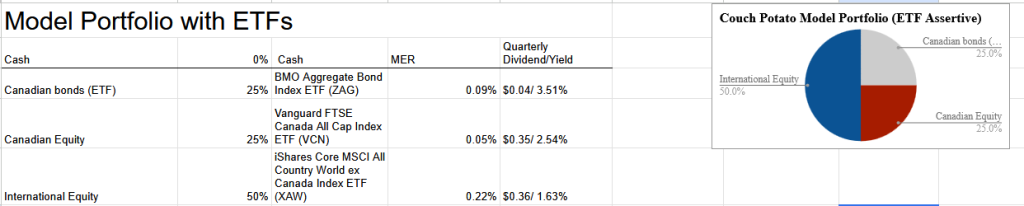
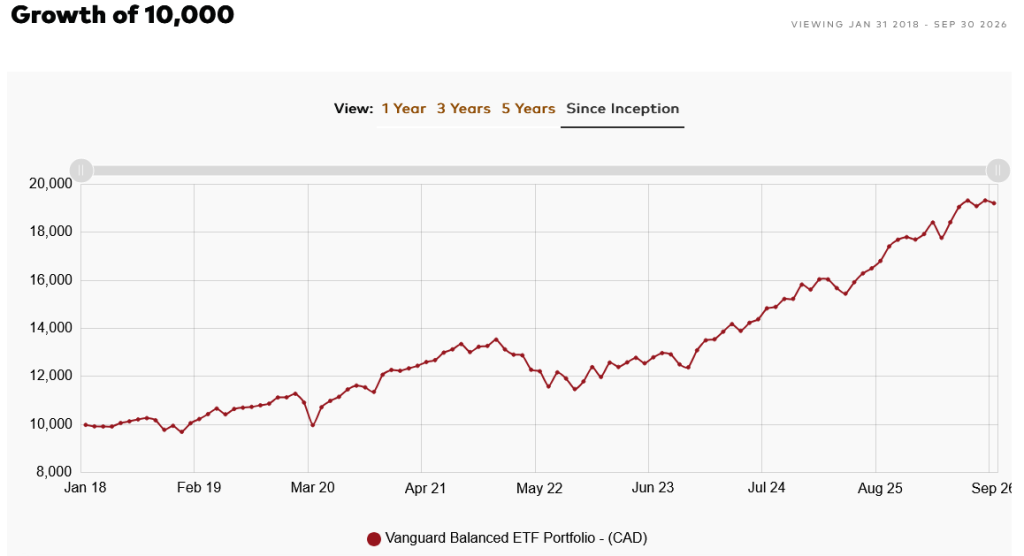
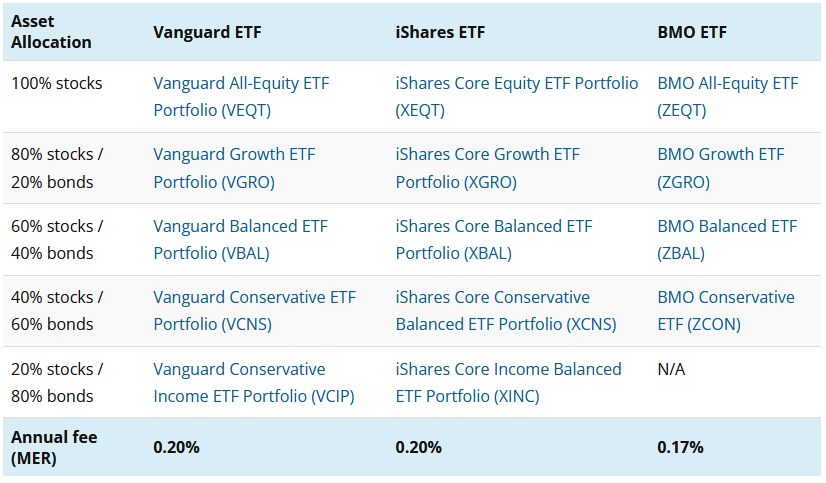
Nowadays, we can achieve the same diversification by picking one product, like VBAL, XBAL, or ZBAL. These funds are all pretty much the same thing. The “BAL” stands for “balanced”. The V, X, or Z is just indicating if you are buying your investment from Vanguard, iShares, or BMO.
If you check out the performance of these funds against each other, you will see they all perform essentially the same. That’s because they are all selling you the same groups (aka indexes) of products.
As you can see from the nice CCP chart below, the “BAL” holds 60% stocks and 40% bonds. If you want a slightly more spicy portfolio, you might pick VGRO instead of VBAL, which gives you 80% stocks and 20% bonds.
Since passive investing is “so easy”, you might expect that you are giving up growth in exchange for simplicity. You might assume that active investing is worth all the hassle, cuz that’s how you get rich, right?
Not according to what these guys, or these guys, or these guys have found.
It’s consistently reported that professional money managers have not been able to consistently out perform basic index funds that simply track the stock market automatically.
So why do so many people still bother with active investing? I can only imagine that it’s a big case of FOMO or a big case of not knowing a better way.
Compare and Contrast
Let’s illustrate my point with two fictional investors. Mia is an active investor. Chloe is a passive investor.
At 8:59 a.m., Mia opens her laptop and launches six websites. The stock market opens in one minute. She has three tabs for charts, two for breaking news, and one for “Is This CEO’s Tweet Bad?”
Meanwhile, Chloe opens her fridge to forage for breakfast.
At 9:13, Mia’s stocks in company XYZ dips by 3.2%. The line on her stock tracking chart keeps trending down, down, down. It’s dipped so much, company XYZ’s poor performance is now featured on the ticker feed of her favourite breaking news site. She starts to sweat. She refreshes her browser, muttering “I knew that earnings call had weird vibes.” She rushes to sell the stock before she looses any more money… only to see the stock price bounce back up, for no discernible reason. Grrr.
Chloe pours herself a coffee and scrolls her Insta feed.
By lunch, Mia has read twelve predictions, made nine trades, and developed a personal feud with a candlestick chart. “This market is irrational,” she says, while trying to predict what millions of other people would do next. Mia cranks her neck, which is feeling oddly tight.
Chloe’s investment plan is to own a diversified fund, add money regularly, and avoid checking it every hour. It happens to be the 15th of the month, Chloe’s money management day, so she checks her portfolio once on her lunch break. Yup, still looks about the same. Her automatic transfers and investment purchases are still working. She sees transfers in the day after her pay day and autonomic purchases the following day; several months of activity, all just as planned. Chloe goes outside for a walk in the sun.
At 3:57, Mia’s portfolio has moved up, down, sideways, and emotionally through all five stages of grief. She celebrated a winning trade, then discovered the fees. All in all, she figures she’s down about $2.75 from this morning.
Chloe has no idea how her portfolio did today. She’s heading out to catch up with an old friend for a drink.
At the end of the day, Mia announced, “I’m taking a break from investing.” Six minutes later, she pulls out her phone to check how the market is doing after hours.
Active investing can involve more research, trading, and stress; passive investing generally aims to track a broad market with fewer decisions. Neither guarantees a profit but, over time, Chloe should have a nice little nest egg that didn’t cause her to loose sleep at night.
—
This Investing ABCs series is for anyone who wants to start investing but doesn’t know the first thing about how to begin. You don’t need to read this series in order, but you should read and learn all the ABCs before venturing forth to buy investment products.
Thanks for reading!
If you enjoyed this post, please subscribe to the weekly MWM email.
Investing ABCs: Rules of Thumb – The 4% Rule
Published: 2026-10-02
This Investing ABCs series is for anyone who wants to start investing, but doesn’t know the first thing about how to begin. You don’t need to read this series in order, but you should read and learn all the ABCs before venturing forth to buy investment products. In this post, I’ll explore one of the best-known retirement-planning guidelines: The 4% Rule.
There are certain “rules of thumb” that circulate the personal finance world. It’s worth understanding what all the buzz is about. Rules of thumb can lead to smart strategies that will help you set intelligent money goals.
Let’s start with a fun one: How do you know how much money you need to retire?
The 4% Rule
The 4% Rule refers to a retirement-planning strategy popularized by financial planner William Bengen in the 1990s. Bengen recognized that he and his colleagues were skilled at investing money for their clients but terrible at advising people how much of a nest egg was “enough” to comfortably retire.
No one, not even the experts, could accurately predict how much was enough!
Attempting to solve the great mystery, Bengen built a financial model based on actual historical financial market data, testing a portfolio made up of 50% stocks and 50% bonds, to map out how portfolios would have performed during the worst economic periods in history. The goal was to find the best portfolio (or ratio of stocks and bonds) and identify a “safe withdrawal rate”, meaning retirement withdrawals that would survive even the most severe market crashes, such as the Great Depression.
Bengen found that if you withdraw 4% of your total portfolio value in the first year of retirement and increasing the withdrawal amount for inflation every year thereafter, your money has a high probability of lasting for (at least) three decades. I include the “at least” because, for practical reasons, he only modelled 30 years of retirement.
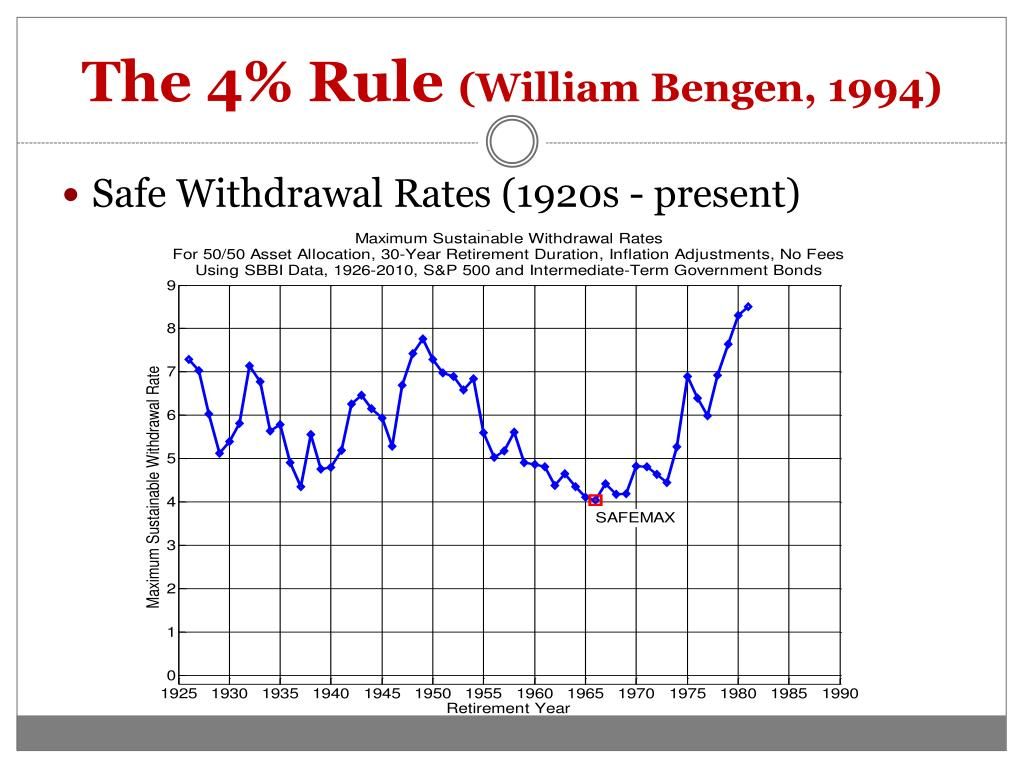
Here is how Bengen’s model worked for withdrawals. You don’t just withdraw 4% every year, because you need to handle the rising cost of living (a.k.a. inflation)
Let’s say you have a cool million sitting in your portfolio. Here’s how withdrawals would work:
- Portfolio: $1,000,000
- First-year withdrawal: $40,000 (4% of $1000000)
- If inflation is 3%, second-year withdrawal: $41,200 ($40,000 * 1.03)
- If inflation is 2.5%, third-year withdrawal: $42,230 ($41,200 * 1.025)
- etc., etc.
If you are into early retirement like me, you gotta appreciate Bengen’s work. He planned for the worst so that we could all aim for the best possible retirement. He wanted to protect people from both under and over saving. After all, you can’t take your money with you, so why work longer than required?
Modern Reboot
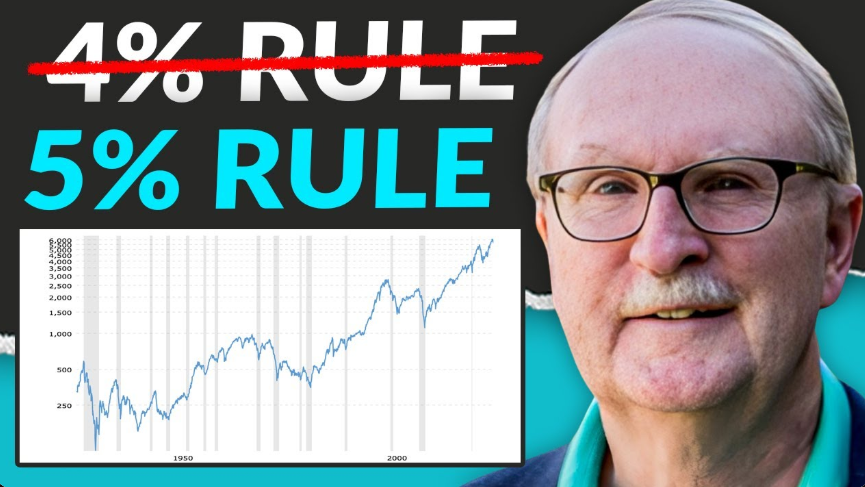
Bengen’s research has evolved since the 90s. He’s updated his model and now says his model was likely too conservative.
Higher Equity Lean: Bengen now believes that a stock allocation between 50% upwards to 75% is preferable. Within this range, his historical test portfolio performed well and using a higher ratio of stocks vs bonds. He now suggests aiming closer to 75% to minimize the probability of running out of money, warming that a portfolio with a high ratio of bonds increases the risk of failure, as bonds are low-return assets that just might not provide enough growth to keep up with withdrawal demands.
Diversification Beyond Stocks and Bonds: Bengen has increased the “sage withdrawal rate” from 4% to 4.7% (even suggesting that 5% could be feasible) assuming a portfolio includes more investment products, beyond just stocks and bonds. In his updated portfolio, he includes more asset classes such as small-cap stocks, micro-cap stocks, international stocks, and treasury bills.
Only Fools Rush In
You cannot expect to blindly follow the 4% rule.
Historical market performance is not a guarantee of future results. No one has a crystal ball and we live in some pretty wild times.
The list of risks to maintaining a portfolio over your lifetime is not small. You might be blessed with a very very long life and outlive your money. Your expenses might balloon in old age due to health care costs. You might retire just as inflation goes sky high and markets tank, killing your portfolio’s lasting power (a risk called sequence-of-returns risk).
Do you recall what happened to markets when the COVID pandemic hit the world? For context, we saw our portfolio drop around 30%. Thankfully retirement was still a few years off.
It’s a guideline, not a guarantee. Do not expect that upon retirement you will set up auto withdrawals and then close your browser, never to check your investment balance again. You cannot blindly trust that everything will just work out. You will still need to continue to make wise choices. For example, if markets are down, you might course correct with “dynamic spending”, which means dialing down your discretionary spending temporarily. For example, you might defer a major purchase like a car or hold off on a non critical renovation. You might sell an asset to free up capital or event take on paid project or fixed term contract to bring in some cash.
How We Use the 4% Rule
In our savings years, the 4% rule gave us a savings target. Using the Life of Pie method, we need a 4% return on our investments to cover our current Life, Housing, Transportation budgets.
We do not use Bengen’s model portfolio to structure our investments, however, our portfolio sounds like’s in the same ballpark as his updated portfolio with more asset classes. Out portfolio is made up of low cost ETFs with a 60% stocks/equity to 40% bonds mix. We ensure our ETFs give us exposure to Canadian equity and bond markets, US equity markets, as well as international equity markets.
In addition to our savings, we also have access to two small pensions as well as CPP and OAS payments as we grow older. It bares reflection that Bengen’s model is simple and does not factor in additional income sources or tax implications. This is where our big spreadsheet helps us model out our financial future.
It’s important to note that we never expected the 4% rule to be our entire retirement strategy. Over the course of our FIRE years, we will continue to monitor our money (our investments and our spending) and will make choices based on our current needs, inflation, and the performance of financial markets.
How About You?
Why not try calculating your own 4% retirement number for fun? Sum up your current housing, transportation, and life spending and divide that number by 0.04.
According to Statistics Canada, the median after tax income per person in Ontario in 2024 was 39,900.
39,900 % 0.04 = 997,500