
Investing ABCs: Rules of Thumb – The 4% Rule
Published: 2026-10-02
This Investing ABCs series is for anyone who wants to start investing, but doesn’t know the first thing about how to begin. You don’t need to read this series in order, but you should read and learn all the ABCs before venturing forth to buy investment products. In this post, I’ll explore one of the best-known retirement-planning guidelines: The 4% Rule.
There are certain “rules of thumb” that circulate the personal finance world. It’s worth understanding what all the buzz is about. Rules of thumb can lead to smart strategies that will help you set intelligent money goals.
Let’s start with a fun one: How do you know how much money you need to retire?
The 4% Rule
The 4% Rule refers to a retirement-planning strategy popularized by financial planner William Bengen in the 1990s. Bengen recognized that he and his colleagues were skilled at investing money for their clients but terrible at advising people how much of a nest egg was “enough” to comfortably retire.
No one, not even the experts, could accurately predict how much was enough!
Attempting to solve the great mystery, Bengen built a financial model based on actual historical financial market data, testing a portfolio made up of 50% stocks and 50% bonds, to map out how portfolios would have performed during the worst economic periods in history. The goal was to find the best portfolio (or ratio of stocks and bonds) and identify a “safe withdrawal rate”, meaning retirement withdrawals that would survive even the most severe market crashes, such as the Great Depression.
Bengen found that if you withdraw 4% of your total portfolio value in the first year of retirement and increasing the withdrawal amount for inflation every year thereafter, your money has a high probability of lasting for (at least) three decades. I include the “at least” because, for practical reasons, he only modelled 30 years of retirement.
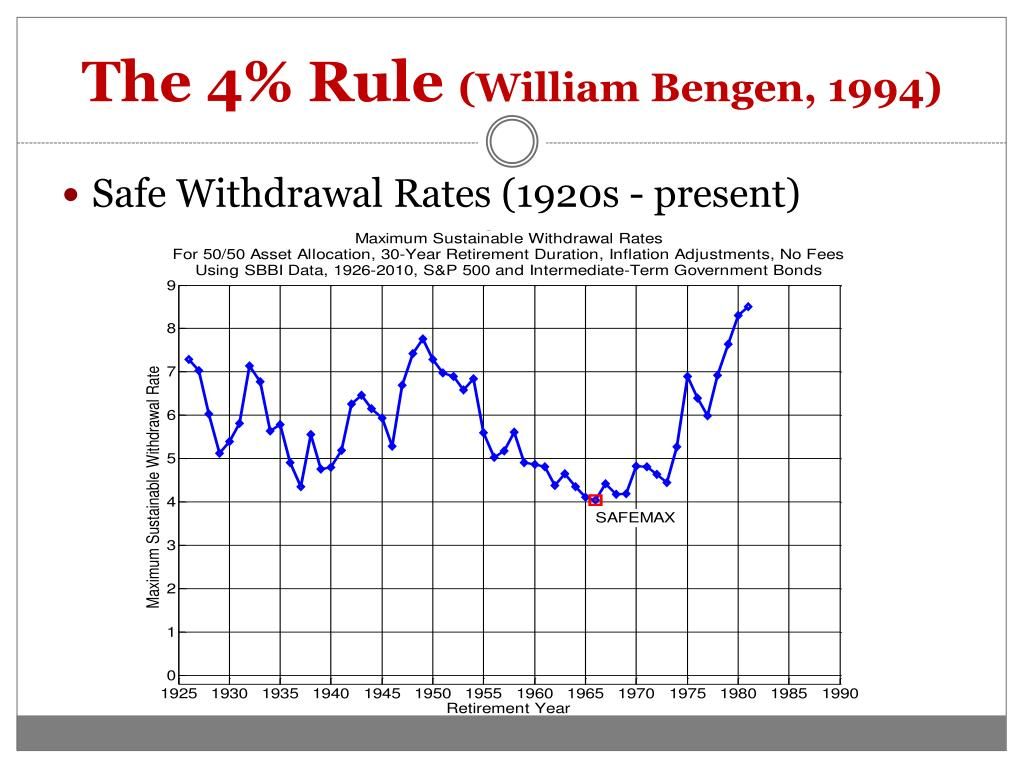
Here is how Bengen’s model worked for withdrawals. You don’t just withdraw 4% every year, because you need to handle the rising cost of living (a.k.a. inflation)
Let’s say you have a cool million sitting in your portfolio. Here’s how withdrawals would work:
- Portfolio: $1,000,000
- First-year withdrawal: $40,000 (4% of $1000000)
- If inflation is 3%, second-year withdrawal: $41,200 ($40,000 * 1.03)
- If inflation is 2.5%, third-year withdrawal: $42,230 ($41,200 * 1.025)
- etc., etc.
If you are into early retirement like me, you gotta appreciate Bengen’s work. He planned for the worst so that we could all aim for the best possible retirement. He wanted to protect people from both under and over saving. After all, you can’t take your money with you, so why work longer than required?
Modern Reboot
Bengen’s research has evolved since the 90s. He’s updated his model and now says his model was likely too conservative.
Higher Equity Lean: Bengen now believes that a stock allocation between 50% upwards to 75% is preferable. Within this range, his historical test portfolio performed well and using a higher ratio of stocks vs bonds. He now suggests aiming closer to 75% to minimize the probability of running out of money, warming that a portfolio with a high ratio of bonds increases the risk of failure, as bonds are low-return assets that just might not provide enough growth to keep up with withdrawal demands.
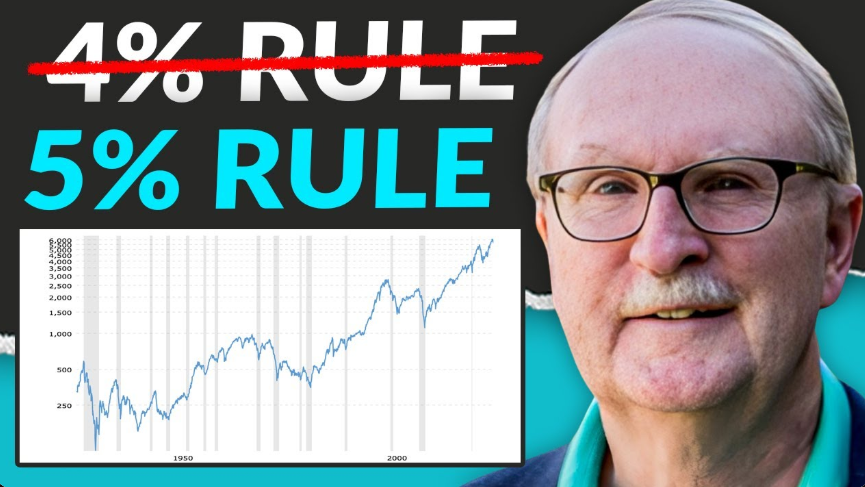
Diversification Beyond Stocks and Bonds: Bengen has increased the “sage withdrawal rate” from 4% to 4.7% (even suggesting that 5% could be feasible) assuming a portfolio includes more investment products, beyond just stocks and bonds. In his updated portfolio, he includes more asset classes such as small-cap stocks, micro-cap stocks, international stocks, and treasury bills.
Only Fools Rush In
You cannot expect to blindly follow the 4% rule.
Historical market performance is not a guarantee of future results. No one has a crystal ball and we live in some pretty wild times.
The list of risks to maintaining a portfolio over your lifetime is not small. You might be blessed with a very very long life and outlive your money. Your expenses might balloon in old age due to health care costs. You might retire just as inflation goes sky high and markets tank, killing your portfolio’s lasting power (a risk called sequence-of-returns risk).
Do you recall what happened to markets when the COVID pandemic hit the world? For context, we saw our portfolio drop around 30%. Thankfully retirement was still a few years off.
It’s a guideline, not a guarantee. Do not expect that upon retirement you will set up auto withdrawals and then close your browser, never to check your investment balance again. You cannot blindly trust that everything will just work out. You will still need to continue to make wise choices. For example, if markets are down, you might course correct with “dynamic spending”, which means dialing down your discretionary spending temporarily. For example, you might defer a major purchase like a car or hold off on a non critical renovation. You might sell an asset to free up capital or event take on paid project or fixed term contract to bring in some cash.
How We Use the 4% Rule
In our savings years, the 4% rule gave us a savings target. Using the Life of Pie method, we need a 4% return on our investments to cover our current Life, Housing, Transportation budgets.
We do not use Bengen’s model portfolio to structure our investments, however, our portfolio sounds like’s in the same ballpark as his updated portfolio with more asset classes. Out portfolio is made up of low cost ETFs with a 60% stocks/equity to 40% bonds mix. We ensure our ETFs give us exposure to Canadian equity and bond markets, US equity markets, as well as international equity markets.
In addition to our savings, we also have access to two small pensions as well as CPP and OAS payments as we grow older. It bares reflection that Bengen’s model is simple and does not factor in additional income sources or tax implications. This is where our big spreadsheet helps us model out our financial future.
It’s important to note that we never expected the 4% rule to be our entire retirement strategy. Over the course of our FIRE years, we will continue to monitor our money (our investments and our spending) and will make choices based on our current needs, inflation, and the performance of financial markets.
How About You?
Why not try calculating your own 4% retirement number for fun? Sum up your current housing, transportation, and life spending and divide that number by 0.04.
According to Statistics Canada, the median after tax income per person in Ontario in 2024 was 39,900.
39,900 % 0.04 = 997,500
If you enjoyed this post, please subscribe to the weekly MWM email.
Investing ABCs: Types of Investment Products
Published: 2026-08-21
This Investing ABCs series is for anyone who wants to start investing, but doesn’t know the first thing about how to begin. You don’t need to read this series in order, but you should read and learn all the ABCs before venturing forth to buy investment products.
Never do anything with your money that you don’t understand. This is easy to say, but tricky to achieve because when you are just getting starting, you don’t even know what you don’t know, ya know?
One big barrier to taking control of your money is that you will need to learn a few new words and some new concepts. In today’s post, I’ll explain four common types of investment products that you likely have already heard about but may not understand what they exactly are or how they exactly work.
Stocks, Bonds, ETFs, and Index Funds.
These are not the only investment products you can buy; we will start with these four and I promise to talk about even more types of investment products in a future post.
The Two Building Blocks: Stocks vs. Bonds
Stocks and Bonds are the two most basic assets types in investing.
1. Stocks (Ownership)
When you buy a stock, you are buying a slice of ownership in a specific company. Companies sell their stocks on a stock exchange in order to raise funds for their business operations. With those funds, the company wants to grows its revenue either directly (by selling stuff) or by innovating (by promising something cool in the future). When they are successful, the value of each stock increases and you may receive cash payouts called dividends. However, if the company fails or runs into trouble, your share value drops. Buying a stock is like buying one specific apartment in a city. If the neighbourhood booms, your property value soars. If the building falls into disrepair, you take the loss.
IMHO, buying individual stocks is gambling and should be avoided. I would only buy an individual stock if I had “play” money that I didn’t care about losing. Understanding stocks and how they work is still very important (more on that below). However, you want your path to growing wealth to be as boring and and predictable as possible. No one has a crystal ball and nothing in investing is guaranteed, but we can make smart decisions and grow our wealth with relativity low risk.
2. Bonds (Loans)
Governments and corporations sell bonds to borrow money from investors. When you buy a bond, you are lending them money. They will use your money to fund public projects, bridge budget deficits, expand operations, or refinance existing debts. Bonds are a promise to pay back the loan at a later date. As the lender, the borrower promises to pay you regular interest over a set period and return your original principal once the bond matures. Bonds generally offer lower returns than stocks, but they are much less volatile. Buying a bond is like acting as a money lender. You don’t own a physical asset, you are lending money now to receive a steady, predictable mortgage payments from the borrower.
The Relationship & Strategy Between Stocks and Bonds
In an investors portfolio, stocks and bonds serve complementary roles.
- Stocks provide growth, but come with risk and volatility
- Bonds provide stability, they returns are more certain but no potential for extra growth
Historically, stocks and bonds move in opposite directions during market swings.
A classic investment strategy is to hold a mix of stocks and bonds. The percentage of stocks vs bonds is a personal choice, but a very common, middle of the road strategy, is to hold 60% stocks and 40% bonds in your portfolio. The higher your risk tolerance and the longer your time horizon, you might choose a higher percentage of stocks. Younger investors with decades ahead usually hold more stocks for maximum growth, while investors closer to retirement hold more bonds to preserve capital. You just don’t want to be “all in” on the stock market right before you need to pull money out. If the market has a crash (the real estate bubble, COVID, politics, an AI bubble) you either want time to ride it out until the market returns to “normal” or not to be holding more safe stuff so that you are not exposed to too much volatility.
The Bundles: ETFs and Index Funds
Buying individual stocks and bonds requires heavy research and carries high risk. If you put all your money into one company and it goes bankrupt, you lose everything.
Once upon a time, dealing with specific stocks and bonds directly was the only way to be a capital investor. But in our modern times, there is a much better option! Financial institutions have created bundled funds. Bundles now make it really easy for you, the investor, to own a fully diversified global portfolio, containing stocks and bonds from every major financial market, in just one fund. And, that fund can be extremely low cost to own. Check out my post on MER to understand why that’s kinda a big deal.
There a couple of different types of bundled funds that you should be aware of.
3. ETFs (Exchange-Traded Funds)
An ETF is actually a bundle of dozens, hundreds, or even thousands of individual stocks or bonds. When you buy one share of an ETF, you instantly gain exposure to every asset inside that basket. What makes an ETF unique is how it is bought and sold: it trades on a public exchange like an individual stock, meaning its price updates in real time throughout the trading day. However, instead of buying one unit of one company, you are buying one unit of thousands of companies. Buying an ETF is like buying an entire neighbourhood of apartment buildings in a city. If the neighbourhood booms, your property value soars. But if only one apartment stays empty, you will have thousands of other apartments still making you income. ETFs smooths out the risk of buying individual stocks because each unit’s value is linked to the success of many companies, not just one.
4. Index Funds
An index fund is an investment strategy designed to track a specific slice of the market (an “index”) rather than trying to pick winning investments. For example, an S&P 500 index fund simply buys shares in the 500 largest publicly traded companies in the United States.
Here is where beginners often get confused: An index fund describes what the fund does (tracks a market index), while an ETF describes how it is traded. You can buy an index fund structured as a mutual fund (which trades once per day at market close) or structured as an ETF (which trades continuously throughout the day).
| Investment Type | What Is It? | Primary Goal | Trading Style |
| Stock | Single company ownership | High growth potential | Real-time during market hours |
| Bond | Loan to a company or government | Capital preservation & regular income | Variable / Over-the-counter |
| ETF | A bundled basket of investments | Instant diversification | Real-time on stock exchanges |
| Index Fund | A fund tracking a market benchmark | Matching broad market returns at low cost | Once daily (Mutual Fund) or real-time (ETF) |
3 Key Takeaways
- Individual assets do different jobs: Stocks offer wealth growth but come with high volatility; bonds offer predictable income and stability during market downturns.
- Diversification beats stock-picking: Buying individual stocks is risky. Broad-market ETFs and index funds allow you to own hundreds of companies simultaneously, spreading out your risk.
- Keep fees low and stay long-term: Passive index ETFs generally charge tiny fraction-of-a-percent management fees compared to traditional actively managed funds. Keeping management costs low ensures more of your money compounds over time.
If you enjoyed this post, please subscribe to the weekly MWM email.
Investing ABCs: Growth Part 2 – But wait, there’s more!
Published: 2026-07-03
This is my third post in my foundational knowledge series for investing. This series is for anyone who wants to start investing, but doesn’t know the first thing about how to begin. You don’t need to read this series in order, but you should read and learn all the ABCs before venturing forth to buy investment products.
When you step into the world of investing, there is a fun perk that you can’t get anywhere else. That perk is called a dividend.
A dividend is a portion of a company’s profit paid out to its shareholders. Determined by the board of directors, they act as a reward for investing and are typically distributed on a regular schedule (e.g., quarterly or annually) in the form of cash (or additional stock). The promise of dividend payouts entices investors to buy and hold shares in the company.
I am always delighted by dividend payments. They are little bonus injections of cash that feel like bonus money. After switching to Wealthsimple almost a year ago, I receive email notifications each time I get a payout. Seeing those happy little notices appear in my inbox still hasn’t gotten old.
In reality though, these payments are not a surprise at all. I already know an estimated amount I should expect and the frequency in which they should arrive. But if you don’t get joy from the little things in life, than what’s the point of even living? Right?
Take a look at the ETF funds that we invest in, as an example. I’ll break down why we settled on these funds in a future post. For now, we’re going to look at their Dividend yield (payouts). The Annual Dividend Rate is how much you should expect your dividend payout to be, per share you own, over the year. Most funds pay out dividends more frequently than annually, so the annual amount gets portioned out over the course of the year. How often is the Frequency, which is also how often I get those fun emails from Wealthsimple ringing my “I just got paid” bell.
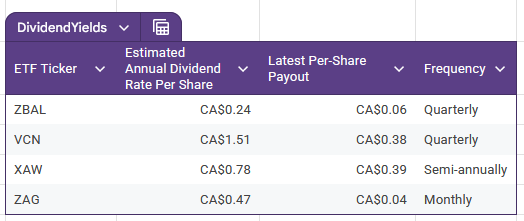
You can take this information and calculate the dividend payout, based on how many shares you own. Let’s assume we own 1000 shares of VCN.
1,000 shares of VCN x $1.51 CAD/share = $1,510 CAD annually, paid $380 quarterly
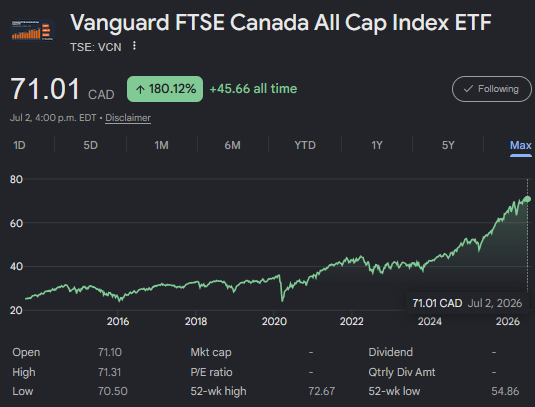
Note that dividends are above and beyond the growth I described in my last post Investing ABCs: Growth. Let’s look at the growth over time of the VCN fund. In 2013, one share was worth just over $25. Today, that same share is worth $71 . So, in addition to each share being worth more over time, you get dividend payouts along the way. The more shares you own, the bigger the dividend payout.
Smart investors take the free money they’ve earned through dividends and reinvest them. Most brokerages (the place online where you buy your investment products like ETFs, stocks, and bonds) offer you a feature called DRIP.
DRIP stands for Dividend ReInvestment Plan.
To set up a DRIP, you update your preferences in your brokerage account once to automatically purchase more shares with future dividend payouts. Remember that lovely curved growth chart I showed you in my last post? A DRIP is the same concept; your wealth over time gets a boosts because you are compounding your growth. You wealth curve will be steeper. When you use your dividends to by more shares, the increase in shares means a larger dividend payout next time. A larger dividend payout then allows you to buy more shares, increasing the total shares that you own, and you earn an even bigger dividend payout the next time, etc. etc. .
Some investors are considered Dividend Investors. Their portfolios aim to make steady passive income from dividend payouts, replacing the need for employment income. To be clear, that is not the path that we have chosen. As much as I love those little bonus payments, they are not our primary wealth building strategy. But every little boost counts towards growing our wealth.
Do you already own investments? Do you know if they pay dividends and what their yield and frequency is?