
Milestones
Published: 2026-08-28
It’s my anniversary today. My husband and I have been married 27 fun filled years. We have known each other for 32 years, which is wild to think about! Even more wild is how much I love my guy. Yup, we’re one of those gross couples who are still madly into each other and I see zero signs of that petering out any time soon.
I am a big believer in celebrating milestones. What I struggle with, sometimes, is deciding the best way to mark certain occasions.
The main issue is that, culturally, North Americans are not that creative. The norms for a celebration are typically food (going out to eat), drinks (ordering an expensive bottle of wine), and sometimes gifts (flowers, gold watches, etc.).
Diminishing Returns
When we were first married, we were crazy poor. Like, we slept on a twin mattress together poor. For, like, a year. So, it goes without saying, that celebrating every early milestone by eating out felt luxurious. For the first five years of our marriage, a milestone moment was probably the only time we sat down in a restaurant to eat. The only exception I can think of was our honeymoon where we lived it up and went out to eat nightly!
But after six or seven times around the sun, our mentalities started to shift. It was around this time that I graduated university, we started to earn double income, and I got my first career related job that was not in the service industry.
Suddenly we had choices. I don’t think we felt like we had money to burn, but we definitely could decide to eat out more, if we wanted to.
The funny thing is, though, that, by this time, we were used to cooking meals at home. All our meals, including bagged lunches for school and work.
With all that practice, we got pretty good at cooking. We learned how to make a steak better than the Keg. We learned how to make seriously delicious pizza. We learned how to make a melt in your mouth roast with Yorkshire pudding. We learned to make a Caesar salad exactly how my husband likes it.
We also were conscious of how much our time was worth. We were both still early in our careers, so while we had lifted ourselves above the poverty line, we were definitely not drowning in cash. We knew how many hours of work it took to buy something, including a sit down meal at a restaurant.
As time unfolded, we just didn’t enjoy going out to eat as much. We found we were paying a chunk of money for an experience that was kinda meh for food that was also kinda meh.
It was around this time that we finally looked at each other and admitted that we didn’t really want to go out to eat.
Finding the Fun
And so a new tradition was born. During this phase of our lives we had two young kids and both of us were working full time. Life was pretty exhausting. It meant that time together had become our most precious resource.
So, for many years, our new go to plan became Xbox and chill. Our game of choice? Dynasty Warriors
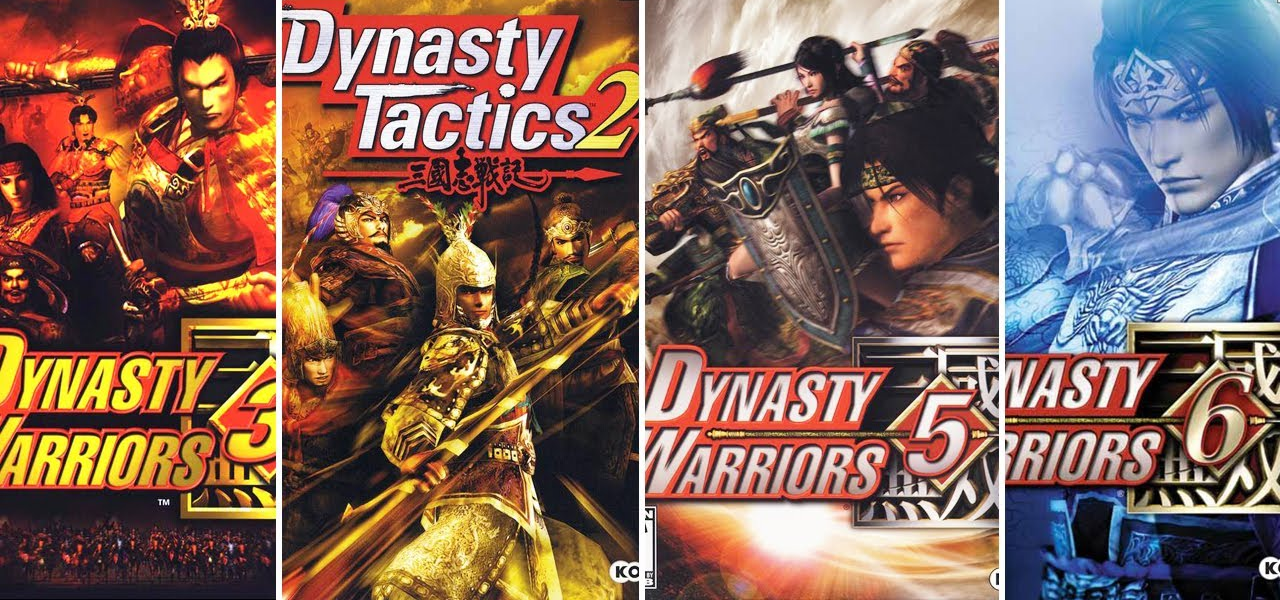
And so, for years, our go to anniversary fun was playing this game for hours upon hours. If a new version was out, we would “splurge” on the latest copy. We might order in something or make something and likely we would grab a bottle of sparkling wine.
Keeping Tradition Alive
I am a bit of a romantic and for my anniversary I have very much enjoyed giving my husband a “traditional” anniversary gift. I find it a little bit of a fun creative adventure to make or find a gift that he will enjoy made from the traditional material associated with that year. For our first anniversary, I wrote out our wedding vows on fancy hand made paper. For our 7th anniversary, I gifted him a Razer Copperhead computer mouse. For our 25th, I gifted him silver cuff links with the Cameron insignia on them.
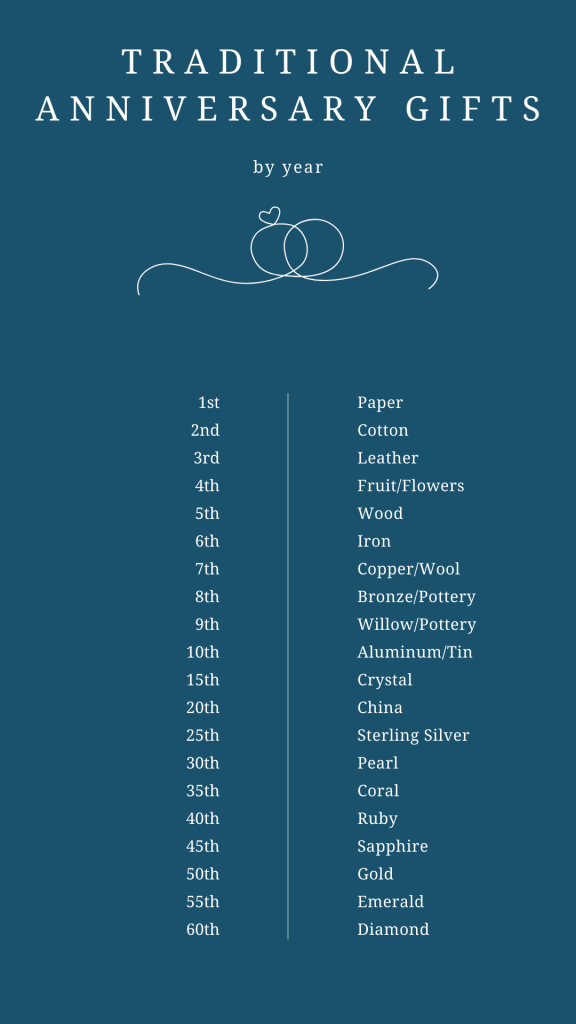
I confess that I don’t remember my gift from every year and I’m sure he doesn’t remember them either. For our 25th, I know we will cherish the big party we threw with our friends and the his & her tattoos that we designed for ourselves far more than some shirt jewellery that now sits in a box on his end table. Still, no regrets, because for me the act of giving a “creative” gift is fun.
You might be surprised to know that my husband rarely gets me an anniversary gift. I think perhaps it may have happened for first year, but I really couldn’t say for sure. And that’s totally fine by me. A gift is not expected or necessary. I don’t want flowers or mindless stuff. While I enjoy thinking of creative gifts to give, he does not. For him, I think having to give a gift under pressure of a date on a calendar is the polar opposite to joy. So, for us, it’s not a big part of how we choose to celebrate.
Evolution
Over the years we’ve built our own traditions. Most importantly, we have evolved our traditions as we’ve evolved as people.
We gave ourselves permission to be more intentional with how we spend our time and money while celebrating being together.
So tell me, how do you celebrate your milestones?
If you enjoyed this post, please subscribe to the weekly MWM email.
Investing ABCs: Types of Investment Products
Published: 2026-08-21
This Investing ABCs series is for anyone who wants to start investing, but doesn’t know the first thing about how to begin. You don’t need to read this series in order, but you should read and learn all the ABCs before venturing forth to buy investment products.
Never do anything with your money that you don’t understand. This is easy to say, but tricky to achieve because when you are just getting starting, you don’t even know what you don’t know, ya know?
One big barrier to taking control of your money is that you will need to learn a few new words and some new concepts. In today’s post, I’ll explain four common types of investment products that you likely have already heard about but may not understand what they exactly are or how they exactly work.
Stocks, Bonds, ETFs, and Index Funds.
These are not the only investment products you can buy; we will start with these four and I promise to talk about even more types of investment products in a future post.
The Two Building Blocks: Stocks vs. Bonds
Stocks and Bonds are the two most basic assets types in investing.
1. Stocks (Ownership)
When you buy a stock, you are buying a slice of ownership in a specific company. Companies sell their stocks on a stock exchange in order to raise funds for their business operations. With those funds, the company wants to grows its revenue either directly (by selling stuff) or by innovating (by promising something cool in the future). When they are successful, the value of each stock increases and you may receive cash payouts called dividends. However, if the company fails or runs into trouble, your share value drops. Buying a stock is like buying one specific apartment in a city. If the neighbourhood booms, your property value soars. If the building falls into disrepair, you take the loss.
IMHO, buying individual stocks is gambling and should be avoided. I would only buy an individual stock if I had “play” money that I didn’t care about losing. Understanding stocks and how they work is still very important (more on that below). However, you want your path to growing wealth to be as boring and and predictable as possible. No one has a crystal ball and nothing in investing is guaranteed, but we can make smart decisions and grow our wealth with relativity low risk.
2. Bonds (Loans)
Governments and corporations sell bonds to borrow money from investors. When you buy a bond, you are lending them money. They will use your money to fund public projects, bridge budget deficits, expand operations, or refinance existing debts. Bonds are a promise to pay back the loan at a later date. As the lender, the borrower promises to pay you regular interest over a set period and return your original principal once the bond matures. Bonds generally offer lower returns than stocks, but they are much less volatile. Buying a bond is like acting as a money lender. You don’t own a physical asset, you are lending money now to receive a steady, predictable mortgage payments from the borrower.
The Relationship & Strategy Between Stocks and Bonds
In an investors portfolio, stocks and bonds serve complementary roles.
- Stocks provide growth, but come with risk and volatility
- Bonds provide stability, they returns are more certain but no potential for extra growth
Historically, stocks and bonds move in opposite directions during market swings.
A classic investment strategy is to hold a mix of stocks and bonds. The percentage of stocks vs bonds is a personal choice, but a very common, middle of the road strategy, is to hold 60% stocks and 40% bonds in your portfolio. The higher your risk tolerance and the longer your time horizon, you might choose a higher percentage of stocks. Younger investors with decades ahead usually hold more stocks for maximum growth, while investors closer to retirement hold more bonds to preserve capital. You just don’t want to be “all in” on the stock market right before you need to pull money out. If the market has a crash (the real estate bubble, COVID, politics, an AI bubble) you either want time to ride it out until the market returns to “normal” or not to be holding more safe stuff so that you are not exposed to too much volatility.
The Bundles: ETFs and Index Funds
Buying individual stocks and bonds requires heavy research and carries high risk. If you put all your money into one company and it goes bankrupt, you lose everything.
Once upon a time, dealing with specific stocks and bonds directly was the only way to be a capital investor. But in our modern times, there is a much better option! Financial institutions have created bundled funds. Bundles now make it really easy for you, the investor, to own a fully diversified global portfolio, containing stocks and bonds from every major financial market, in just one fund. And, that fund can be extremely low cost to own. Check out my post on MER to understand why that’s kinda a big deal.
There a couple of different types of bundled funds that you should be aware of.
3. ETFs (Exchange-Traded Funds)
An ETF is actually a bundle of dozens, hundreds, or even thousands of individual stocks or bonds. When you buy one share of an ETF, you instantly gain exposure to every asset inside that basket. What makes an ETF unique is how it is bought and sold: it trades on a public exchange like an individual stock, meaning its price updates in real time throughout the trading day. However, instead of buying one unit of one company, you are buying one unit of thousands of companies. Buying an ETF is like buying an entire neighbourhood of apartment buildings in a city. If the neighbourhood booms, your property value soars. But if only one apartment stays empty, you will have thousands of other apartments still making you income. ETFs smooths out the risk of buying individual stocks because each unit’s value is linked to the success of many companies, not just one.
4. Index Funds
An index fund is an investment strategy designed to track a specific slice of the market (an “index”) rather than trying to pick winning investments. For example, an S&P 500 index fund simply buys shares in the 500 largest publicly traded companies in the United States.
Here is where beginners often get confused: An index fund describes what the fund does (tracks a market index), while an ETF describes how it is traded. You can buy an index fund structured as a mutual fund (which trades once per day at market close) or structured as an ETF (which trades continuously throughout the day).
| Investment Type | What Is It? | Primary Goal | Trading Style |
| Stock | Single company ownership | High growth potential | Real-time during market hours |
| Bond | Loan to a company or government | Capital preservation & regular income | Variable / Over-the-counter |
| ETF | A bundled basket of investments | Instant diversification | Real-time on stock exchanges |
| Index Fund | A fund tracking a market benchmark | Matching broad market returns at low cost | Once daily (Mutual Fund) or real-time (ETF) |
3 Key Takeaways
- Individual assets do different jobs: Stocks offer wealth growth but come with high volatility; bonds offer predictable income and stability during market downturns.
- Diversification beats stock-picking: Buying individual stocks is risky. Broad-market ETFs and index funds allow you to own hundreds of companies simultaneously, spreading out your risk.
- Keep fees low and stay long-term: Passive index ETFs generally charge tiny fraction-of-a-percent management fees compared to traditional actively managed funds. Keeping management costs low ensures more of your money compounds over time.
If you enjoyed this post, please subscribe to the weekly MWM email.
PSA: Set your survivor and beneficiary on your registered accounts
Published: 2026-08-14
If you have a TFSA or an RRSP, or you are considering opening one, this public service announcement is for you! I will focus on my experience with Wealthsimple, but even if your registered account sits somewhere else, this is still a call to action to review your account information on file with your financial institution.
Last year I moved my investment accounts from TD to Wealthsimple and, so far, the experience has been really positive. Except for one, kinda big (in my mind) thing.
Wealthsimple does not prompt you to set your registered investment accounts successor holder and/or beneficiary.
Registered accounts come in many flavours. You might recognize their acronyms: RRSP, TFSA, FHSA, RESP, and LiRA. (See my glossary for definitions).
In my experience, I opened registered investment accounts with Wealthsimple wihout having to specify a successor or a beneficiary. I only went looking at my accounts after a youtube video sparked my curiosity to check these settings and I found nothing had been defined. When I created my accounts, designating these important roles was not top of my mind, so it wasn’t done!
Why You Should Care
We’re all going to die someday. Most of us will leave behind loves ones who must deal with all the stuff we’ve accumulated over our lifetime, including our bank and investment accounts.
Just like writing a will, ensuring your registered accounts have up to date information defining who gets them when you die is a small gift you are giving to someone you love. It means there is less hassle and red tape transferring your money to the person you want to gift it to when you die.
Taking 10 now minutes now to jump online and check these settings will save a lot of time and hassle for your executor once you are gone.
If you want a deeper dive, these articles do a nice job outlining what happens should you die without having your registered account’s paperwork in order:
- https://will-kit.ca/tfsa-beneficiary-rules-canada/
- https://www.claret.ca/publications/naming-tfsa-successor-holder/
- https://lawyerinfo.ca/guides/ontario/wills-estate-ontario/probate-trust-ontario/dealing-with-a-deceaseds-tfsa-and-rrsp-in-ontario-probate/
It’s Not All About You (Or Maybe It Is)
Getting your paperwork is in order is the right thing to do and you should do it for your loved ones.
But you matter too! You also want to ensure your significant other(s) have their paperwork in order. Odds are, you will be the one left to pick up the pieces when they are gone. Do yourself a big favour and ask your partner(s) to confirm that you have been designated as the successor or beneficiary on their registered accounts.
Which Accounts Need What?
Different accounts need different people defined in specific roles. This article does a nice deep dive into registered accounts, plus other really important stuff like life insurance policies and pensions.
Here’s a quick chart to help you wrap your head around what you need to set for each type of registered account:
| Account Type | Role You Want to Define | What the Role Means |
|---|---|---|
| RRSP | Beneficiary | Receives the proceeds of your RRSP upon your death. This avoids probate. |
| RRIF | Successor Annuitant or Beneficiary | A successor annuitant continues receiving payments; a beneficiary receives a lump sum. |
| TFSA | Successor Holder or Beneficiary | A successor holder takes over the account without affecting TFSA room; a beneficiary receives a lump sum. |
| RESP | Successor Subscriber | Not a beneficiary, the appointed person to manage the RESP on behalf of the child. |
| FHSA | Successor Holder or Beneficiary | It depends. Check out “Types of Beneficiaries” and “Survivors” on this canada.ca page to understand the different cases. |
Yes, you must check every one of your registered accounts separately across all financial institutions.
Pro Tip: Create a spreadsheet listing all of your registered accounts across all institutions. Check or update each account and list who you’ve defined in specific roles. Referring back to this list in future will be much easier than going back to each account. Remember to review this spreadsheet as needed. For example, if you break up with your partner, or they pass away, you will want to update your account paperwork again.
Update your Wealthsimple Registered Accounts
For Wealthsimple clients, here is their guide on configuring your accounts. It explains the criteria of who can be named as survivors and/or beneficiaries (a very important distinction that you should understand before you begin): https://help.wealthsimple.com/hc/en-ca/articles/360058456753-Add-a-beneficiary-or-successor-to-your-registered-account
I found that the instructions for adding a beneficiary a bit lacking. Note that you must be on the web portal via a browser. At the time of this writing, the option doesn’t exist in the mobile app (I’m using the Android app).
- Login via a web portal and click into the specific registered account
- Click on the gear icon, and choose “Manage Beneficiaries” from the pop up menu
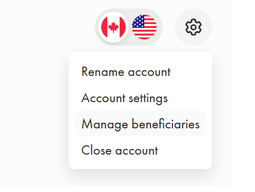
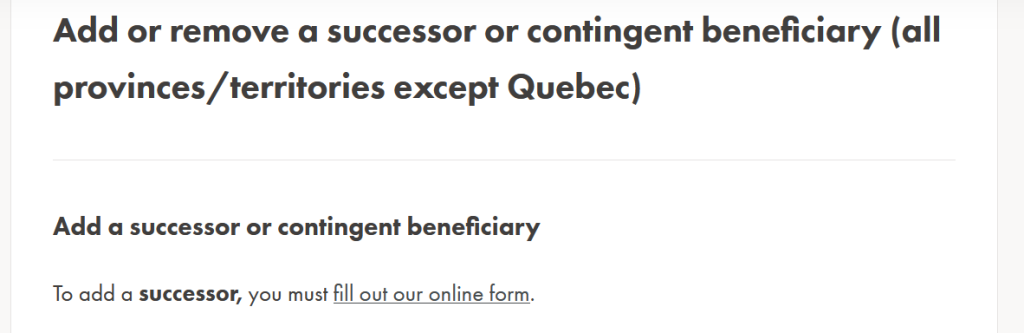
While you can manage beneficiaries online in your account info, you must follow different instructions to add a successor. Note that you need to use a specific online form.
Key Take Aways
- Call to Action: Ensure you and, if you have one, your significant other, have defined survivor-ship and beneficiaries so that whenever the inevitable happens (death comes for us all), accessing your major investment funds does not become a burden of red tape and delays during the worst of times.
- Everyone with a registered account, no matter which financial institution the accounts reside in, should ensure beneficiaries (or equivalent) are up to date
- You must check every account separately. Do your future self a favour and make a spreadsheet with each registered account and who you’ve designated. You can review it as needed, for example if you break up with your partner
If you enjoyed this post, please subscribe to the weekly MWM email.
Investing ABCs: MER, the Silent Wealth Killer
Published: 2026-08-07
This Investing ABCs series is for anyone who wants to start investing, but doesn’t know the first thing about how to begin. You don’t need to read this series in order, but you should read and learn all the ABCs before venturing forth to buy investment products.
When taking control of your financial future through self-directed passive investing, your approach should be to eliminate expensive middleman fees, invest globally across all major markets, and grow your wealth over time.
It’s important to understand that even if you skip the traditional financial advisor and buy ETFs online for “free”, you are still paying an underlying fee.
Enter the Management Expense Ratio (MER). MER is an annual fee you must pay to own Exchange-Traded Funds (ETFs) or mutual funds. All ETF and mutual fund investment products include MER fees. MER is expressed as an annual percentage of the fund’s total assets under management. A “high” MER will be 2% (or higher!) while a “low” MER is around 0.10%.
Even a “high” MER might seem like a tiny fractional percentage on a fund fact sheet, so why should you care? In truth, MER is arguably the single most important variable under your direct control as a passive investor.
Understanding what MER is, how it works, and why it drastically impacts long-term wealth accumulation will make you a wiser investor and help you win the money game.
MER is a hidden fee
MER is a silent wealth killer and it’s critical that you give it careful attention when building your portfolio.
Instead of sending you an annual invoice, fund providers deduct this fee automatically from each fund’s assets behind the scenes. This makes MER invisible unless you actively look for it.
MER is composed of two components:
- Management Fee: The fee paid to the fund company to pay portfolio managers, analysts, and cover institutional administration.
- Operating Expenses & Taxes: Administrative overhead, legal, auditing, regulatory filing fees, and applicable taxes (such as GST/HST in Canada).
Out performance is Rare; Fees Are Guaranteed
Active fund managers charge higher fees because they claim they will beat market performance through stock picking or market timing. However, historical data busts this as a myth and a fairy tale. Decades of data demonstrates that 80% to 90% of actively managed funds fail at their quest to beat their benchmark over a 10 to 15 year horizon. No one owns a crystal ball, so eventually managers get it wrong, plus high fees drag down performance. You always pay MER fees, regardless of how well the fund performed.
Passive investing aims to match market performance at the absolute lowest cost possible. You are not trying to beat the market (that is gambling!) you just want to ride the wave of average market returns. According to this guy, over the last 50 years Canada has posted a 10.3% nominal return and US has posted over 13%. That’s pretty darn great! As a passive investor with index funds, you accept these market returns as the growth you should see in your portfolio.
The primary factor determining whether your net returns beat some other investor holding the exact same index is what you are losing to in fees. This is why, when selecting the investment products to buy for your portfolio, the closer you can get your MER to zero, the more you guarantee that you keep virtually all of a market’s underlying return.
Fund Fees Vary, Buyer Beware
Not all funds are created equal. Knowing what constitutes a “good” MER helps you evaluate investment options:
| Investment Type | Typical MER Range | What You Are Paying For |
| Broad Market Passive ETFs | 0.03% – 0.25% | Automated indexing tracking major benchmarks (e.g., S&P 500, Total World). |
| All-in-One Asset Allocation ETFs | 0.15% – 0.25% | Complete, auto-rebalancing multi-asset portfolios (stocks + bonds). |
| Robo-Advisor Portfolios | 0.40% – 0.70% | ETF fees plus automated platform management and digital advice. |
| Actively Managed Mutual Funds | 1.50% – 2.50%+ | Human management, marketing, dealer trailers, and active trading costs. |
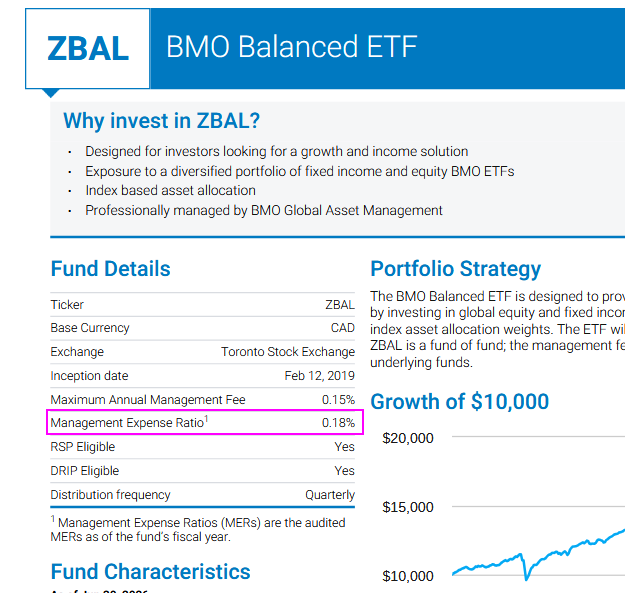
The MER for all funds can be found on their fact sheet. You can easily find the fact sheet for most funds be searching in an internet browser with the fund’s ticker symbol with the words “fact sheet”.
For example, check out the fact sheet for ZBAL here or search for it yourself with “ZBAL fact sheet”. Do you see where the MER is listed?
The Anti-Compounding Effect
To understand the true impact of MER, you should understand the double-edged sword of compounding. Just as compound interest accelerates wealth creation, compound investment fees accelerate wealth destruction.
When a fund charges a 2.00% MER, you are not simply losing 2% of your money that year; you lose the future growth that 2% would have generated for decades to come.
A Tale of Two Investors
Consider two investors, Maya and Liam. Both invest a lump sum of $100,000 into equity funds that achieve an average gross market return of 7% per year over 30 years.
- Maya chooses low-cost, self-directed passive indexing ETFs with an average MER of 0.10%.
- Liam stays in traditional, actively managed equity mutual funds with an MER of 2.00%.
Maya's Net Annual Return: 7.00% - 0.10% = 6.90%
Liam's Net Annual Return: 7.00% - 2.00% = 5.00%
Here is how their initial $100,000 grows over 30 years:
| Time Horizon | Maya (0.10% MER) | Liam (2.00% MER) | The “Fee Gap” Lost to Liam |
| 10 Years | $194,884 | $162,889 | $31,995 |
| 20 Years | $379,799 | $265,330 | $114,469 |
| 30 Years | $740,166 | $432,194 | $307,972 |
Don’t be a Liam
Despite starting with the exact same principal and achieving the exact same market performance before fees:
- Maya ends up with $740,166.
- Liam ends up with $432,194.
- Liam surrendered over $307,000—or roughly 41% of his potential final wealth—solely to fees.
A seemingly small 1.90% difference in annual fees compounded into a life-changing financial loss. For a self-directed investor, reducing your MER from 2.00% down to 0.10% effectively buys you years of additional retirement freedom.
Top 3 Takeaways for Self-Directed Investors
- MER is an Invisible Drain on Your Capital: Management Expense Ratios are subtracted daily behind the scenes before performance figures are reported. Check a fund’s fact sheet to know the exact percentage you are paying.
- Compound Fees Destroy Wealth Exponentially: A fee that sounds small on paper (like 1.5% to 2.0%) can consume over 30% to 40% of your long-term wealth accumulation due to lost opportunity costs and missed compound growth.
- Controlling Fees is Your Greatest Competitive Advantage: You cannot control global markets, inflation, or central bank interest rates. Controlling your MER by choosing broad-market, low-cost ETFs (targeting under 0.20% MER) is the single most reliable way to maximize your net investment returns.