
This Blog Will End Someday
Published: 2026-04-24
Nothing is forever. This blog will end one day, as will I.
This week I received news that a former roller derby league mate died unexpectedly in an accident. She was about my age – old enough to have lived a life, but young enough to grieve a life cut too short.
Zoom out far enough in time and nothing in our lives remains. It’s a fact that I will be gone one day, as will my husband, and my children, and my grandchildren. Everything that I own will, eventually, be rehomed, discarded, and turn to dust. There is nothing I can do to make this not true.
Perhaps this reads a bit “dark”. But darkness helps define the light. Every moment of every day is a gift, because it’s so fleeting. Nothing lasts forever, so I choose to cherish what I have today while still always building a life that brings joy.
Humans struggle with the concepts of mortality, time, and change. Most days we exist in a fantasy bubble in which how life is today is how it will always be. We hyperfocus on problems that actually carry no significance in the weeks/months/years to follow. Even as we get older with the “wisdom” to look back on the previous chapters of life, we are still terrible at looking forward. But the truth is, we don’t know how many days we have left or what our futures hold.
So as I’m thinking about my mortality, I want you to be thinking about yours as well.
Money is a tool. Time is finite. Money plus Time is powerful and we should use them both wisely.
Here are some important concepts I would like you to consider:
- Spend your money with intention. Track it.
- Save and invest.
- Make a plan for your future self based on goals, like when you want to retire.
- Make choices that keep your money lifeline trending up (a.k.a. your net worth).
- Have a will and a power of attorney.
So yeah, this blog will end one day. I didn’t start this project to become a content creator who just pumps out post after post after post. I am writing with intention. I plan to share what I know, while I can, in hopes that it can help people that I care about. I want to do this because it gives me the warm and fuzzies inside. I hope that I will nudge people on a better path and improve the trajectory of their lives. And once I’ve shared what I know, I’ll be done
If you enjoyed this post, please subscribe to the weekly MWM email.
Life of Pie: Debt
Published: 2026-04-16
This is post #3 in my Life of Pie Series. Ideally you have already read my previous posts Building Your Financial House, which gives you a high level picture of healthy finances, and then I’m Ready Now What?, which gets you prepped for the posts in this series. If you haven’t read both of those, I recommend that you jump back to them now before proceeding.
You can read my previous posts in this series here:
Today we are going to tackle the big, bad, D word. Money can come with big feelings, which is especially true when dealing with our debt. Remember, we strive to be intentional with our money and want to make decisions that serve us well now and in our future. We don’t want to be reactive or blinded by emotions. It’s worth taking a moment of self-reflection to understand how you feel about debt. Do you have debt and tend to avoid dealing with it? Do you dread getting bills in the mail? Does debt make you nervous or sick to your stomach? Does your debt control you or do you control your debt?

Debt is a tool that will harm you if you don’t understand how to use it. Ironically, when you are struggling with bills or unable to live within your means, you’re best off avoiding debt at all costs; this is the opposite of what most people do. Conversely, when you are flush with cash and living large, using debt wisely can boost your wealth building powers; this can feel unnatural to people who’ve worked hard to bust debt or have spent their lives avoiding it. Think of it as the Nanny McPhee rule of thumb. If you feel like you have no choice but to go into debt to purchase something, odds are you should be going without until you can afford it. If you don’t need to go into debt but have the option, you can run the numbers and make a logical decision. It can make financial sense if the debt enables you to direct cash on hand towards more lucrative pursuits. This is a more advanced concept that we’ll put to the side for now. I’ll revisit it for you with a deep dive in a future blog post.
The “Debt” portion of your money pie has some unique properties.
- The MWM Life of Pie budget pulls mortgage payments into the Housing slice and car leases or car loans into the Transportation slice. While these are debts, we separate these two obligations specifically to encourage being intentional with your money for a well balanced life.
- Within the debt slice we track all credit cards, store cards, student loans, pay day loans, buy now pay later schemes, (i.e. Klarna), personal loans, RRSP loans, and lines of credit or HELOCs. Hopefully you already took inventory of your debts in MWM Homework Day 0 and can now easily update your copy of the MWM Budget Tracker with your monthly debt obligations.
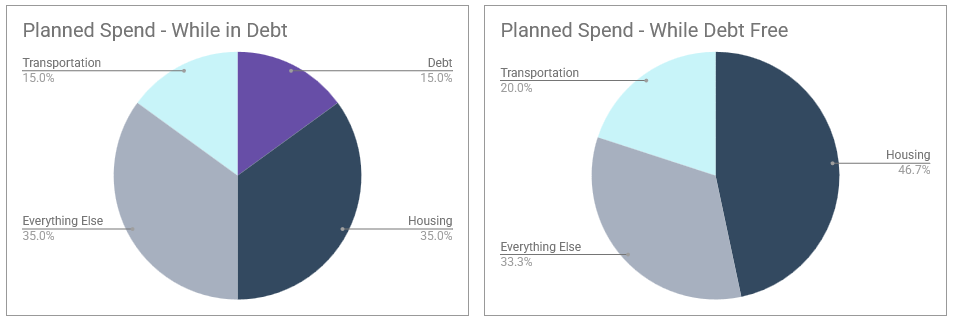
- If you have debt, your MWM monthly spending target is 15%
- Your % MUST be enough to cover your minimum debt payments. If that’s over 15% of your monthly income, that’s a pretty big deal. You owe more than you can comfortably afford.
- For now, note that a debt busting repayment plan ideally gets you debt free in 3 years or less; We’ll go over debt busting techniques in a future blog post.
- You will not be able to get ahead on paying down debt unless you’re paying off your minimums plus additional payments to reduce your total balance owing.
Check In: How Did you Do?
Check your “Debt” slice against the MWM model budget. How did you make out?
I don’t have any debt – Amazing! You are debt free! Congratulations!!! You do not need a debt slice at all. In your case, the 15% that you would have needed to pay back debt will be added to your “Future” pie slice and will make all your money goals happen faster! Woowhoo! To dig into that gem, check out my next post in the Life of Pie series.
I have debt, but my minimums are less than 15% of my income – The good news is that you are on target. If your minimum payments obligations are less than 15%, keep your budget padded to 15% rather than reducing it. Use the extra money towards paying off your highest interest debt faster.
I am over target :/ – If your percentage is over 15%, your financial house is on fire! This is an emergency and you should take drastic measures until you can get your budget back on track. Emergency measures may include
- earning more money by working more at your main gig or by taking on a side hustle
- selling things for cash
- advising friends and family that for birthday and holiday gifts you need money more than things right now
- cutting back on all or most discretionary spending
Remember, emergency measures should be temporary. Once your debt levels are within 15% of your normal income, you can ease off and breathe a bit easier.
If you enjoyed this post, please subscribe to the weekly MWM email.
Credit Cards 101
Published: 2026-04-08
This post is dedicated to my amazing niece. She is wicked smart and on the verge of becoming a fully baked adult! I visited her recently and we got to chatting about the pros and cons of credit cards. I am inspired to write this post for her. It’s a small brain dump of many things I want her to know about using credit wisely as she steps into the big new world of adulting.
Credit Card Companies Are Not Your Friend
Credit is big business. Companies make their money on both ends of every transaction. They charge vendors a merchant fee and they (hope) to charge you interest. They are giving you a mini loan every time you use your card. If you pay them back within 30 days (a.k.a. the grace period), you don’t owe them any interest. But, if you don’t pay the loan back in full within 30 days, they will charge you EXTREMELY high interest. Credit cards use compound interest, usually calculated on a daily basis. This means interest is charged on your initial unpaid balance plus any accumulated interest from previous days, causing your debt to grow faster over time. It’s pretty gross.
The Canada Credit Cards Market size is expected to grow from USD 0.82 trillion in 2025 to USD 0.89 trillion in 2026 and is forecast to reach USD 1.32 trillion by 2031
Source: https://www.mordorintelligence.com/industry-reports/canada-credit-cards-market
As a Post Secondary Student, Credit Card Companies Will be Throwing Themselves at You!
Let’s think critically about why credit card companies, including big banks, set up welcome tables at universities and colleges across Canada every fall. They want to get their plastic into your hot little hands! You are a fresh untapped market. They hope that you are naive enough to charge up your card and fail to pay it off in full every month. They want to get into your wallet first, before another company does, and before you’ve learned how to spend within your means. As a student you will have lots of expenses, stress, and little income for the next few years. For them, it’s a perfect opportunity to latch onto you and siphon what they can in the name of interest payments. See their promo tables for what they are: vampires looking for a reliable source of blood. The person sitting there is a sales person who typically makes commission for every card sign up. To be clear, you will need to make a deal with these devils, just don’t be seduced by free t-shirts, pens, and travel mugs.
Good Luck Living Without Credit!
Seriously, how does anyone book a hotel room, rental car, or plane ticket without a credit card? While still technically possible, the commerce world just assumes that you will be putting these types of purchases on plastic. Credit cards are not evil, they are a tool. Learning to use them properly will serve you well for the rest of your life.
The Case For Credit Cards
Alright, now that we know Credit Card companies are not our friends, we can go into a business relationship with them with our eyes open. So what do we get out of the deal?
Here are a few good things that credit cards provide:
- Consumer Protection – I’m putting this at the top of my list because it’s one of the best uses of credit cards. Unlike debit cards, credit card companies have a dispute process. Did you buy something online and it never arrived? You can launch a dispute with your credit card company and they can reverse the charges, getting you your money back.
- Longer Warranties – Read the fine print on your card. For example, some cards double the warranty period automatically on items like electronics.
- Incentives (Cash Back Rewards, Points, Travel Perks/Lounges) – There is a broad range of cards with all kinds of incentives. While these are nice they often are tied to how much you spend. Treat like a perk, but I don’t recommend “chasing” points as it’s just a trick to get you to spend more than you otherwise would have.
- Car Rental Insurance – Offered on some cards, just beware of the fine print. Many specifically cover small vehicles and won’t apply to a rental of a larger vehicle like an SUV.
- And More! – There are all manner of perks tied to credit cards.
What’s Your Number?
One of the BIGGEST reasons to have a credit card is to manage your credit score. Your credit score is a metric that companies, banks, landlords, and lenders use to understand if you pay back your commitments in a timely manner. In Canada, credit scores range from 300 to 900, with a score of 660 or higher considered good, and 760+ classified as excellent. Higher scores signal lower risk, resulting in better interest rates and easier loan approvals. A high credit score will make it easier to rent an apartment, give you cheaper insurance rates, get you better mortgage interest rates, and, ironically, make it easier to borrow more money for car loans and more credit cards.
However, if you mismanage your credit card payments (pay them late, fail to pay them, or keep a high balance compared to your total credit) this will hurt your credit score and removes all the benefits mentioned above. So be aware.
Don’t Pay Annual Fees
Charging you an annual fee for using their credit card is yet another way that companies make money off of consumers. Usually companies will try to entice you by “waiving” their annual fee for the first year. Just don’t do it. There are lots of no fee cards out there, stick with one of those.
Remember, Only Chumps Carry a Credit Balance
The math is simple and undeniable. When you carry a credit card balance, your future self is going to pay way more for the purchases you enjoy today. Let’s take a look at an example:
Let’s say I get a brand new shiny card. Woowhoo! I treat myself to a hair cut ($120), nails ($60), and eating out a few times ($80). Altogether, I’ve put $260 on my card. In a few weeks, my first monthly bill arrives. Look at that! They only want me to pay $10. Sweet.
Well, that’s the $10 minimum, which is the lowest legal repayment amount credit card companies can require. When I pay it, I’ve paid $10 off of my $260 loan. Now the credit card company can start piling on interest! In Ontario, most standard credit cards have an Annual Percentage Rate (APR) of around 19.99%.
If I only pay the minimum payment, it will take me over two and a half years to pay off my loan and I will have paid about $85 extra as interest. My $260 of charges cost my future self $345.
And that’s assuming I never use that card again to charge anything additional. When you don’t pay your full balance within the month, you lose your “grace period” to pay back your loan. From that moment on, interest is charged on every purchase the second it hits your account. You won’t be finished paying interest charges until you’ve had a $0 balance for over 30 days and even then you likely will be hit with trailing interest!
Don’t Even Think About A Cash Advance!
A cash advance is not the same as charging a purchase to your card. Charges have a grace period. Cash Advances accrue interest immediately with no grace period, often at a higher APR, plus added fees. Unless your life depends on getting fast cash now (for some reason?), do not use your credit card at an ATM for a cash advance.
TLDR;
The big take-a-ways are: Credit Cards are a tool, use them correctly. Don’t carry a balance. Don’t pay annual fees. Don’t take cash advances. Credit Card companies are not your friend!
Love ya, kiddo!
If you enjoyed this post, please subscribe to the weekly MWM email.
Life of Pie: Transportation
Published: 2026-04-03
This is post #2 in my Life of Pie Series. Ideally you have already read my previous posts Building Your Financial House, which gives you a high level picture of healthy finances, and then I’m Ready Now What?, which gets you prepped for the posts in this series. If you haven’t read both of those, I recommend that you jump back to them now before proceeding.
Canadians love their vehicles. According to Stats Canada, in 2023 89% of households owned one or more cars. We convince ourselves that we cannot live without a personal vehicle; Some households insist that two cars are an essential minimum for a family and some households even have more vehicles than drivers.
I find this a bit baffling. Cars are an expensive depreciating asset. They get me from A to B. I do not find cars exciting or attractive. They are machines with ongoing fuel, maintenance, and insurance costs. Left to my own devices, I would not own a car. I intentionally choose to live in places where I can walk to most daily necessities and there is access to transit. I would rent as required for longer trips. However, two things tip the scales in favour of owning a car: 1) We’ve gone electric. It’s still not easy to rent electric cars. 2) My husband wants the convenience of a vehicle on hand. And I do really love the guy, so I guess I’m easily convinced!
And also, we can afford it. Which brings me to our second slice of pie!
Transportation: Your max monthly spending target is 15%
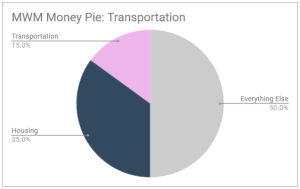
Within this category, whether you own a vehicle or use other transportation methods, be sure to capture all costs:
- Loan or Lease Payments
- Auto Insurance
- Fuel Costs (Gas or EV Charging)
- Train/Bus/Ride Service Fees
- Parking/Tolls
- Maintenance: Repair/Service Fees (everything from oil changes to car washes)
You will note that items 1 & 2 on my list are generally a fixed cost. Your car payments and insurance tend to be more consistent and predictable. For everything else, you need to choose a budget amount that is realistic, not optimistic. Give yourself room to spend on a budget category, even if you likely don’t need to. For example, we avoid tolls and rarely need to pay for parking. We still budget a small amount every month just in case we need it. It’s a much nicer feeling seeing a budget category under-spent than going into the red because you didn’t plan for costs that rarely come up. And this strategy sets us up nicely for a slush fund (a.k.a. sinking fund), a powerful safety net strategy which I’ll dive into with a future post.
For items 3-5, you can total costs over the last 3 or 6 months and use a reasonable average. Use your best judgement.
For #6: Maintenance, this is a bit trickier as it’s the most unpredictable. Your maintenance bills will increase as your car ages. Even with a newer vehicle under warranty there are licence fees, tire changes, filter replacements, uncovered repairs, and other costs that add up. The goal with this budget item is to be pro-active and not reactive. If you own a vehicle, you need to maintain it. Pick an amount that is higher than you need and will allow you to pool some money over time. For example, if you budget $200 a month, that’s $2400 you can spread over the year and can help cover any surprise maintenance bills. Each month any unspent money gets routed to your slush fund to be used if and when you need to go over budget.
Now let’s write down your numbers. Grab your numbers from your MWM Homework Day 0 prep work, along with your estimates, and update your copy of the MWM Budget Tracker in the Expenses table of the Spending worksheet.
Let’s check how you compare to the MWM model budget. Are you under the 15% target?
My transportation costs are low – If this is you, I’m happy for you! Maybe you don’t plan to buy a car, which will likely save you a lot of money over time. Or maybe you need a car in the coming years, in which case you could save almost 15% of your net income into a high interest savings account and this will be your “future car” money.
I am on target – Is your percentage at or near 15%? Congratulations, you are on target! If your percentage is less than target, you have more money to direct to other pieces of your money pie.
I am over target :/ – Is your percentage over 15%? Is there an obvious line item that’s draining your budget? Do you own more cars than you need? Should you sell or downsize? Are you leasing or financing a car more expensive than you can truly afford? What changes will you make to bring your transportation costs in line? It’s so easy to over commit your income to transportation when you own one or more vehicles. Car companies always want you to buy new and buy often and we live in a car culture where owning a car is the norm. But this is the one category I really don’t want to see you overspend in! Remember, your pie is finite. A big transportation slice squeezes other slices down. It might feel tough or even impossible, but I believe in you. Think outside the box. You have the power to make changes to set yourself up for a fantastic and balanced life!