
What it Means to be a Team
Published: 2026-05-29
I have always been the primary breadwinner for my family, with maybe the exception of one maternity leave. This has never bothered my husband in the slightest. In fact, he’s been known to joke about how sweet it was that I brought home the big money.
Until a few days ago, I assumed that the ickiness of the 90s where men had ego about making more money than a woman was a thing of the past. But the internet will always surprise you. While watching a YouTube podcast last week, the topic came up with a young couple who were struggling to connect around money. The wife expressed her feelings that making more money than her husband was a bad thing and declared that she wanted her husband to lead their family and for their children to see him be successful. My feminist eyes could not have rolled any harder back into my head. Are you kidding me?
Looking back on our lives, I know in my bones that we never would have achieved our dreams of retiring early without being a solid team. We would not have been able to dump our debt, we couldn’t have paid off our first family home early, and we never would have had the space and courage to execute our “Freedom 45” retire early plan.
We’re In This Together Now
“You and me, we’re in this together now. None of them can stop us now. We will make it through somehow.”
— Trent Reznor, Nine Inch Nails
My husband and I have always had the philosophy that we are a team. It is us against the world. This is true in regards to chores, parenting, and it’s especially true with our money. When we first moved in together money was tight. I worked a minimum wage job while going to university and he stayed home raising our daughter. In a weird way, having one small income simplified things for us. We never got used to “his and hers” money because we didn’t have separate pay cheques. It was just the money coming in that we used to pay our rent and put food on the table.
As life unfolded, we eventually became a double income household (oh my!). Fortunately, we kept operating as a team. It was the way we had learned to survive. We were both equally dedicated to our budget. I never had to worry about my husband undermining my plans by spending our rent money on magic cards. He never had to worry about me hiding purchases or justifying uncontrolled spending on our kids school clothes because it was “for the children”.
We give each other equal say in how our money is spent. We don’t tie decision making power to who specifically made what money or where a windfall came from. We especially don’t allow money to give either of us power over the other. We are two individuals making choices together for the good of us both. While we generally agree on how to spend and save our money, sometimes we have to negotiate with each other and advocate for what we want. And that can, sometimes, be hard. When we want to spend household money that is outside our spending plan, we check in with each other and hold each other accountable. We each have the ability to veto a decision if we feel strongly about it.
We also saw our household of four as a team. This showed up in how we raised our kids.
We did not pay our kids for chores because we did not want a power dynamic over money with our children. Chores were how our family loved and cared for each other and our home. Chores were an act of service to each other. If you choose to pay your kids for chores, be prepared for the day your teenager turns to you and says “I’m not taking out the garbage today. I don’t need any money this week.” (or something to this effect but much less polite)
We did pay our kids an allowance, which was expressly separate from chores. It was a humble amount of a dollar per year old they were. For us, an allowance was a vehicle to teach our kids key lessons around money: its value, that money is finite, and the balance between saving vs spending. At one point, in her preteen years, I went so far as to fund a loan to my oldest daughter so that she could buy a mini fridge for her room. She had to pay back the loan monthly with interest and I would send her statements to show her how soon until she paid off her debt. (My husband told me later in life that he was not a fan that I did this, but he didn’t veto it so Meh?)
We had other ways that our kids participated in money planning. We meal planned together. We let our kids know how much we had to spend a week on groceries and they were able to plan meals and snacks accordingly. Once a week, they were each responsible for choosing and cooking a meal for the family, and it had to fit into our budget. They also knew their birthday budget. They had the agency to choose a big gift, or a big party, or a balance of something in between, as long as it fit into their budget.
Consequently, our kids grew up living and breathing spending plans. As adults, they are both crazy proficient at living within their means. Sometimes a bit overly proficient. I’ve been trying to get my daughter to invest in new kitchen towels since we started living together. (The current ones have too many holes for my liking). I haven’t convinced her yet, but I will keep working on her!
Our Spending Rule
For most of our relationship, we’ve had a spending rule – an agreed max amount that we won’t exceed without permission. It happened pretty organically. We check in with each other if we want to spend more than our set amount. In our early years, our cap was $20. We made so little, that amount was considered a significant spend for us. We increased our spending cap as our income increased. Exceptional spending does not come up often, but when it does we have a system in place to check in with each other. By having an common understanding, we’ve given ourselves guard rails which foster respect for each other but also allows us to stretch outside our limit if we both agree it’s what we want.
More than the Sum of our Parts
“I know there is strength in the differences between us, and I know there is comfort where we overlap”
— Ani DiFranco
The beauty of working together is that we each bring different strengths to our money mindset. And we have the power to influence each other in positive ways. And together we’ve built a great life.
I am a planner and a dreamer. My husband is a rules guy and lives on logic. We are both good savers.
I’ve definitely nudged him into being a planner. Twenty years ago, I was the one who obsessively checked our budget multiple times a day, downloading transactions, and categorizing everything. Now, my husband’s the one downloading our transactions and often has them all neatly categorized before I can open our budgeting software. I used to be the one obsessing to not overspend in a category. Now, he’s the one closely monitoring our food budget and ensuring we stick to our spending plan. I’m still the primary person to forecast our investment projections and rebalance our portfolio, however, even that has evolved over the past year as well. He’s taken more ownership over re-investing his TFSA and RRSP dividends and is more active in our future projections spreadsheet than ever before. And I’m pretty thrilled about it.
And I know he’s influenced me too. He’s my accountability person. He’s taught me to be more patient, to advocate, and to communicate on decisions. Together we’ve agreed on systems and household rules, and he’s definitely kept me honest and (mostly) on track over our marriage. I’ve had to accept that sometimes he doesn’t agree with something I want. I’m not good at not getting my way and I’m not always 100% graceful about conflict, but I work at keeping my communication respectful and try to see his point of view.
After being together for 26 years, we operate as one team with our money. I really appreciate my partner and I wouldn’t want it any other way.
Drop me a comment… do you and your partner use a ‘spending limit’ rule? What was your starting number?
If you enjoyed this post, please subscribe to the weekly MWM email.
You and Your Emergency Fund
Published: 2026-05-22
You want your finances to be boring. Seriously. Exciting finances are chaotic. Exciting finances have no balance. Exciting finances give you sleepless nights. Big windfalls and surprise bills are two sides of the same coin. Put systems in place so that you know exactly where the money is going or coming from. Your future self will thank you!
More money in than planned is a great problem to have. If it’s more money from a raise or a new job, your system is to revisit your spending plan (see my Life of Pie series) and update your budget with your new amount. Evert dollar has a job. If it’s a windfall, you should have a goal in mind. Put most or all your windfall towards you primary goal. Congratulations, you have just moved the date forward to achieve your dreams!
On the flip side is a nasty surprise with an unexpected cost and the power to seriously interrupt your life. Your car breaks down. You need to fly somewhere in a hurry for family reasons. Your stove dies. Your furnace won’t start. Your water pipes freeze and burst. Life will throw so many things in your path! These are just a few unexpected examples from my life. Yours will be it’s own interesting list of events, I’m sure.
Enter the Emergency Fund.
“You’ve left me with nothing, but I’ve worked with less.” — Ani Difranco
We all start with nothing when we’re born. No money in, but also no money out. Our parents/guardians look after all our needs until, eventually, we enter the adult world of income and bills. When I left home I was 18. I had a baby on my hip and $10,000 in my pocket (actually it was in a shoe box). I had saved up money working throughout my high school years at a pizza restaurant. I didn’t really know how I was going to make ends meet, but failure was not an option. Whatever I lacked in knowledge, I made up for with sheer determination.
If I could go back in time and teach my younger self, I would have told myself to put one to three months of my total monthly planned spend into an Emergency Fund. Having that money in hand was a golden opportunity to set myself up for success. I didn’t have that savvy at the time, and so, of course, the money got spent, as unplanned money always does! My next few years were chaotic, financially speaking. We lived in overdraft. We lived pay cheque to pay cheque. We had a sword dangling over our heads for years and any major emergency would have ended us at any moment.
Save yourself a lot of sleepless nights. Get your financial house in order and have an emergency fund!
The Magic of a Separate Account
There is power in having a separate bank account for your emergency fund.
Humans are funny creatures. We tell ourselves all sorts of stories, especially when it comes to our money. We also have a hard time feeling connected with the power of our money and making rational decisions. That is why we put systems in place. We want to make our finances boring and protect us from our own irrational feelings when it comes to money.
So here’s the system I recommend. Have your income (ie your pay cheque) direct deposit to your daily spending account. A day or two after you get paid, have an automatic transfer move your planned emergency savings amount to a separate high interest savings account that is ONLY for your emergency savings. Do not pool it with other money. Check out my Life of Pie: Future post for more details on how to allocate your future savings.
Why is this magical? There is no tracking required. You check the account balance on your emergency fund, and you know exactly how much you have to work with. During the good times, you can sleep at night know that you have bought yourself flexibility and financial resiliency. During the bad times, you don’t have to think about anything. You can tap your emergency fund at will.
The Magic of Goals
If you have no emergency fund at all, I recommend that you start out with whatever amount you can manage. The amount will scale based on your life situations. When I started, $20 a pay cheque was all we could muster. And that was fine. We were building our money muscles learning how to plan ahead rather than reactive spending. Our first goal was to save up enough to cover one pay cheque. Once we reached that, it was save up to cover one month of essential spending. And then we upped it to three months. Then six months, and then one year.
Splitting our emergency savings goals into manageable, bite sizes goals gave us the ability to celebrate each milestone. Saving money should be rewarding on its own. But humans are funny creatures. You need to find a way to stay excited about making your financial life boring. Goals are the magic.
How Much is Enough?
So how much do you need, anyway? A few things to think about
- You cannot predict the future, so you will never know how much is the “right” amount. Stop stressing over if you have enough. Save what you can in a balanced way and congratulate yourself for being awesome!
- Even the experts cannot agree. You will hear one month, three months, six months, even one year! As I just mentioned, there is no “correct” amount. Three months is pretty good and gives you some run way in case you lose your job. But, more run way is always better. If you have dependants, are the sole bread winner, work based on contracts, or may be laid off by your employer, you will want to pad your emergency more so that you can sustain periods of unemployment.
- A credit card is not an emergency fund. Yes, it should be in a separate high interest savings account. A credit card or a line of credit is not an emergency fund. Tapping any credit during the bad times, while it may be necessary, is dangerous. It makes you more vulnerable and pushes you towards a cliff. The last thing you need in a true emergency is the stress of more higher bills and a debt hangover.
- Never ever ever ever use a money lender. They are blood sucking vultures that will cost you a lot of money in the long run. Just don’t do it.
- You Emergency budget is less than your spending plan budget. When deciding how much you need in a month, go back to the Life of Pie spending plan. In an extended emergency, like loosing your job, you can hit pause on some items. A lot of your “Life” expenses are discretionary. Things like eating out, vacations, and gifts should all be paused until you are back on your feet. You might reduce your dept repayment plan to cover the minimums, just for the short term. Review your spending plan now. How much do you really need in a month if you are living your leanest? That’s the amount you should use to calculate a three or six month emergency fund.
Just Do It
If you are reading this post and you don’t have an emergency fund, I am challenging you to set one up today!
Step 1: Go online and search “free online high interest savings account” and you will find many options to choose from. Apply online; I’ve been able to open high interest savings accounts in less than 5 minutes without leaving my house.
Step 2: Setup your automatic transfer (either monthly or per pay cycle) to move money into your emergency fund every month.
That’s it! You’ve set yourself for a balanced and boring financial future. Well done! Now go play some video games.
If you enjoyed this post, please subscribe to the weekly MWM email.
An Ode to My Mom
Published: 2026-05-10
It’s Mother’s Day and I am dedicating this post to celebrate my mom! Without her, there would be no Money Wise Mom.
Everyone has a mother. Moms shape and influence us in so many ways. When I think about my mother, I’m grateful for the many lessons that she’s taught me.
How to Budget
I’ve had a budget for my entire adult life. No one had to teach me how to budget because I grew up watching my mom manage our household spending. She had this big white binder. She would pull it out periodically and sit with it at our kitchen table. I watched her scribbling away in it, totalling up household receipts. It was through her consistency and habit that I internalized the importance of tracking my spending.
How to Balance the Value of a Dollar
My dad used to say “A penny saved is a penny earned!”. He may have said it, but my mom lived it. She was the primary shopper raising three kids. We didn’t want for anything but she didn’t get silly buying brand name clothes either. If we wanted a new toy, we might try to work on her a bit. Sometimes we “won” but she also wasn’t shy to say no, or not right now, or we can’t afford it. But on the flip side, we always had plenty of gifts under our Christmas, we had school supply shopping every fall, and we went on some big family vacations. My brothers and I were in sports and extra curricular activities. We definitely were raised not to waste money, but money should be used as a part of a good life.
How to Meal Prep
I was often my mom’s helper at the grocery store. I remember her planning dinners and making lists before we shopped. I remember her prepping a week’s worth of sandwiches for my dad’s big metal work lunch box, which she packed every day. As I entered the work force, I always packed my lunches. Even to this day, my husband and I meal plan. It’s a habit that’s saved us heaps of money.
Eating out is a Treat
As a family, eating out was generally reserved for special occasions. Fast food might happen if we were on a family vacation. Restaurants might happen to celebrate a graduation or an anniversary. Reflecting on my life and those of my brothers, none of us eat out overly much. DoorDash is not a thing any of us really do.
How to be Resourceful
My mom is not afraid to pick up a hammer. She is not afraid to learn new things. She is hard working. She worked in the home raising kids and running the household. She ran a private home day care business for many years. I watched her navigate through life negotiating for what she wanted. She taught me what tenacity looks like. If something stood in her way, she often found a way around it. She was clever and resourceful and I know I get those qualities from her.
How to be Generous
My mother is incredibly generous and I see that she gets tremendous joy by helping others. I owe her a great deal for supporting me when I became a teenage mom. She came with me to my prenatal appointments and she cared for my daughter during week days so that I could finish my last semester of high school in class. She cared for foster children. She cared for her aging parents. She’s planned and funded major multi-family vacations, allowing our scattered families to come together and make wonderful memories. She makes beautiful handmade quilts, many of which she gives away.
Mom, Thank you for all the lessons you’ve taught me. They have served me well and I have, in turn, passed them on to my children. What a beautiful legacy.
Happy Mother’s Day!
If you enjoyed this post, please subscribe to the weekly MWM email.
Life of Pie: Life
Published:
This is post #5 in my Life of Pie series. If you’ve new here, I recommend that you read two posts before jumping into this series. Building Your Financial House gives you a high level picture of healthy finances, and I’m Ready Now What? includes actions to prep you for the posts in this series. I recommend that you jump back to those posts once you’re ready to begin making positive changes in your life!
Here are my previous posts in this series:
We’ve come to our fifth and final slice of pie, which I call Life. The Life slice is everything not already accounted for in your spending plan. It includes food, alcohol, holiday spending, gifts, clothing, subscriptions, vacations, and everything else you spend money on.
If you’ve been keeping track of your portion sizes, you will already know that your Life slice target size is 25% of your total income. If you haven’t already, you should now update your spending plan and add a Life category. If you are using the MWM Budget Tracker the beginner and normal modes are there by default.
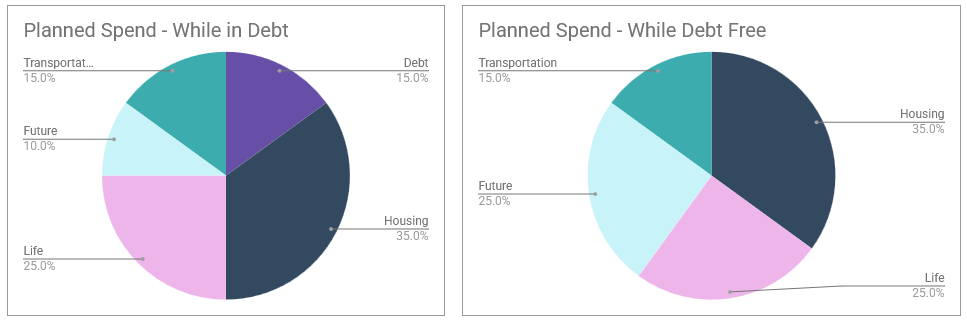
As I’ve mentioned before, your spending plan may not completely match our Money Wise Mom targets. However, here are some guidelines to help give you some perspective.
- Under 25% – It’s unlikely that you spend less than 25% on Life unless you’re doing it intentionally. We all need to live and we all like our creature comforts. We exist in a consumerist world and from the moment we open our eyes and check our phones to when our head hits the pillow at night, we are inundated with ads and nudges designed to make us spend, spend, spend!
To be clear, spending your money on Life is a good thing. Everyone needs balance and this category has the power to bring you joy beyond the bare necessities. Spending under 25% is an indicator that you are restricting your budget.
If you are in debt and motivated to bust it fast, you might restrict your life spending voluntarily for a set period of time. It’s okay to grind it out, as long as you have a clear debt repayment plan with a defined timeline. Typically I recommend creating a debt payment plan you can achieve in three years or less. If you want to grind, I feel that more than 12 months of restricted spending becomes unsustainable.
There is one other situation that warrants intentionally reducing your Life spending. If you find yourself in a financial emergency, like losing your primary income, the Life category is the one with the most fat to trim. If you’re between jobs, you might shift from a normal spending plan to an emergency spending plan, which is designed to stretch your emergency fund for as long as possible. Cutting out gifts, holiday spending, vacations, and other optional things will give you more time to find another source of income. - Over 25% – Overspending on Life may indicate that you are doing really well or that the roof of your financial house is on fire. We have to look to the other slices of your pie to get the full picture. If your housing and/or transportation spending is low and you have no debt, those slices will be reduced and you might redirect those dollars into Life. You should also have a healthy grasp on your Future slice and be saving and investing wisely. Do not screw over your future self so that you can eat out every day. Remember, you are looking for balance.
Alternatively, if you spend over 25% on Life and you have debt or your Future slice is missing, your financial house is on fire! It’s time for action. You need to get your budget in order and you must change your spending habits. Failing to do this means you cannot not have a happy, balanced, financial life.
To Track or Not To Track
You probably will not be surprised when I tell you that I am a tracker. I like spreadsheets and goals and projections. Since I was a teenager I’ve tracked my spending. If you are like me, you will want an app or a spreadsheet and you will enjoy taking the time categorize where all your money goes every month.
However, maybe you are not like me. Perhaps tracking your spending is a habit that just doesn’t work for you. If that’s the case, I recommend you simplify your spending system.
For me and my husband, we buy all our life stuff on a credit card that gives us 2% cash back. We always pay our monthly balance in full. We do not pay credit card interest.
Note: If you are beginner level, this method is not for you. Even I, who’s been tracking money closely for over 30 years, can get surprised at how big the credit card bill is when it arrives.
We host our own budget tracking software called Actual Budget (we’ve used simple spreadsheets and other apps in the past) which is not perfect but it allows us to categorize every transaction and all the data is stored locally. We pay a small annual fee for a third party service called SimpleFIN which acts as a bridge between our budget software and our credit and bank accounts. SimpleFIN allows us to import every transaction into Actual Budget on demand. We don’t need to use SimpleFIN, as we could manually import all our transactions, however, theoretically, it’s saving us time and hassle. Honestly though, how much time and hassle saved is debatable – all our financial accounts have multi factor authentication enabled which SimpleFIN cannot bypass which IS a hassle and takes time.
Anyways, if you are not into tracking every transaction there is an incredibly simple and fool proof method to ensure you do not overspend. Some people call it the jar method and some people call it the envelope method.
The Jar Method
When we were in our debt busting years, we followed the Jar Method. It’s a simple system where you live on cash. It is impossible to overspend if you follow this method correctly. The basic approach is this
- When you get paid, you withdraw the 25% that you are planning to spend on Life
- Put the money in a jar on top of your fridge
- Spend this money for life stuff
- If you spend all the money, you have to wait until next month!
- If you have money left over, you can leave it to accumulate and spend it in the future
You only need one jar but I recommend that you have a few to balance your spending. Our big categories are Vacations, Food, Clothing, Gifts, Christmas, Roller Derby, Entertainment (his and hers), and Misc Spending. We do not take a vacation every month, however we allocate money to this category every month until it’s pooled up enough to use.
If you want to go above and beyond, place receipts spent into the jar. Then once a month, before you replenish the cash, take out all your receipts and jot down in your budget tracker where the money went. This is a simple step if you want to start tracking your spending. You may also be amazed at how quickly you forget what you bought over the past four weeks!
If you are not a fan of living on cash, you could simulate the jar method by moving 25% of your pay to a separate bank account and spend it from there. Some institutions allow you to have multiple accounts or allow you to “earmark” money into categories inside one savings account. The key is that you move only the 25% amount that you plan to spend down over the next 30 days.
How Rich Do You Feel?
How you feel about your money is a shifty thing. Feeling like you don’t have enough money sucks. The Life slice can get pretty emotional. The key is to be intentional with your spending. Want to know a trick that’s served us well over the years? Any time we adjust our Life budget, we ask ourselves “What would make us feel rich?”. Once upon a time, we had debt to pay off and low income and therefore, no room for alcohol in our budget. Eventually we busted our debt and earned more. We then got to sit down together and decide where to up our spending. Yeehaw! Going from nothing to something felt luxurious!
We also periodically trim back on spending that we no longer care about. At some point, we agreed that eating out didn’t really bring us joy. So we ditched planning to spend on that but planned a good sized food budget so that we could eat out once in a blue moon but make yummy meals at home together, which we loved.
Your spending habits and priorities will change over time. Your spending plan should be updated as well to put more money towards things that bring you joy and limit or remove spending that you no longer care about.
If you enjoyed this post, please subscribe to the weekly MWM email.
Crushing the Marshmallow Test
Published: 2026-05-08
My husband and I are a little too good at the marshmallow test. By which I mean, we can take our natural skills in delayed gratification a bit too far.
The marshmallow test, in case you’re not familiar, is a psychology experiment from the 70s that studied delayed gratification in 6 year old kids. If kids were able to restrain themselves from eating treats while unsupervised for a period of time, they would earn double their rewards. Or “fail” the test and eat their treat early and get no extra treats, screwing over their future selves.
If you think about this in terms of personal finance, it’s basically the power to wait until you can afford something before you buy it. In today’s world of credit cards, pay day loans, lines of credit, and online buy-now-pay-later services, there are so many ways to buy things before you can afford. Lenders want to make your buying experience as frictionless as possible to allow them to make money while you to treat yourself to x, y, and z product.
But like those eager kids who ate the treat early, paying for stuff with credit that you cannot afford is screwing over your future self. Debt is an anchor that drags you down. It slows down the rate at which you can reach your financial goals. In the worst scenario, it can take goals completely off the table for you. Interest payments on debt are a bill that you are handing over to your future self, who will have to work harder and longer to pay more for the treat that you get to enjoy today. Buying stuff feels good in the moment. Since the interest bill comes later, most people don’t quantify the true cost of stuff that they put on a credit card. When they don’t pay their balance in full before the grace period, interest is the hidden tax on everything you buy. Canadians know that you always have to round up the price tag to include sales taxes. However, with sales tax you know the exact percentage you need to factor in. With credit card interest, how much you pay depends on how long until the debt is paid off. At an average credit card interest rate of 20%–25%, a purchase will cost double in approximately 3 to 4 years if you only make minimum payments. Oof! Was that $8 sub that you bought today really worth making your future self pay $16 for? And do you really still want to be paying for it years from now?
Nature vs Nurture
So how does delayed gratification show up in my life and when did it start? As a teenager I remember choosing to walk halfway across the city to save $0.50 on bus fare. As I became a young adult, I remember comparison shopping for the cheapest shoes I could find and frequenting thrift stores. My ability to budget and save was strong as a kid.
It wasn’t until I moved out at the tender age of 18 that I started to flirt with debt. By that time I was already a mom, having had my daughter at 17. Originally I moved out on my own, but it was only a matter of months until my daughter’s father (now my husband) joined me and we became an instant family of three, living below the poverty line.
A lot of new adult expenses (rent, transportation, food, etc.) coupled with access to new forms of credit (credit cards, store cards, and student loans) was a dangerous cocktail. We often lived in overdraft, for which I could tell myself that “we had no choice”. Perhaps, perhaps not. We lived simply, but we did buy stuff on credit instead of waiting. We bought a stereo before we could purchase it out right (no one needs a stereo). We didn’t eat out often, but we did sometimes. We bought each other birthday and Christmas presents. We had pets, which made life more expensive than it needed to be. Nothing too extreme, but when you’re poor, even small stuff can drive you into a cycle of debt. When you don’t have a lot and can’t see a brighter future, buying things that you just want is seductive. Especially things that you can’t afford and, deep down, you know you shouldn’t buy. It’s like eating cookies when you’re on a diet. When willpower cracks, you can tell yourself all sorts of things to justify that sweet treat. But you always have to deal with the sugar hang over the next day.
It’s a Money Muscle
It was 5 or 6 years later when we finally got serious with our money. At our “rock bottom” we had a mortgage, a HeLoc, a student loan, and over $10k in consumer debt.
We were in our mid twenties when we finally decided we were done with debt. We wanted it gone and we needed a plan. We needed to bulk up our money muscles. To do that, we built our household budget based on our goal to become debt free. We allocated every extra penny to paying off our debts asap. Our early budget was pretty extreme. At one point (maybe early 2000s?) our monthly household budget was $20 for entertainment. Woohoo. Yes, that’s household (with two kids), not per person. We didn’t have any budget allocated for alcohol (that was a need, not a want); I remember buying my husband a case of beer for his Christmas present as a big treat. We didn’t have money to buy xbox games, so we would rent them for a fraction of the cost. We spent many hours at the library and would all read for entertainment. It definitely wasn’t glamorous, but we had a good life and we were putting our future selves first. And, as the debt balances came down, it actually felt good to live without. We stopped using all credit cards. We prioritized doing things for free. We loved our local libraries. We went to the park. We were finally winning the marshmallow test.
How that showed up in our children
My kids were between 2 and 7 when we started our debt free journey. For them, I think watching us be intentional with our money is all that they’ve ever known. And today, both my kids are extremely proficient budgeters. Like, extremely proficient – to the point that, sometimes I wonder if we broke them a little bit.
Of course, I say that tongue in cheek! I see them flexing money budgeting muscles all the time and it brings me joy. As MoneyWiseMom, I’m extremely proud of my kids and how they make the most of their money. They budget for big expenses. They don’t overspend at the holidays. They second hand shop. When they take on debt, like student loans, they pay it off aggressively. They live below their means and save for their futures.
What could be wrong with be intentional with money?
The Dark Side of Extreme Frugality
As life went on, our financial lives naturally improved. We stuck to our budget, crushed the debt, and started investing. Along the way, we advanced in our careers and started to earn raises and bonuses. When our income went up, we would revisit our household budget and allocate money intentionally, based on our current life goal, to up our budget. We would ask ourselves, how should we up our budget so that we feel “rich”. Our lux categories were entertainment, alcohol, and vacations (no surprise as these are the categories that were heavily constrained early on in our marriage!). And because we lived so constrained for so long, even a small bump in these line items felt amazing! What do you mean we can just go to the movies? How rich are we, lol?
Fast Forward to Today
Over the past year, we’ve done a major life reset. Just over a year ago, I left my high paying tech job and intentionally left the workforce to live a life of financial independence (what can I say, all that saving and investing really worked!). As part of our big life reset, we choose to go back to basics with a pretty frugal budget. In 2024, we didn’t think twice about eating out or how much we spent at the grocery store. Today, we thoughtfully plan our meals and shop based on sales. We choose to go back to feeling a wee bit constrained so that we would focus on people and experiences over money and things.
And we may be a little too good at it. We currently have a pretty humble budget for miscellaneous expenses. We draw on that money for extras, like when buying a new cell phone or kitchen gadget. We’ve keep a list of things we want to buy next. It has about ten items on it right now. At the current rate, it will take years to build up the money to go out and buy all that stuff.
Our tendency to “just wait” to buy things may be bit out of wack. Two weeks ago, we decided that only having one cutting board was not working for us. This week, I finally convinced my husband to just get a second one, even though we’re overspent on our misc exp budget right now. And even though we were “going wild” just buying it, he still flexed his frugal money muscles and found one for half off in the Ikea “As Is” section. Which I fully support, by the way. It was the right purchase for the right amount and we shopped to our values by choosing a bamboo cutting board that was the right size for what we wanted and I know that it will be used every week for years to come! And of course, we’re still going to pay off our full credit card balance this month. We haven’t paid credit card interest in decades, and we won’t be going back to that old life.
Final Thoughts
In our mid forties, we discovered that we still had our money muscles that we developed up in our twenties. But the dark side is, we might over built those muscles at the expense of flexibility. I know that today sometimes we stress ourselves out sticking exactly within budget. In truth, our budget is an arbitrary rule we’ve created for ourselves. We value a stress free life and we’re still working on finding the right balance that works for us. But it’s a pretty great life and I wouldn’t really want it any other way.
If you enjoyed this post, please subscribe to the weekly MWM email.
Life of Pie: Future
Published: 2026-05-01
This is post #4 in my Life of Pie series. If you’ve new here, I recommend that you read my previous post Building Your Financial House, which gives you a high level picture of healthy finances, and then I’m Ready Now What?, which preps you for the posts in this series. I recommend that you jump back to those posts once you’re ready to begin making positive changes in your life!
Here are my previous posts in this series:
The Future slice, IMHO, is the best slice of all the slices! This one has the power to change your life for the better and in a really big way. Your Future slice includes your safety net (a.k.a. your emergency fund) and your investments, which is how you grow your money engine. Your money engine allows your future self, one day, to stop trading their time for money (a.k.a. working). In between saving for disasters and saving for financial independence, you might also choose to save for major expenses like a down payment on a house or post secondary education. Everything in this slice is about building a better future. How cool is that?
Some key concepts for success.
- Funding your future is not negotiable. Even if you have debt, you save. This is the path to a balanced financial life.
- Your savings are a monthly bill that you pay yourself. Automate it so that it comes out of your spending account the day after you get paid.
- Keep your Emergency Fund in a separate, no fee, high interest savings account. There are many to choose from, just do a quick search online.
- Never do anything with your savings that you don’t understand. That includes sending it to “some money guy” who “handles” all your investing for you.
- Money + Time is magic! Compound interest is the growth that you need in your life. If you are not putting money aside now, you are missing out in a major way.
Choose Your Level
This slice comes in beginner, normal, and advanced modes.
Beginner: If you have debt, your financial house is on fire, and prioritizing getting rid of it forever is critical. But setting up your Emergency Fund is also critical, as is putting money away now for your future self. Your strategy should be do a little of all these things, as they are all important. Once you are out of debt, you can contribute to your future in a more meaningful way. In Beginner Mode, your target for Future is 10%.
Reality Check: I want to add a note here for those who are struggling. If you can get your financial life in balance and your Life of Pie slices are relatively on target, then great! However, I’ve lived below the poverty line and I’ve had to survive on overdraft (so gross, I know!). I know that sometimes after covering the essentials, money can be impossibly tight. I urge you to do what you can, no mater how little. During our tightest times, we put a meager $20 a month away in our emergency fund. Savings is a muscle. Just like going to the gym, the most important thing is to show up and do what you can. Showing up for your future means putting something away every month. If it’s very small, your goal will be to increase that amount as your financial life improves. Focus on ways to reduce expenses and increase your income to get your Future slice up to at least beginner mode.
Normal: When you are debt free, you have the power to supercharge your future! You can now divert the 15% that would have gone to debt payments to yourself! Huzzah!
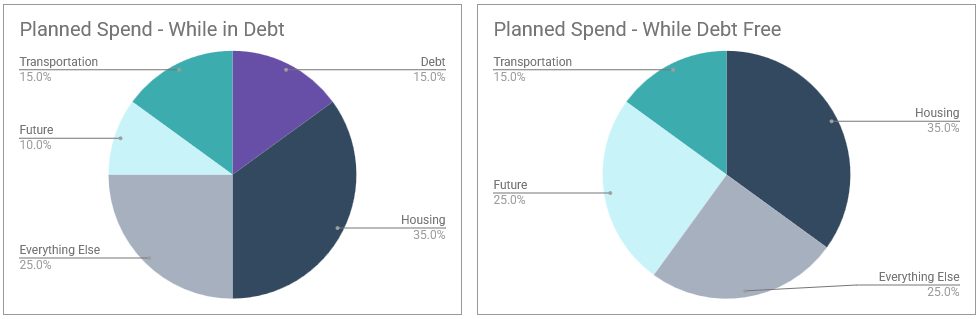
Advanced: Do you recall how I said in Life of Pie: Housing that “Life is squishy, and your pie will likely never be 100% perfect.”? Once you’ve got your financial life dialed in, you might explore increasing your Future slice to be even bigger! The bigger this slice, the faster you reach your goals. This is not required for a healthy financial life, but for me, understanding this option was a game changer and it allowed my husband and I to reach financial independence by the time we were each 45. If this sounds interesting to you, I encourage you to read the blog post that changed my life in a big way “The Shockingly Simple Math Behind Early Retirement” by Mr. Money Moustache. It’s his writings that educated me the most and opened my eyes to an alternative lifestyle that really resonated with my value system. In our most plush days, my husband and I would squirrel away around 60% of our income to Future (a.k.a our investments). The key is, in your working years you always save at least 10%-25%. However, as you win at life, you can choose to reduce other slices and put even more. You get to decide for yourself how much is enough.
Cool Story, Bro. Now What?
The deeper strategies on how to allocate your future savings warrants it’s own post. For now, you should accomplish three actions
- Update your spending plan based on whichever “mode” fits your life right now. If you are using the MWM Budget Tracker the beginner and normal modes are there by default.
- Setup a separate no fee, high interest, savings account for your emergency savings. If you don’t know or have investments, then just shove all your Future money into savings for now.
- Automate your savings. If you have a regular pay day, schedule a transfer to your savings account a day or two after it hits your spending account.
Now give yourself a high five and go play some video games! You did great things today.