
Travel Budgeting Tip: Track As You Go
Published: 2026-10-22
In a previous post, I shared with you the system we use to budget for travel.
A quick recap:
- Have a system for vacation savings. For example, move money every month into a seperate account.
- Build a budget for your trip. Decide before you start booking tickets if you can afford the trip you want to take.
- Save up, then spend. Having vacation money saved up before you leave is the best way to skip money stress. No guilt travel is the best travel!
We are currently on the final days of our Sweden trip. I am writing this post from an Airbnb in downtown Copenhagen, sipping my morning coffee, full from a yummy homemade breakfast of eggs and avocado toast. Sadly, I am without my beloved hot sauce, but sometimes you just have to make due when you are on the road.
It’s been a great trip! We reconnected with some old friends, ate and drank our fill, and visited so many cool historical sites.
Living in the moment, I find it’s easy to feel a bit overwhelmed with so much spending. Converting prices on the fly can be a bit tricky and we have been tapping our cards left and right.
Luckily, we keep our cool by sticking to our travel budget. We chose to stay in control by tracking our spending as we go.
Each evening, when we’re back at our accommodations, we take 2 minutes to update our tracking spreadsheet before settling in. We use saved receipts if we paid cash or we use the days transactions from our Wise app if we paid by card.
It only takes a couple of minutes. And it means that we know 100% on a daily basis if we are under or over spent. And, since we know we are under budget, we can enjoy a guilt free final dinner out on our last day before heading home.
If you enjoyed this post, please subscribe to the weekly MWM email.
The Case for Coupons
Published: 2026-10-15
Coupons are awesome.
I’m not talking about the coupons you clip. I don’t actually care much about retail coupons that come by way of flyers or your inbox. I’m talking about a family tradition that we’ve embraced for the almost 30 years.
In my family, it’s incredibly common for us to give each other IOU coupons as gifts.
Coupons have been on my mind thanks to my husband, who has been cashing in a string of IOUs that he’s been hoarding for years.
Why Coupons?
In my family, we celebrate Christmas.
Christmas is a highly commercialized holiday that is heaped in excess. Nestled in between the quant holiday traditions and the family gatherings is pressure to give store bought gifts, entertain, and dress up in fancy clothes. All the festivities are fun, but also lead to overspending, holiday debt hangovers, and over eating.
Enter the humble coupon.
Coupons help us keep it real. They cost time and effort rather than money. They require thoughtfulness and planning. A good coupon is tailored to the recipient. The coupon giver should put intention into their gift.
As a coupon receiver, you get the joy of cashing in the coupon, and you get the gift of anticipation! Part of the joy is planning the perfect time to cash in a coupon. It’s like a gift before the actual gift.
Experiences Over Things
In our early years, even though we didn’t have money to blow, we spent money we didn’t have on gifts.
There is so much social pressure to give stuff to each other. As parents, we definitely felt the pressure to give our kids stuff, some of which was pretty expensive. Most of it ended up broken at the bottom of a toy box. I can remember surveying an entire basement full of toys when my kids were little, wondering where it all came from and being overcome by how much work it was to clean up after.
In our culture, we normalize stuff as love to our kids. As parents, is up to us to show our kids a different path.
The sad truth is that most people cannot remember what you gave them last Christmas. Most people cannot remember what they gave last Christmas. It seems to me that we are all participating in an endless cycle of mindless purchases.
So why do we tie ourselves into pretzels trying to impress each other with purchases?
Commercialization. The entire retail industry wants you to equate buying stuff with love.
If you think about, who really needs more stuff in their life? Most of us have way more stuff than we need and a lot of the time we don’t even want the stuff we are given!
Doing something for and with someone is way more memorable, personal, and enjoyable.
I cherish the memory of going on a hike with my kids (given to me as a mother’s Day coupon) or breakfast in bed (given to me as a birthday coupon) or an afternoon of games with my daughter (given to me as a Christmas coupon).
Be Creative
Some of our families best coupon ideas from over the years
- A hike together
- Doing the dishes without complaining
- A board game of the receivers choice
- A batch of homemade pierogies
- Money towards a tattoo
- Breakfast in bed
- A game of crib
- Money towards a video game
- A massage
- A day of video games together
Perhaps you notice a trend? Many of them are no cost and allow us to spend time on or with each other.
Some Advice
Speaking from experience, here are some things to keep in mind:
- Give your coupons an expiry date. This will help people who like to hoard things actually use them
- The issue can mark up a coupon as “used” once it’s been redeemed. This lets the recipient hang on to it for memories, if they want, and is very satisfying as the issuer.. it’s just feels like a job well done after the promise has been fulfilled
- Get artistic. You can design your own coupon or find printable ones online for free. Have fun decorating them or put them on fancy paper or write them into a handmade card.
The best part of giving coupons is that you can tailor them to the recipient in really personal and meaningful ways.
I hope this holiday season, you go forth and coupon!
If you enjoyed this post, please subscribe to the weekly MWM email.
Oh the places you will go
Published: 2026-09-18
We travelled a lot this year. So far, I’ve taken eleven trips. These have all been within the province and the budget for each has varied. I have one more local trip I’m taking this weekend and then we will end our year with la pièce de résistance: a trip to Sweden where we will watch the WFTDA roller derby championships!
As I am writing this, thirteen trips sounds extreme to me. It’s certainly the most I’ve ever travelled in one year for personal entertainment. I suspect we will calm down our travel plans next year, but who knows! This year we focused on doing a lot of roller derby activities which kept us busy most weekends over the summer season.
How to Think About Vacations
Vacations shouldn’t take you by surprise and you shouldn’t take on debt for travel. You are in charge of deciding how many trips you take, where you go, and how much you will spend.
Here is how we approach vacation spending.
- We allocate vacation spending in our monthly budget This has been our system for the past 30 years. In our traditional earning years, we would move a budgeted amount, for example $200 a month, to a separate account that I lovingly referred to as our “slush fund”. Now a days, we work a little differently, but for most people, I highly recommend a separate spot to stash earmarked cash. Our slush-fund account held house money intended to pool over time for large expenses like vacations, annual insurance bills, and Christmas. How much we had sitting in each “pot” of our slush fund was tracked within our budget. This system gave us predictability, stability, and an upper limit to what we could spend.
Predictability: We transferred money every month, without fail from our joint daily spending account to our slush fund account. It was a “bill” that we paid ourselves. If we didn’t spend it all in one year, it would roll into the next year to give us a bit more spending power, if we wanted it. Our system kept our money management simple and boring (which is the goal!).
Stability: Our monthly transfer meant a slow and steady drip of money into our pool. The monthly amount was decided once a year, during a money talk. We reviewed our income and expenses and set out all our planned spending for the upcoming year. The amount we allocated to vacation was based on what our household could afford monthly and it fit within on our total life expenses of 25% net income.
A Ceiling: Our system made it very easy to know when we could afford a trip, if ever. Instead of making life “exciting” and just deciding we deserved a vacation as we felt like it, our system insulated us from making choices based on FOMO. We did not “stretch ourselves” and there was no “we will figure it out later” mental gymnastics. We had the money that we had and it would only go so far. If we could afford $200 a month for vacations, the math was simple, that’s a max of $2400 a year for vacation spending. - We set special budgets for special occasions At a monthly money talk last last year, well before the travel season was upon us, we decided together that we wanted to dedicate more to travel this year. It was our first year together as retired and we wanted to spend more time focusing on roller derby events. So we looked at what we felt we could afford and allocated two extra pots of money. These are considered one time “special spending” budgets. The money was from surplus cash, rather than our monthly budgeted vacation amount.
Pot 1:France TripLocal Derby Travel
I wanted to attend MRDA championships in France. It ticked the box in which we like to double up derby destination travel with fun experiences and going to France is on my bucket list. So, I pencilled a special budget line item for a trip. However, as we approached the travel season and during one of our monthly money talks, my husband had a counter proposal: rather then blow so much money on one trip, we should spread our budget over a lot more short and local trips, giving us a heck of a lot more derby experiences. I came around to the plan and I figure we are simply deferring a France trip to a future adventure.
Pot 2: Sweden Trip
This will be a ten day trip that we are both looking forward to! We are gong to the 2026 WFTDA Roller Derby Championships and padding a few extra days for sightseeing. Would I have thought to go to Sweden otherwise? Probably not, but that’s the fun of bundling travel with derby. We see corners of the world we would not otherwise have visited. I had assumed that because we no longer had day jobs, it would be “easy” to spend several weeks overseas. But two things worked against us: 1) vacationing is not cheap! For a multi week trip, I think I would need to be more creative to try and live like a local rather than a tourist 2) somehow we are still really busy! We have life stuff happening at home which didn’t lend itself for us taking a longer trip.
The Best Vacation is One You’ve Already Paid For
I like planning stuff and we both really like tracking stuff.
- Set your budget ceiling. Either from your pooled vacation money or from a special pot of “extra” funds that you already have on hand.
- Build your budget! Planning the trip is (for me) the super fun part. I build a spreadsheet that lays out your itinerary, when you depart and return, which calculates your total days of travel.
I always include a few standard categories:
EV Charging (if driving) or Flights – based on how many times we figure we will need to supercharge our car or a google flight search
Accommodations – I use a guesstimate rate for accommodations, based on a somewhat educated guess as to where we are going, and times it by the total days. In the example below, I assumed $100 per day for hotel or an airbnb.
Food & Drink – Similar to accommodations, I assume a daily rate of $75
Events & Attractions – For a short / targeted trip, you might only have one event you are attending. You can either build your budget around that (i.e. the cost of a pair of tickets to the event) or, if it’s a trip where we want to sight see, I’ll just set a daily rate of $50-$100 (best guess) to have something to stay within.
Land Travel – Typically required for sightseeing trips. This might be a rental car, local transit, or ride services.
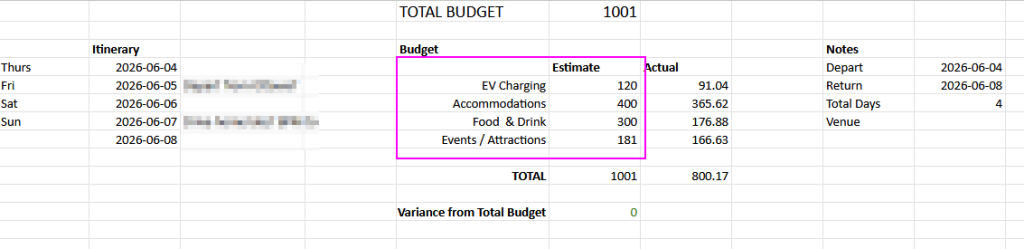

3. Decide if you can afford it. This is a big one and you must not skip it. At this point, we have not yet committed to taking the trip. Will the projected budget for the trip fit within our budget? For example, maybe flights are really expensive. If you are working from special budget of extra money, maybe you can allocate some of your vacation to cover the gap. Otherwise, the trip is probably a no go. And that’s okay! It’s far better to realize if you can afford a trip before you start booking stuff, rather than dealing with a debt hangover afterwards!
4. Book Stuff! Once you know you can afford it, you have the green light to book stuff! I like to copy past links and screen shots of my flight and accommodation booking into my spreadsheet so everything is in one place. As you pay for stuff, track your actual spending. Being over budget in one category is not a big deal, as long as it fits your total trip budget.
5. Let the count down begin! Now that everything is booked, you get to sit back and anticipate how much fun your next adventure will be!
6. Enjoy your fully funded guilt free trip! There is nothing as good as guilt free travel. Having everything paid for ahead of time means you will enjoy being in the moment, without a foreboding feeling of a looming debt hangover.
7. Post trip stuff – As I mentioned, we like to track stuff. So we do keep track of our travel spending. After a trip, we ensure the money we spent during travel is tracked in the Actual column of our budget sheet, so that we can keep ourselves accountable. Tracking our spending also helps us with our guesstimates for planning future trips.
Rinse and Repeat
And that’s how we plan all our trips! It’s a simple system and it’s easy to replicate. It also keeps us within a spending limit. And sometimes, it helps us feel good about turning down opportunities. Even with so much travel this year, I did turn down three other travel opportunities, solely because it wasn’t in our plan and I couldn’t afford it. And that’s totally okay! We all have limited funds and we all have the power to choose what we do with them.
If you enjoyed this post, please subscribe to the weekly MWM email.
PSA: Set your survivor and beneficiary on your registered accounts
Published: 2026-08-14
If you have a TFSA or an RRSP, or you are considering opening one, this public service announcement is for you! I will focus on my experience with Wealthsimple, but even if your registered account sits somewhere else, this is still a call to action to review your account information on file with your financial institution.
Last year I moved my investment accounts from TD to Wealthsimple and, so far, the experience has been really positive. Except for one, kinda big (in my mind) thing.
Wealthsimple does not prompt you to set your registered investment accounts successor holder and/or beneficiary.
Registered accounts come in many flavours. You might recognize their acronyms: RRSP, TFSA, FHSA, RESP, and LiRA. (See my glossary for definitions).
In my experience, I opened registered investment accounts with Wealthsimple wihout having to specify a successor or a beneficiary. I only went looking at my accounts after a youtube video sparked my curiosity to check these settings and I found nothing had been defined. When I created my accounts, designating these important roles was not top of my mind, so it wasn’t done!
Why You Should Care
We’re all going to die someday. Most of us will leave behind loves ones who must deal with all the stuff we’ve accumulated over our lifetime, including our bank and investment accounts.
Just like writing a will, ensuring your registered accounts have up to date information defining who gets them when you die is a small gift you are giving to someone you love. It means there is less hassle and red tape transferring your money to the person you want to gift it to when you die.
Taking 10 now minutes now to jump online and check these settings will save a lot of time and hassle for your executor once you are gone.
If you want a deeper dive, these articles do a nice job outlining what happens should you die without having your registered account’s paperwork in order:
- https://will-kit.ca/tfsa-beneficiary-rules-canada/
- https://www.claret.ca/publications/naming-tfsa-successor-holder/
- https://lawyerinfo.ca/guides/ontario/wills-estate-ontario/probate-trust-ontario/dealing-with-a-deceaseds-tfsa-and-rrsp-in-ontario-probate/
It’s Not All About You (Or Maybe It Is)
Getting your paperwork is in order is the right thing to do and you should do it for your loved ones.
But you matter too! You also want to ensure your significant other(s) have their paperwork in order. Odds are, you will be the one left to pick up the pieces when they are gone. Do yourself a big favour and ask your partner(s) to confirm that you have been designated as the successor or beneficiary on their registered accounts.
Which Accounts Need What?
Different accounts need different people defined in specific roles. This article does a nice deep dive into registered accounts, plus other really important stuff like life insurance policies and pensions.
Here’s a quick chart to help you wrap your head around what you need to set for each type of registered account:
| Account Type | Role You Want to Define | What the Role Means |
|---|---|---|
| RRSP | Beneficiary | Receives the proceeds of your RRSP upon your death. This avoids probate. |
| RRIF | Successor Annuitant or Beneficiary | A successor annuitant continues receiving payments; a beneficiary receives a lump sum. |
| TFSA | Successor Holder or Beneficiary | A successor holder takes over the account without affecting TFSA room; a beneficiary receives a lump sum. |
| RESP | Successor Subscriber | Not a beneficiary, the appointed person to manage the RESP on behalf of the child. |
| FHSA | Successor Holder or Beneficiary | It depends. Check out “Types of Beneficiaries” and “Survivors” on this canada.ca page to understand the different cases. |
Yes, you must check every one of your registered accounts separately across all financial institutions.
Pro Tip: Create a spreadsheet listing all of your registered accounts across all institutions. Check or update each account and list who you’ve defined in specific roles. Referring back to this list in future will be much easier than going back to each account. Remember to review this spreadsheet as needed. For example, if you break up with your partner, or they pass away, you will want to update your account paperwork again.
Update your Wealthsimple Registered Accounts
For Wealthsimple clients, here is their guide on configuring your accounts. It explains the criteria of who can be named as survivors and/or beneficiaries (a very important distinction that you should understand before you begin): https://help.wealthsimple.com/hc/en-ca/articles/360058456753-Add-a-beneficiary-or-successor-to-your-registered-account
I found that the instructions for adding a beneficiary a bit lacking. Note that you must be on the web portal via a browser. At the time of this writing, the option doesn’t exist in the mobile app (I’m using the Android app).
- Login via a web portal and click into the specific registered account
- Click on the gear icon, and choose “Manage Beneficiaries” from the pop up menu
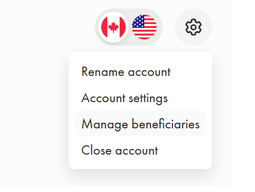
While you can manage beneficiaries online in your account info, you must follow different instructions to add a successor. Note that you need to use a specific online form.
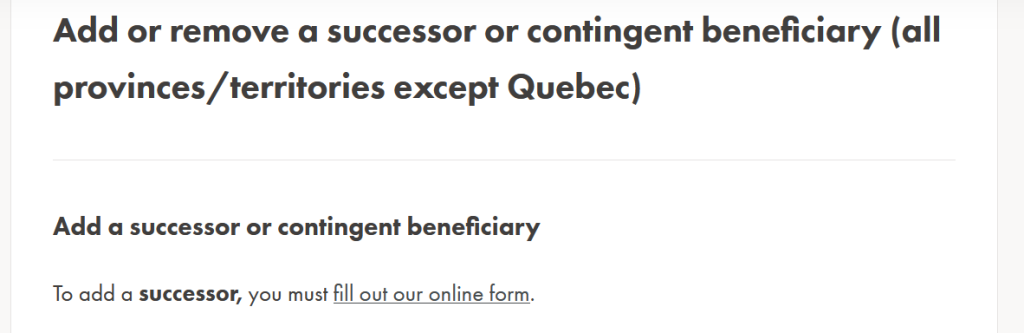
Key Take Aways
- Call to Action: Ensure you and, if you have one, your significant other, have defined survivor-ship and beneficiaries so that whenever the inevitable happens (death comes for us all), accessing your major investment funds does not become a burden of red tape and delays during the worst of times.
- Everyone with a registered account, no matter which financial institution the accounts reside in, should ensure beneficiaries (or equivalent) are up to date
- You must check every account separately. Do your future self a favour and make a spreadsheet with each registered account and who you’ve designated. You can review it as needed, for example if you break up with your partner
If you enjoyed this post, please subscribe to the weekly MWM email.
I’m Ready! Now What?
Published: 2026-03-16
Cool, you just read my last blog post building your financial house and you’re ready to “get better at money”! But what now?
Rest assured, we will dive into our first pillar, which is our spending plan, in due course. Before we deep dive into that topic, let’s set you up for success. Here are a few tips and a little bit of homework so that when we start building our spending plan, you will really be ready to go.
Set Yourself Up for Success
Your calendar is a reflection of what matters to you. If you care about fitness, you will have dedicated time for activities that make you sweat. If you care about your friends, you might have a standing monthly brunch meetup. The same is true for money. If you want to get serious about your money, you’re going to start setting aside time to deal with it.
Prep Work
- Block out 1 hour of focus time
- Pick a time when you will have the energy to focus and a place to work that is distraction free.
Pro Tip #1: When planning focus time, be realistic and be intentional. Planning to dive into money stuff at 8pm on Thursday night after an exhausting day is not ideal.
Pro Tip #2: Commit to focus time. Set your phone to do not disturb and shutdown your email. I have a timer on my phone called “Focus Time” which helps me remain dedicated to the planned task and pulls me out when my time is up. - Pick a location. Choose a quiet spot where you can truly focus. If you can access most of you financial information from a personal laptop or your phone, you might go to the library for an hour. Or, consider heading into work early one day. Or simply find a room at home where you can shut the door. The key is to find a distraction free location, just know that you will need access to your financial accounts and bills.
- Book it in. Now let’s make it official and add it to your calendar. Call it “MWM Homework Day 0”. Do it now. I will wait.
- Pick a time when you will have the energy to focus and a place to work that is distraction free.
MWM Homework Day 0 – Gathering Intel
You did it! You dedicated time to “get better with money”. Don’t forget to set your focus timer and let’s begin.
- Create a worksheet. Either on a piece of paper or create a new spreadsheet.
- Create a section for Income
- Write down your monthly net income.
- If you get a salary with a relatively stable pay cheque, you just need a recent pay-stub. Or check deposits made to your bank account.
- If you have a variable income (tips, gig work, varying hours), I recommend that you grab your last 12 months of income (pay stubs, invoices, income transactions from your bank account). Add up the 12 months and divide by 12. This gives you a reasonable number to expect on a monthly basis.
- You know your situation best. Your goal is pick a reasonable monthly income that you can safely expect to earn every month.
- If you are in a household with multiple earners, jot down the income for each person separately. If you don’t know what their income is, make a follow up action item for yourself. You need to gather this information to make a spending plan for your household.
- For many people, income from employment may be their only source. If you have other income streams (dividends from investments, rental income, government grants or programs, spousal support, etc.) add entries for these as well. If these are not regular monthly amounts, you can add up what you would have received over the past 12 months and divide by 12 to give you a monthly estimate to work with for now.
- Write down your monthly net income.
- Below is the list of information you are going to gather. This is a generic list, so skip any information that is not applicable to you. For example, if you don’t own a car, you will skip “Car Insurance”. You will find this information in physical documents or digital copies.
For each item in this list, add an entry on your worksheet with the monthly value. If something is paid annually, either make note of that or use the divide by 12 trick to estimate your monthly expense.
- Monthly rental or mortgage payment (you likely can jot this down off the top of your head, but if you’re unsure, check your bank transactions)
- Condo or Homeowner Association (HOA) Fees
- Home or Tenant Insurance Bill
- Automobile Insurance bill
- Car loan(s) (either from a monthly statement, your original loan schedule, or the per-authorized transaction from your bank transactions)
- Other transportation costs. For each of these ones, total up your bank transactions from the last 3 months and divide by 3.
- Transit Costs (bus, Uber, train, metro, taxi, Lyft, Uride, etc)
- Fuel or EV charging costs )
- Tolls
- Parking Fees
- One recent utility bill for Water, Hydro/Electricity, Gas, and household Internet
- Your last statements for all your credit accounts. Remember to include
- Credit cards (Visa/Mastercard)
- Retail store charge cards
- Pay day loan statements
- Medical debt payments
- Personal loans (jot down the total amount you owe and what you pay back monthly)
- A list of any buy now, pay later outstanding balances. (BNPL, Pay in 4, Afterpay, Klarna, Affirm, Sezzle, Zip)
- A recent mobile phone bill
Stop the clock, you’re done! Give yourself a HUGE pat on the back for the amazing work! I’m very proud of you. That was a lot of deep dive work and I know gathering all that information can be daunting. Keep worksheet intel handy; we’ll be using them to build a spending plan to check if your money life is in balance.