
Investing ABCs: Growth
Published: 2026-06-26
This is my second post in my foundational knowledge series for investing. This series is for anyone who wants to start investing, but doesn’t know the first thing about how to begin. You don’t need to read this series in order, but you should read and learn all the ABCs before venturing forth to buy investment products.
The Magic of Compound Interest
Money + Time = Magic
Ahhhh, the wonder of compound interest. When I first started saving in a simple savings account, I loved seeing “free money” roll into my account every month in the form of interest. Sure it was less than the cost of a cup of coffee, but it was money that I now had and I hadn’t had to show up to work to earn. This is most peoples first experience with interest. Interest earned on your savings account is money coming in, rather than those high interest charges on your credit cards which is money going out. In a way, interest is a money game of life. Earning interest is winning. Paying interest is losing (usually – read Learning to Think Like Rich People to understand more context).
Compound interest takes winning at money to another level. It is money earned on both your original money AND on the interest you have already earned. This is growth and it is the “magic” of compounding. Over time, your money begins to multiply your wealth exponentially instead of linearly. This is how you win the money game.
Here is a very simple example of compound interest.
You invest $100 at 10% interest and never add any more money.
- Year 1: You make 10% on your $100 = $10 interest. (Total: $110)
- Year 2: You make 10% on your new $110 = $11 interest. (Total: $121) <== Instead of earning the same $10 as year 1, your interest just earned you an extra dollar. Over time, that extra dollar snowballs.
- Year 3: 10% of $121.00 = $12.10 interest (Total: $133.10)
- Year 4: 10% of $133.10 = $13.31 interest (Total: $146.41)
- Year 5: 10% of $146.41 = $14.64 interest (Total: $161.05)
- Year 6: 10% of $161.05 = $16.11 interest (Total: $177.16)
- Year 7: 10% of $177.16 = $17.72 interest (Total: $194.87)
- Year 8: 10% of $194.87 = $19.49 interest (Total: $214.36)
- Year 9: 10% of $214.36 = $21.44 interest (Total: $235.79)
- Year 10: 10% of $235.79 = $23.58 interest (Total: $259.37)
Build a Money Engine
By the time I was 15, I was already keenly aware that my time was finite and that I would have to acquire money to live on by some means. If I just traded my labour for money, i.e. by earning a pay cheque for working 9-5 Monday through Friday, there would be a hard ceiling to how much money I could ever bring in. For example, if I made $37 an hour, for 40 hours a week, that’s a hard cap at $1480 weekly income (Yes, I am ignoring taxes and other stuff that get skimmed off the top of take home pay for simplicity!).
I also dreaded how much time I would have to spend sitting at a desk. Forty hours a week felt like a high price to pay. A better way to win at life would be to build a money engine that makes money for me 24/7/365 through growth, freeing up my time to do as I pleased. I didn’t know it when I was 15, but this is the concept of Financial Independence.
Enter compounding growth. The more you can feed your money engine, the harder compounding can work for you and the faster your wealth will grow.
It’s easiest to see what I mean with a few fun graphs.
Scenario 1: Go to Work Until you Die
Earn $1480 a week for 40 years, but without any savings and, therefore, no compound magic of any sort.
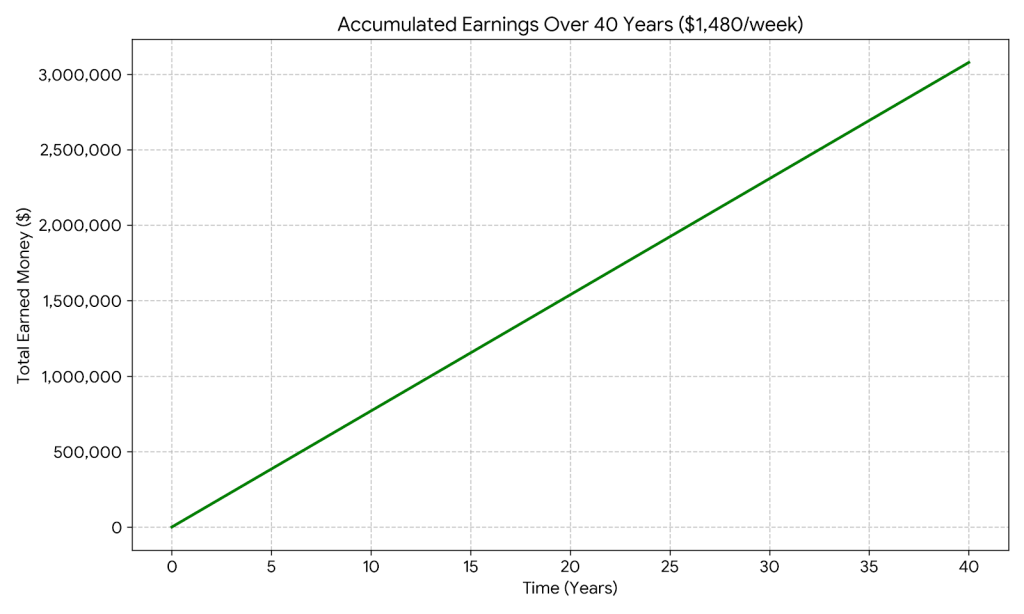
Weekly Earnings: $1,480
Annual Earnings (52 weeks): $1,480 x 52 = $76,960
Total Earnings after 40 Years: $76,960 x 40 = $3,078,400
Over $3 Million is a hefty amount. but, to be clear, this is not your net worth over time. This is not how much you would earn over 40 years at a $37/hr wage. It is how much you traded 4 decades of your life to bring in. Note that the line is straight. This is what not having a money engine looks like.
Scenario 2: Invest 10%
Now let’s add in the magic and assume that we are putting 10% of our earnings, $148 a week, into an investment that grows at 7% annually.
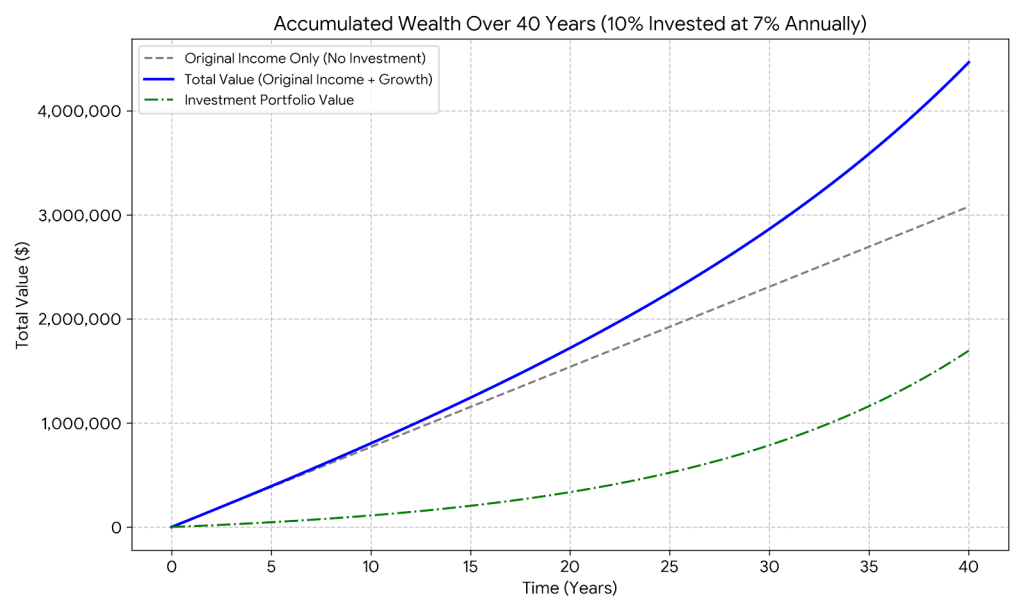
Total Income Earned: Over 40 years, your total gross income remains $3,078,400.
Cash Retained (90%): You keep $1,332 per week for regular spending or savings, which totals $2,770,560.00 over 40 years.
Principal Invested (10%): You contribute $148 per week into the investment, which amounts to a total out-of-pocket contribution of $307,840.00.
$3,078,400.00 (Income from wage) + $1,386,787.52 (Growth Earned) = $4,465,187.52
Notice that our wealth line is starting to curve up! The steeper you can make your line bend, the more growth you have. This is what a working money engine looks like!
Scenario 3: Invest 25%
Finally, let’s assume you follow the MWM Budget and are investing 25% of your take home pay.
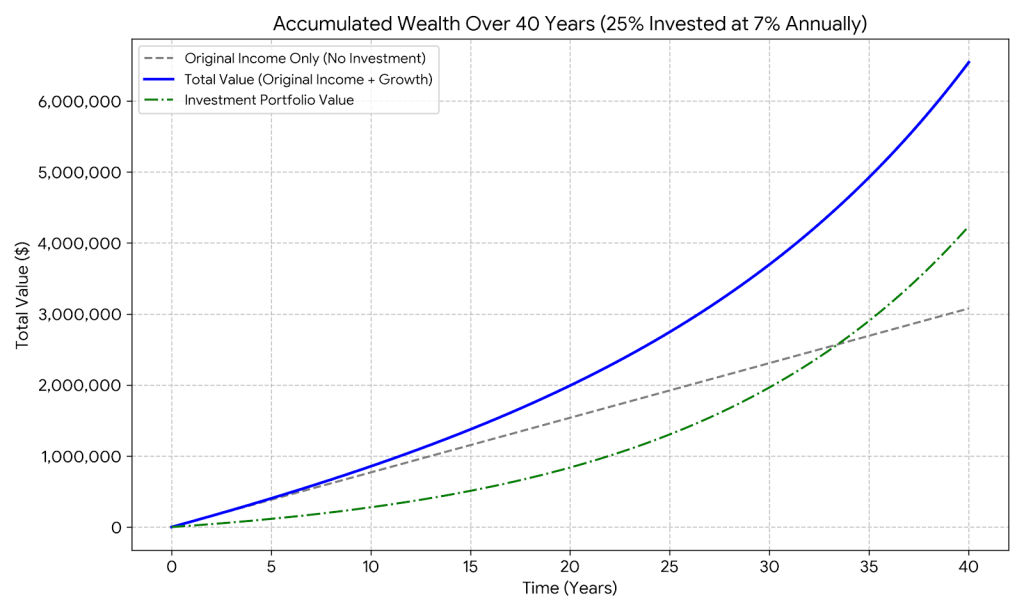
Total Income Earned: Over 40 years, your total gross income remains $3,078,400.
Cash Retained (75%): You keep $1,110 per week for regular spending/savings, which totals $2,308,800.00 over 40 years.
Principal Invested (25%): You contribute $370 per week into the investment, which amounts to an out-of-pocket contribution of $769,600.00.
Total Portfolio Value: Compounding annually at 7%, your investment portfolio grows to an impressive $4,236,568.80
$3,078,400.00 (Income from wage) + $3,466,968.80 (Growth Earned) = $6,545,368.80
Now that is a money engine firing on all cylinders! We have effectively double our earnings over our working lifetime.
One fun thing to note from this chart. Take a look at year 34. Do you see what I see? It’s the point at which the investment portfolio value overtakes the value of your lifetime earned income. This is the moment your money engine is working harder than you are and is what we love to see! If you could invest more money sooner (which would bend your curve even steeper), you could pull that timeline forward and find financial independence sooner.
Comparison Summary
Here is how the three investment rates compare after 40 years:
- 0% Invested: Total earnings of $3,078,400
- 10% Invested: Total earnings of $4,465,187.52$ (Portfolio is $1.69 Million)
- 25% Invested: Total value of $6,545,368.80$ (Portfolio is $4.24 Million)
Why Not Win?
It’s wild to me that more people are not harnessing the power of compound growth through investing. Especially people just entering the workforce. I want to run up to every young person and shake them by the shoulders. They have so much time. They have so much potential. But, sadly, most people do not understand the magic of compounding. It’s not intuitive and honestly, even as someone who’s built a money engine and now depends on it 100% to live, it’s still wild to think about. It still feels like a fairy tale.
But it’s not fantasy, it’s math. And you don’t just have take my word for it; have some fun with an investment calculator and play with your own numbers. How big can you make your money engine?
If you enjoyed this post, please subscribe to the weekly MWM email.
Protected: Thank you, Dad!
Published: 2026-06-21
If you enjoyed this post, please subscribe to the weekly MWM email.
Investing ABCs: Net Worth
Published: 2026-06-19
This is my first post in my foundational knowledge series for investing. This series is for anyone who wants to start investing, but doesn’t know the first thing about how to begin. You don’t need to read this series in order, but you should read and learn all the ABCs before venturing forth to buy investment products.
Our topic today is understanding your Net Worth, how to calculate it, and how to use it to build wealth. Figuring out your net worth is not complicated and should take you less than 15 minutes (you may need to log into some apps and grab some balances, if you want to be 100% accurate).
The Math
Net Worth = Total Assets – Total Liabilities
Start by downloading my Net Worth Tracker from my Resources page or create your own spreadsheet.
If you are building your own, make a new table and list all the assets that you own, like a primary residence, other property, vehicles, savings account balances, investment accounts, pensions, etc. In a column next to each asset, jot down its market value. Market value is what you could sell them for today. Make a Total Assets row at the bottom and sum up the value of all your assets.
In a second table, list all your liabilities, which is everything you owe. Those will be mortgages, student loans, car loans, credit card balances, store card balances, Buy Now Pay Later balances (i.e. Klarna), personal loans, pay day loans, etc. Make a Total Liabilities row at the bottom and sum up the value of all your liabilities.
Subtract you total liabilities (everything that you owe) from your total assets (everything that you have) and voila, you now know your Net Worth.
Why It Matters
Knowledge is power. Without it, you are just driving blind.
Everyone intuitively knows that to build wealth you will need to make more money than you spend. While technically correct, this is a narrow view of wealth building which locks people into a “paycheck to paycheck” mentality. People limited to this mindset are like someone driving a car while only looking 3 meters ahead of themselves the entire drive and no help from a navigation system. As your Money Wise Mom, I want you to have a longer view. I want you thinking BIG PICTURE. I want you looking down the road to clearly see where your choices are leading you.
Let’s do a thought experiment and chart your financial life line’s trajectory (a.k.a. your trend line). You don’t need to bust out another spreadsheet to follow along (unless you really want to). You can do this in your head.
Your ultimate goal is to identify your choices that have lead to your current net worth and what future choices you can make to build a better tomorrow.
Key Take Away: Your financial life line is your net worth mapped over the course of your life.
Envision your financial life as a graph line on a chart. The X axis is your age and the Y axis is your net worth. In Year 0 you were born. Fortunately, as a Canadian, you were born with a blank slate, financially speaking. Babies have no debt and, typically, no assets. We all start at coordinates “0,0” on our financial life charts.
Now picture your financial life line extending out from year 0 up to today.
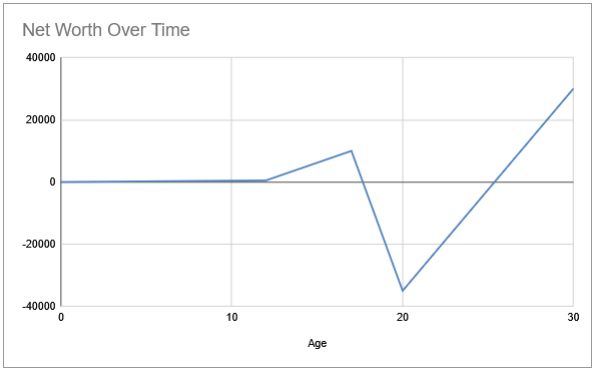
For most of us, it’s a flat line in our youth. As babies, we have parents or guardians who provide food, shelter, and the necessities of life. Some of us are privileged with parents who save money on our behalf for our education. This would nudge your line upwards. We get our first job and we start having choices. We might spend or save our income. It may nudge our line upwards a tiny wee bit, but typically everyone stays pretty close to zero during their first 16 years of life. Things start to get more exciting as we enter our late teenage years. We get to make even more choices! Some of those choices nudge our financial life lines up and others push it down. Earn a scholarship? Your line bumps up. Take on student loans? Your line dips down. Apply for your first credit card but don’t pay it off? Your line dips some more. When you get your first “real” job, the line hopefully climbs up thanks to savings from more income and, perhaps, a pension plan. Other choices will drag your line down, like financing a car or taking on other debts to support yourself as a fully baked adult.
The point is, your financial life line trends up and down, depending on the choices that you make. What direction is your financial life line heading right now? Is it on an upwards trajectory? How steep is the line? Are there choices that you’ve made that are dragging it down?
The car you buy, the partner you pick, the career you choose, where you live, and the debt you choose to take on – these are the very big life decisions that significantly impact your financial life line. If we want to build wealth, these big choices have far bigger impact than the many small spending decisions you probably focus on day to day.
Living within a balanced budget is good for you, but focusing solely on your spending habits does not build your wealth. You need goals that increase your net worth over time. You need your financial life line to trend up.
Predicting Your Future
Let’s take our thought experiment a step further. Picture your financial life line extending out from today until the day you die.
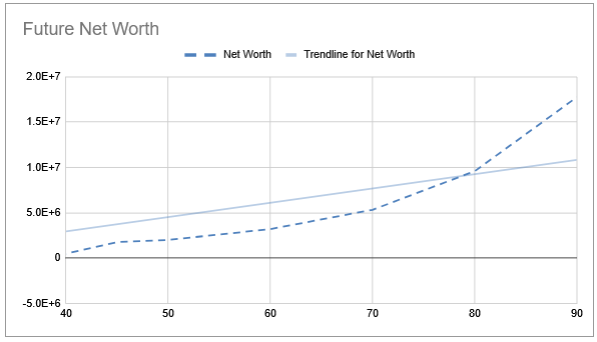
What do you want it to look like? Is the trajectory of your financial past going to lead you to a future you want? If you make no changes today, is the line trending up or down? It’s not likely to be a flat line. Life is a constant churn of change.
Predicting your own future is actually really hard. No one knows how long we have on this earth and what fun surprises are coming our way. But we can all predict that we will die, one day. Nobody gets out of here alive. You probably don’t want to work until the day you die. Let’s assume you are lucky enough to live long enough to retire one day. At what age do you want to stop working? Are you happy with the traditional 65-70 years old or do you want to retire younger? Will your financial life line rise high enough to provide a comfortable lifestyle in your sunset years? How do you know how much is enough? Do you want to leave a financial legacy for others or do you want to spend you wealth down to zero? So many big questions!
I hope this little thought experiment has helped you think about your money a bit differently than before. Your Net Worth over time is really powerful concept to understand. If you can start thinking about your net worth over years and decades, rather than just your monthly budget, you gain the wisdom to make decisions that impact your wealth. You set your future self up for success by making choices now to point your trend line up.
A Penny For Your Thoughts
Did this post make you think differently about your money over time? Does your past financial life line look like mine (flat line until about age 16)? Is there anything in my post that was unclear or confusing? Drop me a comment below!
If you enjoyed this post, please subscribe to the weekly MWM email.
Comments Enabled
Published: 2026-06-15
Thank you @cherry for your encouragement to add a comment section under posts. I’ve updated the site, completed some minimal testing, and we’re all systems go!
For anyone wishing to add a comment, you will first need to register for an account and be logged in before you may leave a note.
I look forward to hearing everyone’s thoughts and reactions to posts going forward. 🙂 If you run into issues, please feel free to email me at info@moneywisemom.ca
Cheers
If you enjoyed this post, please subscribe to the weekly MWM email.
Learning to Think Like Rich People
Published: 2026-06-12
My youngest daughter said the coolest thing last night.
“Now that I know more about money, I probably paid my student loans off too fast.”
Let me give you context. She’s just gone back to school for more training in her chosen field and is navigating the world of OSAP loans, grants, and applying for her last RESP payout. As this is her second time around, she’s already versed in the machine that is the educational financial system.
The first time she signed for OSAP loans, from the get go, she was bound and determined to bust that debt asap. And she did a fantastic job. Throughout her learning years, she budgeted carefully and made choices with her money that enabled her to pay her loans in short order after graduation. As her parents, we were really proud of her for completing her post secondary program and for being so money conscious. She set herself a goal and she totally smashed it!
Fast forward to current day. She’s gotten the rare opportunity to walk the same path again.
It was a delight to hear her insight on managing her loans. Do I think she should regret busting her debt fast? Nope, I’m still a proud Mom. Do I think she’s on to something? 100%, yes!
She’s graduated her thinking from someone who sees debt strictly as a burden to someone who understands that borrowed money has the power to work for her and elevate her net worth.
She’s thinking about opportunity cost.
She’s thinking like a rich person.
It’s Just Math
And here’s where the math comes in. Let me walk you through a scenario to show you why my daughter is exactly right.
Debt, when incurred for an investment like a home or post secondary education, let’s you have your cake and eat it too. In the case of a mortgage, you get your house now and then pay for it over time. The amount you borrowed is called the principle. The interest that you pay is the “fee” you surrender to the money lender in addition to paying back the principle.
The interest fees you pay are based on an interest rate. This is also called your mortgage rate. Hopping over to the TD mortgage rates page, the current posted mortgage rate is 4.861%, so we will use this in our scenario.
Let’s pop open a handy Mortgage Calculator hosted by Government Canada.(Links to this calculator and more are listed on the Handy Links section of my Resources page)
We’re taking out a $500k mortgage that will be paid back (aka amortized) over 25 years with a 5 year term. We’re going to save money by opting into the Accelerated Bi-weekly payment, which ensures you are paying 26 times a year rather than 24 times a year if you pay twice monthly or 12 times a year if you are paying monthly.
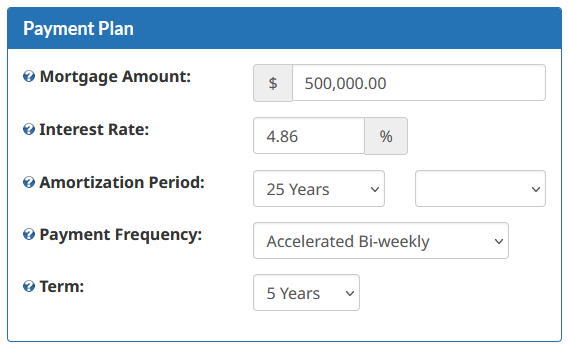
Now let’s hit calculate and see what we get.
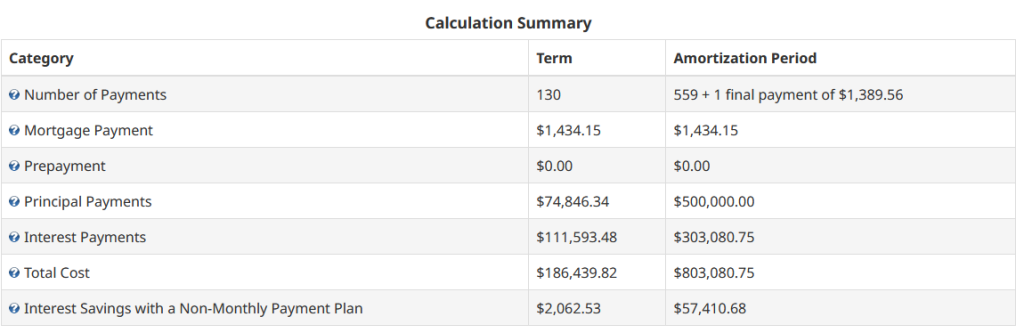
The output shows how much we will pay over the term vs the life of the loan.
If you understand what a “term” is, please skip to the next paragraph. For everyone else, here’s how to understand the term in relation to mortgages. Mortgages can take decades to pay back. A bank does not want to lock into a low mortgage rate for 25 years. A buyer does not want to lock into a high mortgage rate for 25 years. To allow both parties to renegotiate, mortgages are split up into milestones called terms. A term can be short, like 6 months, but commonly are 3 or 5 years. At the start of each term, your interest rate is known. Once the term ends, you need to make a new agreement with your loan provider for a new term to set your new interest rate and other possibly other repayment details. When your term is up, you have the option to shop around to find the best possible rate with another provider and you pay off the mortgage completely or move to another lender without penalties.
Let’s focus on the second results column, titled Amortization Period, which shows info for the entire life of the loan. For simplicity, we’re going to ignore things like down payments (we would, of course, choose to pay 20% down to avoid CMHC insurance costs). The calculator assumes that our interest rate will remain 4.86% for the entire 25 year life of the loan. This is unlikely, but it’s giving us a number to work with that’s “close enough” to make smart decisions.
So, after 25 years, we pay back our $500,000 principle. We also pay an eye watering $303,081 to the bank in interest. But here’s where we pat ourselves on the back for choosing the accelerated bi-weekly. The last row in the table confirms that by paying 26 times a years rather than 12, we’ve saved ourselves over $57,000 over the life of the loan. Nice.
Now let’s pretend the day that we sign our mortgage papers, we win the lottery (woohoo!) And guess what? It’s $500k, the exact same amount that we needed to buy our house.
Now we have choices!
We could incur some fees and pay off the loan right away.
Or we could pay off our mortgage over the current term. We would increase our bi-weekly payments to the max amount allowed (most banks let you go up to double) and make the maximum pre-payment every year, for 5 years of the term (for example, TD lets you prepay up to 15% of the loan principle per year). At the end of the 5 year term, we pay off the remaining principle. This will save us the most in interest costs and fees and get us mortgage free.

That all sounds super smart, but there is another option! We might choose to not pay our mortgage off aggressively. Instead, we keep our mortgage and invest the $500k in a self managed diversified portfolio.
Understanding what we would gain by investing that money is called the Opportunity Cost. We have the opportunity to put that money to work for us.
Let’s use this handy investment calculator provided by SmartAsset (also linked from the Handy Links section of my Resources page)
We’re going assume we put the entire $500k into an investment that earns us 7% return. I’ve chosen 7% as this is a very common and conservative investment interest rate used for long term planning. We will not add any more money to the investment and we will let it grow for 25 years (the same life of our mortgage loan).
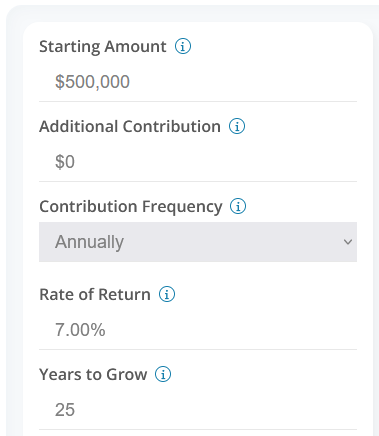
How did we do?
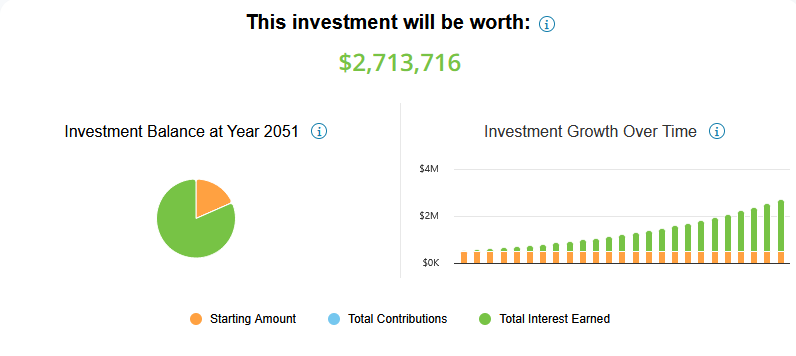
If we earn 7% and never add any more to it, after 25 years it will grow to $2,713,716. That is a tidy sum.
Now let’s compare this to our worst case mortgage scenario where we just paid the minimum mortgage amount over 25 years. The loan will cost us $803,081.
$2,713,716 – $803,081 = $1,910,635
If we choose to pay off the mortgage, instead of investing the money, we give up almost $2 million dollars!
This is the power of compound interest.
This is thinking like a rich person.
Shifting Thinking is Hard
As I mentioned already, I do not fault my daughter for paying off her student loans aggressively. Truth be told, her numbers would be a lot smaller than my example, so much less “opportunity” up for grabs. There is something to be said for the simplicity and peace of mind gained from busting your debt. These are real. Sleeping soundly every night is important.
We had similar focus early in our lives. When we received a small inheritance, we opted to pay off my student loans in full.
We wanted to be debt free, so we focused hard on budgeting and paid off the mortgage on our first home in under 10 years.
It felt good to “save” the interest fees we would have incurred on our loans. But I didn’t run the numbers. I was focused on the fees we would save and I didn’t consider the opportunity cost we were giving up to be debt free.
And that’s all okay. By busting our debt, we were still winning at life. Sure we didn’t make the most optimally perfect decision. Instead we were excited to save towards a common goal and see our mortgage balance fall away. Paying off debt was rewarding and it expanded our capacity to take on different opportunities later in life.
Since then, however, we’ve become a little more savvy.
At one point, we financed a car when the car company offered a 0% interest loan. We had the money to pay in full but we wanted to let the money grow over the term of the loan, because the loan was “free” money.
Currently, we’re choosing to slow roll a mortgage. The loan rate is a low 2.89% and our investments returns are around 11%. I don’t need an online calculator to know it’s a no brainier to keep our money invested.
This, of course, only works if you invest the money you would have spent. If you spend it, you dig yourself into a debt hole which is an awful place to be! You want to be wise with your money to win the money game.
But even knowing the math, it’s not easy to stay the course. I still carry a deep instinct to be debt free. When that feeling starts to creep in, I just remind myself to think like a rich person.
If you enjoyed this post, please subscribe to the weekly MWM email.
You Can Manage Your Own Investments
Published: 2026-06-05
My husband and I just topped up our TFSAs with our annual contribution and the “work” to complete the task took us less than 5 minutes. The process was literally “click, click, done”! Frankly, it’s so easy that it’s a little bit scary.
If you can shop online, you have the skills to buy and sell your own investments. Buying ETFs online is pretty much just loading up an online shopping cart. It’s not difficult and there are no fee options the make it basically free (minus MER, but we’ll save that topic for a deep dive post!). Managing your own portfolio is empowering and rewarding and it can boost your net worth by significant amounts. So why doesn’t everyone do it? Because lacking foundational knowledge is scary and uncomfortable. If you don’t know all the rules of the financial game, you can be frozen into inaction.
It’s fine for me to say how easy it is, now that I’ve done it for decades! I remember setting up my fist brokerage account and making my first purchase of ETFs though TD Waterhouse and it certainly didn’t feel easy, at the time. It felt terrifying! Hitting the “buy” button with my families life savings on the line made me sick to my stomach. I just didn’t want to mess it up.
Spoiler alert, I didn’t mess up my families finances. I actually did very well because I had done my homework by reading books and blogs to guide me through the process.
Taking your first step into the work of investments can feel like standing in a pitch dark room. You might be frozen with fear. As your eyes adjust to the darkness and your hands cautiously feel for the familiar, you eventually get a sense of the room around you, one small piece at a time, until it’s not scary anymore.
Allow me to turn on the lights for you. Over the next several weeks, I will do a deep dive on each of these topics to help you understand
Here’s a basic framework of what you need to know to manage your own investments.
Foundational knowledge you should understand about investing:
- What is your Net Worth and how to track it
- How investments grow through compound interest and dividends
- The types of investment accounts that exist and when to use specific ones to be more efficient with your taxes (TFSA, RRSP, FHSA, RESP, Non Registered, LIRA)
- Understanding the upfront and hidden fees, like MER, and how they can impact your net worth over time
- The types of investment products you can buy inside your investment account like stocks, bonds, ETFS, and index funds
- Recommended investment products for passive investments (diversified with low MER fees)
- Common “Rules of thumb” like the 4% rule, the 25 times rule, the relationship between stocks and bonds, and the Money Wise Mom’s philosophy to “keep it boring”.
Systems you need to be prepared before you start investing:
- An account at a no fee brokerage like Wealthsimple to create investment accounts in which you will buy and sell investment products.
- A plan on how you will rebalance your portfolio
Also highly recommended:
- A tracker spreadsheet to record your contributions to registered accounts (TFSA, FHSA, RRSP) so that you do not accidentally over contribute
- Defined long term goals so you know what you are saving for (retirement, a house, or a kids educations)
- Projections for when you will be debt free or how much your net worth will grow.
- A plan to spend the money. You can’t take it with you. You can leave for others, but I’m assuming you want your money to cover your living expenses when you retire.
So yeah, the buying of products is simple. It’s as easy as click click done. Building up your foundational knowledge so that you have the CONFIDENCE to know that you’re not making mistakes is the hard part. But you can do it. And it’s worth doing. Your future self will thank you.