
Life of Pie: Transportation
Published: 2026-04-03
This is post #2 in my Life of Pie Series. Ideally you have already read my previous posts Building Your Financial House, which gives you a high level picture of healthy finances, and then I’m Ready Now What?, which gets you prepped for the posts in this series. If you haven’t read both of those, I recommend that you jump back to them now before proceeding.
Canadians love their vehicles. According to Stats Canada, in 2023 89% of households owned one or more cars. We convince ourselves that we cannot live without a personal vehicle; Some households insist that two cars are an essential minimum for a family and some households even have more vehicles than drivers.
I find this a bit baffling. Cars are an expensive depreciating asset. They get me from A to B. I do not find cars exciting or attractive. They are machines with ongoing fuel, maintenance, and insurance costs. Left to my own devices, I would not own a car. I intentionally choose to live in places where I can walk to most daily necessities and there is access to transit. I would rent as required for longer trips. However, two things tip the scales in favour of owning a car: 1) We’ve gone electric. It’s still not easy to rent electric cars. 2) My husband wants the convenience of a vehicle on hand. And I do really love the guy, so I guess I’m easily convinced!
And also, we can afford it. Which brings me to our second slice of pie!
Transportation: Your max monthly spending target is 15%
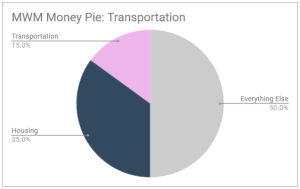
Within this category, whether you own a vehicle or use other transportation methods, be sure to capture all costs:
- Loan or Lease Payments
- Auto Insurance
- Fuel Costs (Gas or EV Charging)
- Train/Bus/Ride Service Fees
- Parking/Tolls
- Maintenance: Repair/Service Fees (everything from oil changes to car washes)
You will note that items 1 & 2 on my list are generally a fixed cost. Your car payments and insurance tend to be more consistent and predictable. For everything else, you need to choose a budget amount that is realistic, not optimistic. Give yourself room to spend on a budget category, even if you likely don’t need to. For example, we avoid tolls and rarely need to pay for parking. We still budget a small amount every month just in case we need it. It’s a much nicer feeling seeing a budget category under-spent than going into the red because you didn’t plan for costs that rarely come up. And this strategy sets us up nicely for a slush fund (a.k.a. sinking fund), a powerful safety net strategy which I’ll dive into with a future post.
For items 3-5, you can total costs over the last 3 or 6 months and use a reasonable average. Use your best judgement.
For #6: Maintenance, this is a bit trickier as it’s the most unpredictable. Your maintenance bills will increase as your car ages. Even with a newer vehicle under warranty there are licence fees, tire changes, filter replacements, uncovered repairs, and other costs that add up. The goal with this budget item is to be pro-active and not reactive. If you own a vehicle, you need to maintain it. Pick an amount that is higher than you need and will allow you to pool some money over time. For example, if you budget $200 a month, that’s $2400 you can spread over the year and can help cover any surprise maintenance bills. Each month any unspent money gets routed to your slush fund to be used if and when you need to go over budget.
Now let’s write down your numbers. Grab your numbers from your MWM Homework Day 0 prep work, along with your estimates, and update your copy of the MWM Budget Tracker in the Expenses table of the Spending worksheet.
Let’s check how you compare to the MWM model budget. Are you under the 15% target?
My transportation costs are low – If this is you, I’m happy for you! Maybe you don’t plan to buy a car, which will likely save you a lot of money over time. Or maybe you need a car in the coming years, in which case you could save almost 15% of your net income into a high interest savings account and this will be your “future car” money.
I am on target – Is your percentage at or near 15%? Congratulations, you are on target! If your percentage is less than target, you have more money to direct to other pieces of your money pie.
I am over target :/ – Is your percentage over 15%? Is there an obvious line item that’s draining your budget? Do you own more cars than you need? Should you sell or downsize? Are you leasing or financing a car more expensive than you can truly afford? What changes will you make to bring your transportation costs in line? It’s so easy to over commit your income to transportation when you own one or more vehicles. Car companies always want you to buy new and buy often and we live in a car culture where owning a car is the norm. But this is the one category I really don’t want to see you overspend in! Remember, your pie is finite. A big transportation slice squeezes other slices down. It might feel tough or even impossible, but I believe in you. Think outside the box. You have the power to make changes to set yourself up for a fantastic and balanced life!