
Investing ABC’s: Active vs Passive Investing
Published: 2026-10-09
It May Not Mean What You Think It Means
A few nights ago we had family over for dinner. It was really nice catching up. We chatted for quite a while and, eventually, over our post dinner coffees, the conversation turned to investing. It took a few beats for me to realize that, although we were all talking about investing, we were not all talking about the same thing.
There are two very different philosophies in the investing world. Active Investing and Passive Investing.
The disconnect in our dinner conversation is the inspiration for today’s post. To be clear, the investing approach I follow is passive, which is an entirely different beast than active investing.
Understanding Active vs Passive Investing
When most people hear the word investing, they picture some version of active investing. Active investing is picking stocks that are winners, tracking the latest news for hot tips, and, these days, probably buying and selling some crypto. When I hear people talk this way, I envision horse racing. Picking a winning stock is like picking a winning horse. The thrill of watching your stock portfolio rocket to the moon is not dissimilar to watching your horse cross the finish line in first place.
Passive investing is none of those things. Passive investing takes a long term, moderate view that it’s better to build wealth over time in a (somewhat) predictable way. If you are doing it right, it’s actually pretty boring!
Here are some hallmarks of Passive Investing
- Dollar cost averaging – This is the practice of investing the same amount of money regularly, regardless of how markets are behaving. For example, investing $200 every month no matter what. If markets are down, you get to buy products while they are on sale (yay!). If markets are up, you end up buying a little less, but at least you are still growing your nest egg. The important concept is that buying every month averages out in your favour over time.
- Investing in entire markets – Why pick one or two stocks when you can easily invest in 100s of the top performing companies in a market? This is the power of index funds. An index fund tracks the best performers in a group, for example the group of companies with stocks on the exchange. An index fund might track the top 100 companies with stocks on the Toronto Stock Exchange (TSX). If one company’s stock value falls to spot 101, another company automatically graduates to spot 100. As an investor, you pick your index fund(s) and just keep investing in that fund, which automatically means your investing in the best 100 of the TSX. You don’t buy and sell specific company stocks. You don’t have to spend ANY mental bandwidth guessing which companies are winners and losers or worrying that you’ve held a looser for too long.
- Holding a mix of Stocks/Equity and Bonds – one of our rules of thumb is that when stocks go up, typically bonds are worth less. And when stocks go down, bonds are typically worth more. Stock values can vary a lot, bond values tend to vary a little over time. For this reason, to protect us from big swings in the stock market bouncing up and down, we invest in both stocks and bonds. A popular ratio is investing in 60% stock and 40% bonds. This is common practice considered to be pretty moderate to low risk. Of course, as an investor you can choose to hold more stocks (i.e. 70% stocks, 30% bonds) if you are fine exposing yourself more to stock market swings.
- Investing across markets in Canada, US, and International – We don’t want to tie ourselves to just one market in just one economy. There could be a recession in Canada, but the States might be booming. For this reason, we want to choose index funds with a healthy mix of financial markets from around the globe. With this strategy we get the best of what’s happening in Canada, the US, Asia, etc.
- Low Cost Investing – we want to protect our gains and we don’t want to lose more than we have to in upfront or hidden fees. The best ways to keep fees low is to manage your own investments via a no fee brokerage (like Wealthsimple) and to buy investment products with a low MER. You can read my post MER the Silent Wealth Killer if you would like a deeper dive into why.
When you are just learning, passive investing sounds like a lot. There are so many terms and concepts. But here are the stripped down basics to understand:
- Buy Low Cost (ETFs with MER below 0.2%)
- Buy On a Schedule (Invest Monthly)
- Invest in Markets, not individual Companies (Index Funds)
- Diversify (Stocks & Bonds, Domestic and International)
The Really Good News
The really good news is that some very smart people have created model portfolios that ticks all four of the passive investing boxes above! And, thanks to some other very smart people, you can achieve it all by buying one investment product. Yes, one product you can just keep buying and never have to think about it.
I’m referring to the Canadian Couch Potato model portfolio.
I have been following the Canadian Couch Potato (CCP) model portfolios for over twenty years. It has evolved over time as newer and better products have been created.
In the good old days, my portfolio was a mix of three products: ZAG, VCN, and XAW.
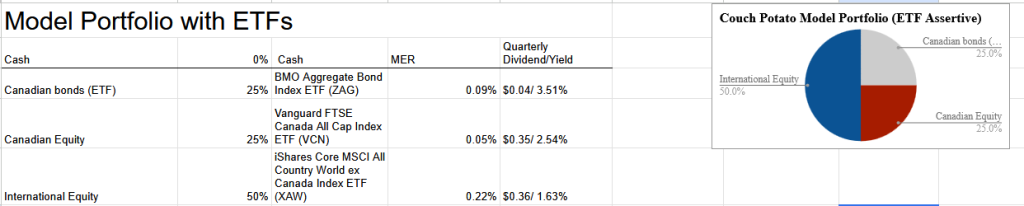
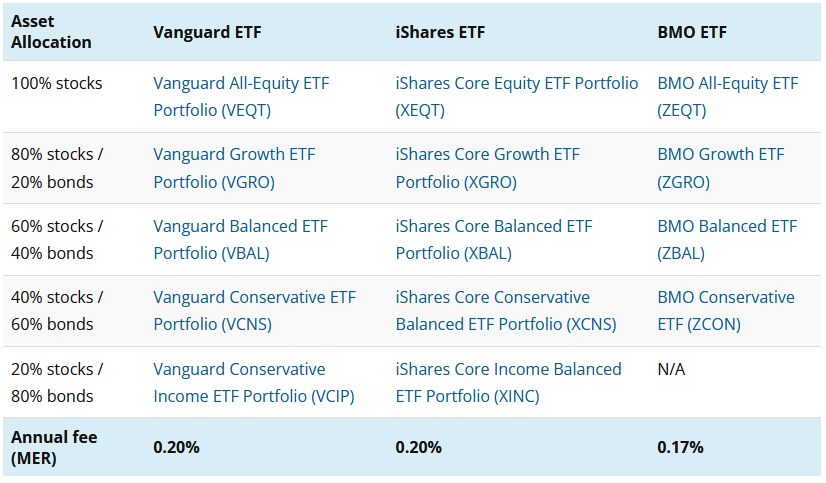
Nowadays, we can achieve the same diversification by picking one product, like VBAL, XBAL, or ZBAL. These funds are all pretty much the same thing. The “BAL” stands for “balanced”. The V, X, or Z is just indicating if you are buying your investment from Vanguard, iShares, or BMO.
If you check out the performance of these funds against each other, you will see they all perform essentially the same. That’s because they are all selling you the same groups (aka indexes) of products.
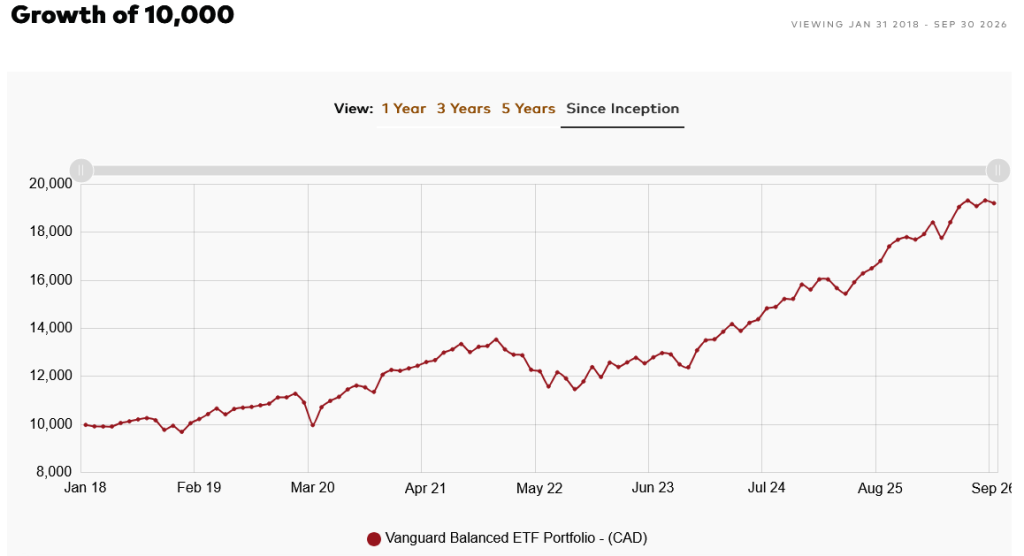
As you can see from the nice CCP chart below, the “BAL” holds 60% stocks and 40% bonds. If you want a slightly more spicy portfolio, you might pick VGRO instead of VBAL, which gives you 80% stocks and 20% bonds.
Since passive investing is “so easy”, you might expect that you are giving up growth in exchange for simplicity. You might assume that active investing is worth all the hassle, cuz that’s how you get rich, right?
Not according to what these guys, or these guys, or these guys have found.
It’s consistently reported that professional money managers have not been able to consistently out perform basic index funds that simply track the stock market automatically.
So why do so many people still bother with active investing? I can only imagine that it’s a big case of FOMO or a big case of not knowing a better way.
Compare and Contrast
Let’s illustrate my point with two fictional investors. Mia is an active investor. Chloe is a passive investor.
At 8:59 a.m., Mia opens her laptop and launches six websites. The stock market opens in one minute. She has three tabs for charts, two for breaking news, and one for “Is This CEO’s Tweet Bad?”
Meanwhile, Chloe opens her fridge to forage for breakfast.
At 9:13, Mia’s stocks in company XYZ dips by 3.2%. The line on her stock tracking chart keeps trending down, down, down. It’s dipped so much, company XYZ’s poor performance is now featured on the ticker feed of her favourite breaking news site. She starts to sweat. She refreshes her browser, muttering “I knew that earnings call had weird vibes.” She rushes to sell the stock before she looses any more money… only to see the stock price bounce back up, for no discernible reason. Grrr.
Chloe pours herself a coffee and scrolls her Insta feed.
By lunch, Mia has read twelve predictions, made nine trades, and developed a personal feud with a candlestick chart. “This market is irrational,” she says, while trying to predict what millions of other people would do next. Mia cranks her neck, which is feeling oddly tight.
Chloe’s investment plan is to own a diversified fund, add money regularly, and avoid checking it every hour. It happens to be the 15th of the month, Chloe’s money management day, so she checks her portfolio once on her lunch break. Yup, still looks about the same. Her automatic transfers and investment purchases are still working. She sees transfers in the day after her pay day and autonomic purchases the following day; several months of activity, all just as planned. Chloe goes outside for a walk in the sun.
At 3:57, Mia’s portfolio has moved up, down, sideways, and emotionally through all five stages of grief. She celebrated a winning trade, then discovered the fees. All in all, she figures she’s down about $2.75 from this morning.
Chloe has no idea how her portfolio did today. She’s heading out to catch up with an old friend for a drink.
At the end of the day, Mia announced, “I’m taking a break from investing.” Six minutes later, she pulls out her phone to check how the market is doing after hours.
Active investing can involve more research, trading, and stress; passive investing generally aims to track a broad market with fewer decisions. Neither guarantees a profit but, over time, Chloe should have a nice little nest egg that didn’t cause her to loose sleep at night.
—
This Investing ABCs series is for anyone who wants to start investing but doesn’t know the first thing about how to begin. You don’t need to read this series in order, but you should read and learn all the ABCs before venturing forth to buy investment products.
Thanks for reading!