
Life of Pie: Life
Published: 2026-05-10
This is post #5 in my Life of Pie series. If you’ve new here, I recommend that you read two posts before jumping into this series. Building Your Financial House gives you a high level picture of healthy finances, and I’m Ready Now What? includes actions to prep you for the posts in this series. I recommend that you jump back to those posts once you’re ready to begin making positive changes in your life!
Here are my previous posts in this series:
We’ve come to our fifth and final slice of pie, which I call Life. The Life slice is everything not already accounted for in your spending plan. It includes food, alcohol, holiday spending, gifts, clothing, subscriptions, vacations, and everything else you spend money on.
If you’ve been keeping track of your portion sizes, you will already know that your Life slice target size is 25% of your total income. If you haven’t already, you should now update your spending plan and add a Life category. If you are using the MWM Budget Tracker the beginner and normal modes are there by default.
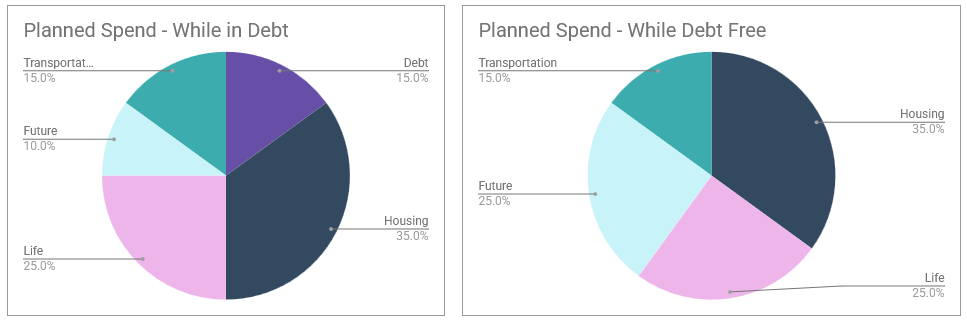
As I’ve mentioned before, your spending plan may not completely match our Money Wise Mom targets. However, here are some guidelines to help give you some perspective.
- Under 25% – It’s unlikely that you spend less than 25% on Life unless you’re doing it intentionally. We all need to live and we all like our creature comforts. We exist in a consumerist world and from the moment we open our eyes and check our phones to when our head hits the pillow at night, we are inundated with ads and nudges designed to make us spend, spend, spend!
To be clear, spending your money on Life is a good thing. Everyone needs balance and this category has the power to bring you joy beyond the bare necessities. Spending under 25% is an indicator that you are restricting your budget.
If you are in debt and motivated to bust it fast, you might restrict your life spending voluntarily for a set period of time. It’s okay to grind it out, as long as you have a clear debt repayment plan with a defined timeline. Typically I recommend creating a debt payment plan you can achieve in three years or less. If you want to grind, I feel that more than 12 months of restricted spending becomes unsustainable.
There is one other situation that warrants intentionally reducing your Life spending. If you find yourself in a financial emergency, like losing your primary income, the Life category is the one with the most fat to trim. If you’re between jobs, you might shift from a normal spending plan to an emergency spending plan, which is designed to stretch your emergency fund for as long as possible. Cutting out gifts, holiday spending, vacations, and other optional things will give you more time to find another source of income. - Over 25% – Overspending on Life may indicate that you are doing really well or that the roof of your financial house is on fire. We have to look to the other slices of your pie to get the full picture. If your housing and/or transportation spending is low and you have no debt, those slices will be reduced and you might redirect those dollars into Life. You should also have a healthy grasp on your Future slice and be saving and investing wisely. Do not screw over your future self so that you can eat out every day. Remember, you are looking for balance.
Alternatively, if you spend over 25% on Life and you have debt or your Future slice is missing, your financial house is on fire! It’s time for action. You need to get your budget in order and you must change your spending habits. Failing to do this means you cannot not have a happy, balanced, financial life.
To Track or Not To Track
You probably will not be surprised when I tell you that I am a tracker. I like spreadsheets and goals and projections. Since I was a teenager I’ve tracked my spending. If you are like me, you will want an app or a spreadsheet and you will enjoy taking the time categorize where all your money goes every month.
However, maybe you are not like me. Perhaps tracking your spending is a habit that just doesn’t work for you. If that’s the case, I recommend you simplify your spending system.
For me and my husband, we buy all our life stuff on a credit card that gives us 2% cash back. We always pay our monthly balance in full. We do not pay credit card interest.
Note: If you are beginner level, this method is not for you. Even I, who’s been tracking money closely for over 30 years, can get surprised at how big the credit card bill is when it arrives.
We host our own budget tracking software called Actual Budget (we’ve used simple spreadsheets and other apps in the past) which is not perfect but it allows us to categorize every transaction and all the data is stored locally. We pay a small annual fee for a third party service called SimpleFIN which acts as a bridge between our budget software and our credit and bank accounts. SimpleFIN allows us to import every transaction into Actual Budget on demand. We don’t need to use SimpleFIN, as we could manually import all our transactions, however, theoretically, it’s saving us time and hassle. Honestly though, how much time and hassle saved is debatable – all our financial accounts have multi factor authentication enabled which SimpleFIN cannot bypass which IS a hassle and takes time.
Anyways, if you are not into tracking every transaction there is an incredibly simple and fool proof method to ensure you do not overspend. Some people call it the jar method and some people call it the envelope method.
The Jar Method
When we were in our debt busting years, we followed the Jar Method. It’s a simple system where you live on cash. It is impossible to overspend if you follow this method correctly. The basic approach is this
- When you get paid, you withdraw the 25% that you are planning to spend on Life
- Put the money in a jar on top of your fridge
- Spend this money for life stuff
- If you spend all the money, you have to wait until next month!
- If you have money left over, you can leave it to accumulate and spend it in the future
You only need one jar but I recommend that you have a few to balance your spending. Our big categories are Vacations, Food, Clothing, Gifts, Christmas, Roller Derby, Entertainment (his and hers), and Misc Spending. We do not take a vacation every month, however we allocate money to this category every month until it’s pooled up enough to use.
If you want to go above and beyond, place receipts spent into the jar. Then once a month, before you replenish the cash, take out all your receipts and jot down in your budget tracker where the money went. This is a simple step if you want to start tracking your spending. You may also be amazed at how quickly you forget what you bought over the past four weeks!
If you are not a fan of living on cash, you could simulate the jar method by moving 25% of your pay to a separate bank account and spend it from there. Some institutions allow you to have multiple accounts or allow you to “earmark” money into categories inside one savings account. The key is that you move only the 25% amount that you plan to spend down over the next 30 days.
How Rich Do You Feel?
How you feel about your money is a shifty thing. Feeling like you don’t have enough money sucks. The Life slice can get pretty emotional. The key is to be intentional with your spending. Want to know a trick that’s served us well over the years? Any time we adjust our Life budget, we ask ourselves “What would make us feel rich?”. Once upon a time, we had debt to pay off and low income and therefore, no room for alcohol in our budget. Eventually we busted our debt and earned more. We then got to sit down together and decide where to up our spending. Yeehaw! Going from nothing to something felt luxurious!
We also periodically trim back on spending that we no longer care about. At some point, we agreed that eating out didn’t really bring us joy. So we ditched planning to spend on that but planned a good sized food budget so that we could eat out once in a blue moon but make yummy meals at home together, which we loved.
Your spending habits and priorities will change over time. Your spending plan should be updated as well to put more money towards things that bring you joy and limit or remove spending that you no longer care about.