
Oh the places you will go
Published: 2026-09-18
We travelled a lot this year. So far, I’ve taken eleven trips. These have all been within the province and the budget for each has varied. I have one more local trip I’m taking this weekend and then we will end our year with la pièce de résistance: a trip to Sweden where we will watch the WFTDA roller derby championships!
As I am writing this, thirteen trips sounds extreme to me. It’s certainly the most I’ve ever travelled in one year for personal entertainment. I suspect we will calm down our travel plans next year, but who knows! This year we focused on doing a lot of roller derby activities which kept us busy most weekends over the summer season.
How to Think About Vacations
Vacations shouldn’t take you by surprise and you shouldn’t take on debt for travel. You are in charge of deciding how many trips you take, where you go, and how much you will spend.
Here is how we approach vacation spending.
- We allocate vacation spending in our monthly budget This has been our system for the past 30 years. In our traditional earning years, we would move a budgeted amount, for example $200 a month, to a separate account that I lovingly referred to as our “slush fund”. Now a days, we work a little differently, but for most people, I highly recommend a separate spot to stash earmarked cash. Our slush-fund account held house money intended to pool over time for large expenses like vacations, annual insurance bills, and Christmas. How much we had sitting in each “pot” of our slush fund was tracked within our budget. This system gave us predictability, stability, and an upper limit to what we could spend.
Predictability: We transferred money every month, without fail from our joint daily spending account to our slush fund account. It was a “bill” that we paid ourselves. If we didn’t spend it all in one year, it would roll into the next year to give us a bit more spending power, if we wanted it. Our system kept our money management simple and boring (which is the goal!).
Stability: Our monthly transfer meant a slow and steady drip of money into our pool. The monthly amount was decided once a year, during a money talk. We reviewed our income and expenses and set out all our planned spending for the upcoming year. The amount we allocated to vacation was based on what our household could afford monthly and it fit within on our total life expenses of 25% net income.
A Ceiling: Our system made it very easy to know when we could afford a trip, if ever. Instead of making life “exciting” and just deciding we deserved a vacation as we felt like it, our system insulated us from making choices based on FOMO. We did not “stretch ourselves” and there was no “we will figure it out later” mental gymnastics. We had the money that we had and it would only go so far. If we could afford $200 a month for vacations, the math was simple, that’s a max of $2400 a year for vacation spending. - We set special budgets for special occasions At a monthly money talk last last year, well before the travel season was upon us, we decided together that we wanted to dedicate more to travel this year. It was our first year together as retired and we wanted to spend more time focusing on roller derby events. So we looked at what we felt we could afford and allocated two extra pots of money. These are considered one time “special spending” budgets. The money was from surplus cash, rather than our monthly budgeted vacation amount.
Pot 1:France TripLocal Derby Travel
I wanted to attend MRDA championships in France. It ticked the box in which we like to double up derby destination travel with fun experiences and going to France is on my bucket list. So, I pencilled a special budget line item for a trip. However, as we approached the travel season and during one of our monthly money talks, my husband had a counter proposal: rather then blow so much money on one trip, we should spread our budget over a lot more short and local trips, giving us a heck of a lot more derby experiences. I came around to the plan and I figure we are simply deferring a France trip to a future adventure.
Pot 2: Sweden Trip
This will be a ten day trip that we are both looking forward to! We are gong to the 2026 WFTDA Roller Derby Championships and padding a few extra days for sightseeing. Would I have thought to go to Sweden otherwise? Probably not, but that’s the fun of bundling travel with derby. We see corners of the world we would not otherwise have visited. I had assumed that because we no longer had day jobs, it would be “easy” to spend several weeks overseas. But two things worked against us: 1) vacationing is not cheap! For a multi week trip, I think I would need to be more creative to try and live like a local rather than a tourist 2) somehow we are still really busy! We have life stuff happening at home which didn’t lend itself for us taking a longer trip.
The Best Vacation is One You’ve Already Paid For
I like planning stuff and we both really like tracking stuff.
- Set your budget ceiling. Either from your pooled vacation money or from a special pot of “extra” funds that you already have on hand.
- Build your budget! Planning the trip is (for me) the super fun part. I build a spreadsheet that lays out your itinerary, when you depart and return, which calculates your total days of travel.
I always include a few standard categories:
EV Charging (if driving) or Flights – based on how many times we figure we will need to supercharge our car or a google flight search
Accommodations – I use a guesstimate rate for accommodations, based on a somewhat educated guess as to where we are going, and times it by the total days. In the example below, I assumed $100 per day for hotel or an airbnb.
Food & Drink – Similar to accommodations, I assume a daily rate of $75
Events & Attractions – For a short / targeted trip, you might only have one event you are attending. You can either build your budget around that (i.e. the cost of a pair of tickets to the event) or, if it’s a trip where we want to sight see, I’ll just set a daily rate of $50-$100 (best guess) to have something to stay within.
Land Travel – Typically required for sightseeing trips. This might be a rental car, local transit, or ride services.
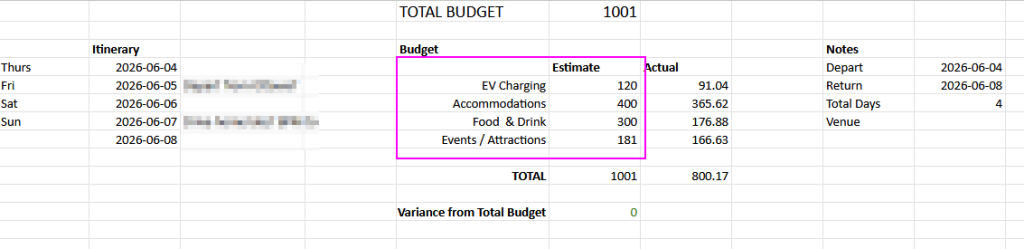

3. Decide if you can afford it. This is a big one and you must not skip it. At this point, we have not yet committed to taking the trip. Will the projected budget for the trip fit within our budget? For example, maybe flights are really expensive. If you are working from special budget of extra money, maybe you can allocate some of your vacation to cover the gap. Otherwise, the trip is probably a no go. And that’s okay! It’s far better to realize if you can afford a trip before you start booking stuff, rather than dealing with a debt hangover afterwards!
4. Book Stuff! Once you know you can afford it, you have the green light to book stuff! I like to copy past links and screen shots of my flight and accommodation booking into my spreadsheet so everything is in one place. As you pay for stuff, track your actual spending. Being over budget in one category is not a big deal, as long as it fits your total trip budget.
5. Let the count down begin! Now that everything is booked, you get to sit back and anticipate how much fun your next adventure will be!
6. Enjoy your fully funded guilt free trip! There is nothing as good as guilt free travel. Having everything paid for ahead of time means you will enjoy being in the moment, without a foreboding feeling of a looming debt hangover.
7. Post trip stuff – As I mentioned, we like to track stuff. So we do keep track of our travel spending. After a trip, we ensure the money we spent during travel is tracked in the Actual column of our budget sheet, so that we can keep ourselves accountable. Tracking our spending also helps us with our guesstimates for planning future trips.
Rinse and Repeat
And that’s how we plan all our trips! It’s a simple system and it’s easy to replicate. It also keeps us within a spending limit. And sometimes, it helps us feel good about turning down opportunities. Even with so much travel this year, I did turn down three other travel opportunities, solely because it wasn’t in our plan and I couldn’t afford it. And that’s totally okay! We all have limited funds and we all have the power to choose what we do with them.