
Investing ABCs: Rules of Thumb – The 4% Rule
Published: 2026-10-02
This Investing ABCs series is for anyone who wants to start investing, but doesn’t know the first thing about how to begin. You don’t need to read this series in order, but you should read and learn all the ABCs before venturing forth to buy investment products. In this post, I’ll explore one of the best-known retirement-planning guidelines: The 4% Rule.
There are certain “rules of thumb” that circulate the personal finance world. It’s worth understanding what all the buzz is about. Rules of thumb can lead to smart strategies that will help you set intelligent money goals.
Let’s start with a fun one: How do you know how much money you need to retire?
The 4% Rule
The 4% Rule refers to a retirement-planning strategy popularized by financial planner William Bengen in the 1990s. Bengen recognized that he and his colleagues were skilled at investing money for their clients but terrible at advising people how much of a nest egg was “enough” to comfortably retire.
No one, not even the experts, could accurately predict how much was enough!
Attempting to solve the great mystery, Bengen built a financial model based on actual historical financial market data, testing a portfolio made up of 50% stocks and 50% bonds, to map out how portfolios would have performed during the worst economic periods in history. The goal was to find the best portfolio (or ratio of stocks and bonds) and identify a “safe withdrawal rate”, meaning retirement withdrawals that would survive even the most severe market crashes, such as the Great Depression.
Bengen found that if you withdraw 4% of your total portfolio value in the first year of retirement and increasing the withdrawal amount for inflation every year thereafter, your money has a high probability of lasting for (at least) three decades. I include the “at least” because, for practical reasons, he only modelled 30 years of retirement.
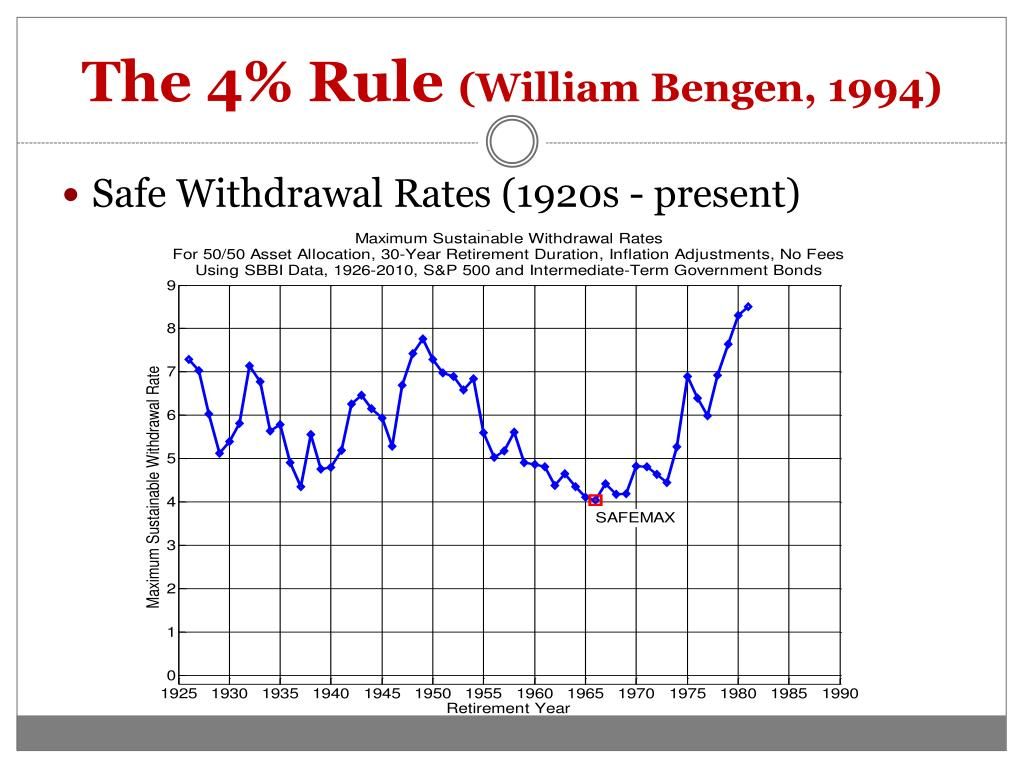
Here is how Bengen’s model worked for withdrawals. You don’t just withdraw 4% every year, because you need to handle the rising cost of living (a.k.a. inflation)
Let’s say you have a cool million sitting in your portfolio. Here’s how withdrawals would work:
- Portfolio: $1,000,000
- First-year withdrawal: $40,000 (4% of $1000000)
- If inflation is 3%, second-year withdrawal: $41,200 ($40,000 * 1.03)
- If inflation is 2.5%, third-year withdrawal: $42,230 ($41,200 * 1.025)
- etc., etc.
If you are into early retirement like me, you gotta appreciate Bengen’s work. He planned for the worst so that we could all aim for the best possible retirement. He wanted to protect people from both under and over saving. After all, you can’t take your money with you, so why work longer than required?
Modern Reboot
Bengen’s research has evolved since the 90s. He’s updated his model and now says his model was likely too conservative.
Higher Equity Lean: Bengen now believes that a stock allocation between 50% upwards to 75% is preferable. Within this range, his historical test portfolio performed well and using a higher ratio of stocks vs bonds. He now suggests aiming closer to 75% to minimize the probability of running out of money, warming that a portfolio with a high ratio of bonds increases the risk of failure, as bonds are low-return assets that just might not provide enough growth to keep up with withdrawal demands.
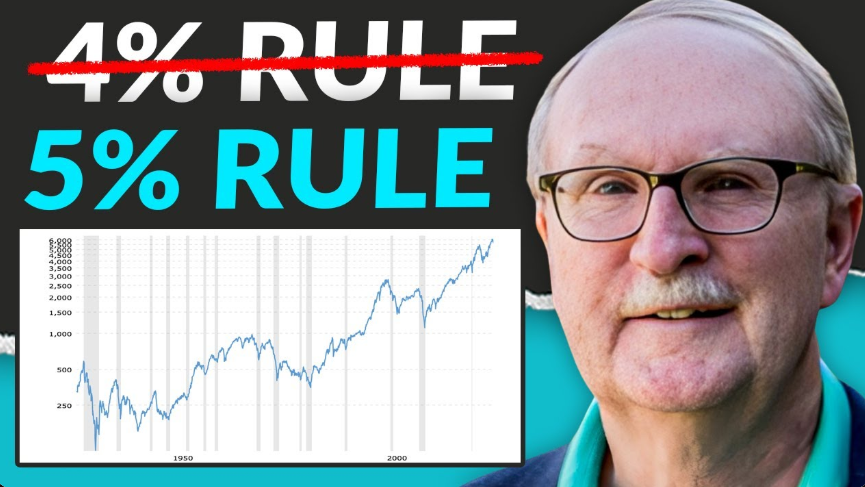
Diversification Beyond Stocks and Bonds: Bengen has increased the “sage withdrawal rate” from 4% to 4.7% (even suggesting that 5% could be feasible) assuming a portfolio includes more investment products, beyond just stocks and bonds. In his updated portfolio, he includes more asset classes such as small-cap stocks, micro-cap stocks, international stocks, and treasury bills.
Only Fools Rush In
You cannot expect to blindly follow the 4% rule.
Historical market performance is not a guarantee of future results. No one has a crystal ball and we live in some pretty wild times.
The list of risks to maintaining a portfolio over your lifetime is not small. You might be blessed with a very very long life and outlive your money. Your expenses might balloon in old age due to health care costs. You might retire just as inflation goes sky high and markets tank, killing your portfolio’s lasting power (a risk called sequence-of-returns risk).
Do you recall what happened to markets when the COVID pandemic hit the world? For context, we saw our portfolio drop around 30%. Thankfully retirement was still a few years off.
It’s a guideline, not a guarantee. Do not expect that upon retirement you will set up auto withdrawals and then close your browser, never to check your investment balance again. You cannot blindly trust that everything will just work out. You will still need to continue to make wise choices. For example, if markets are down, you might course correct with “dynamic spending”, which means dialing down your discretionary spending temporarily. For example, you might defer a major purchase like a car or hold off on a non critical renovation. You might sell an asset to free up capital or event take on paid project or fixed term contract to bring in some cash.
How We Use the 4% Rule
In our savings years, the 4% rule gave us a savings target. Using the Life of Pie method, we need a 4% return on our investments to cover our current Life, Housing, Transportation budgets.
We do not use Bengen’s model portfolio to structure our investments, however, our portfolio sounds like’s in the same ballpark as his updated portfolio with more asset classes. Out portfolio is made up of low cost ETFs with a 60% stocks/equity to 40% bonds mix. We ensure our ETFs give us exposure to Canadian equity and bond markets, US equity markets, as well as international equity markets.
In addition to our savings, we also have access to two small pensions as well as CPP and OAS payments as we grow older. It bares reflection that Bengen’s model is simple and does not factor in additional income sources or tax implications. This is where our big spreadsheet helps us model out our financial future.
It’s important to note that we never expected the 4% rule to be our entire retirement strategy. Over the course of our FIRE years, we will continue to monitor our money (our investments and our spending) and will make choices based on our current needs, inflation, and the performance of financial markets.
How About You?
Why not try calculating your own 4% retirement number for fun? Sum up your current housing, transportation, and life spending and divide that number by 0.04.
According to Statistics Canada, the median after tax income per person in Ontario in 2024 was 39,900.
39,900 % 0.04 = 997,500