
Learning to Think Like Rich People
Published: 2026-06-12
My youngest daughter said the coolest thing last night.
“Now that I know more about money, I probably paid my student loans off too fast.”
Let me give you context. She’s just gone back to school for more training in her chosen field and is navigating the world of OSAP loans, grants, and applying for her last RESP payout. As this is her second time around, she’s already versed in the machine that is the educational financial system.
The first time she signed for OSAP loans, from the get go, she was bound and determined to bust that debt asap. And she did a fantastic job. Throughout her learning years, she budgeted carefully and made choices with her money that enabled her to pay her loans in short order after graduation. As her parents, we were really proud of her for completing her post secondary program and for being so money conscious. She set herself a goal and she totally smashed it!
Fast forward to current day. She’s gotten the rare opportunity to walk the same path again.
It was a delight to hear her insight on managing her loans. Do I think she should regret busting her debt fast? Nope, I’m still a proud Mom. Do I think she’s on to something? 100%, yes!
She’s graduated her thinking from someone who sees debt strictly as a burden to someone who understands that borrowed money has the power to work for her and elevate her net worth.
She’s thinking about opportunity cost.
She’s thinking like a rich person.
It’s Just Math
And here’s where the math comes in. Let me walk you through a scenario to show you why my daughter is exactly right.
Debt, when incurred for an investment like a home or post secondary education, let’s you have your cake and eat it too. In the case of a mortgage, you get your house now and then pay for it over time. The amount you borrowed is called the principle. The interest that you pay is the “fee” you surrender to the money lender in addition to paying back the principle.
The interest fees you pay are based on an interest rate. This is also called your mortgage rate. Hopping over to the TD mortgage rates page, the current posted mortgage rate is 4.861%, so we will use this in our scenario.
Let’s pop open a handy Mortgage Calculator hosted by Government Canada.(Links to this calculator and more are listed on the Handy Links section of my Resources page)
We’re taking out a $500k mortgage that will be paid back (aka amortized) over 25 years with a 5 year term. We’re going to save money by opting into the Accelerated Bi-weekly payment, which ensures you are paying 26 times a year rather than 24 times a year if you pay twice monthly or 12 times a year if you are paying monthly.
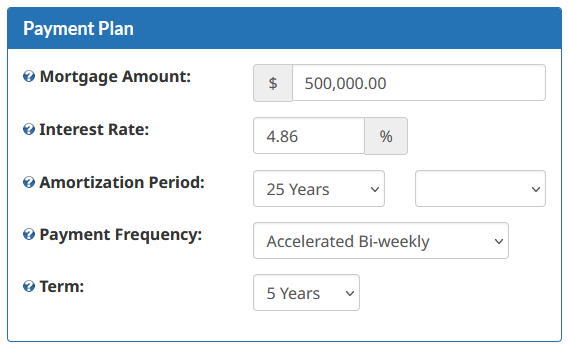
Now let’s hit calculate and see what we get.
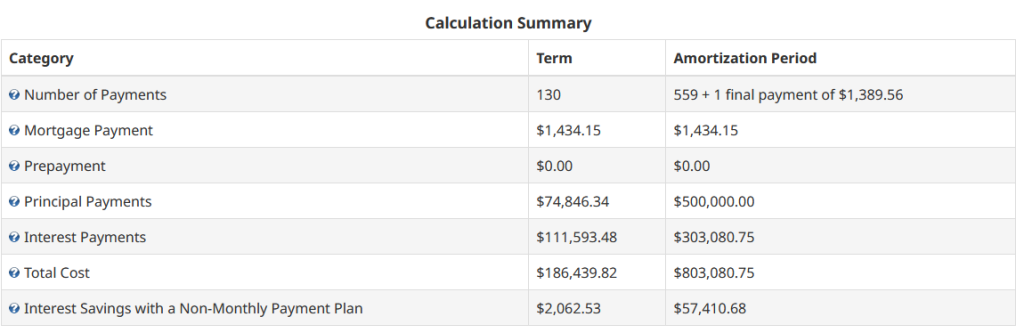
The output shows how much we will pay over the term vs the life of the loan.
If you understand what a “term” is, please skip to the next paragraph. For everyone else, here’s how to understand the term in relation to mortgages. Mortgages can take decades to pay back. A bank does not want to lock into a low mortgage rate for 25 years. A buyer does not want to lock into a high mortgage rate for 25 years. To allow both parties to renegotiate, mortgages are split up into milestones called terms. A term can be short, like 6 months, but commonly are 3 or 5 years. At the start of each term, your interest rate is known. Once the term ends, you need to make a new agreement with your loan provider for a new term to set your new interest rate and other possibly other repayment details. When your term is up, you have the option to shop around to find the best possible rate with another provider and you pay off the mortgage completely or move to another lender without penalties.
Let’s focus on the second results column, titled Amortization Period, which shows info for the entire life of the loan. For simplicity, we’re going to ignore things like down payments (we would, of course, choose to pay 20% down to avoid CMHC insurance costs). The calculator assumes that our interest rate will remain 4.86% for the entire 25 year life of the loan. This is unlikely, but it’s giving us a number to work with that’s “close enough” to make smart decisions.
So, after 25 years, we pay back our $500,000 principle. We also pay an eye watering $303,081 to the bank in interest. But here’s where we pat ourselves on the back for choosing the accelerated bi-weekly. The last row in the table confirms that by paying 26 times a years rather than 12, we’ve saved ourselves over $57,000 over the life of the loan. Nice.
Now let’s pretend the day that we sign our mortgage papers, we win the lottery (woohoo!) And guess what? It’s $500k, the exact same amount that we needed to buy our house.
Now we have choices!
We could incur some fees and pay off the loan right away.
Or we could pay off our mortgage over the current term. We would increase our bi-weekly payments to the max amount allowed (most banks let you go up to double) and make the maximum pre-payment every year, for 5 years of the term (for example, TD lets you prepay up to 15% of the loan principle per year). At the end of the 5 year term, we pay off the remaining principle. This will save us the most in interest costs and fees and get us mortgage free.

That all sounds super smart, but there is another option! We might choose to not pay our mortgage off aggressively. Instead, we keep our mortgage and invest the $500k in a self managed diversified portfolio.
Understanding what we would gain by investing that money is called the Opportunity Cost. We have the opportunity to put that money to work for us.
Let’s use this handy investment calculator provided by SmartAsset (also linked from the Handy Links section of my Resources page)
We’re going assume we put the entire $500k into an investment that earns us 7% return. I’ve chosen 7% as this is a very common and conservative investment interest rate used for long term planning. We will not add any more money to the investment and we will let it grow for 25 years (the same life of our mortgage loan).
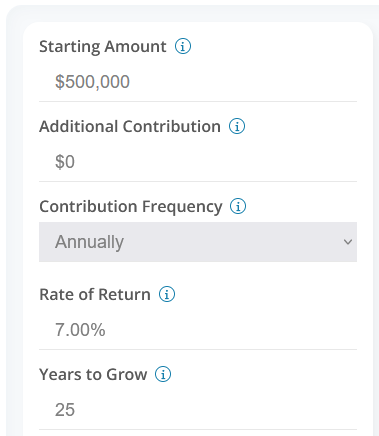
How did we do?
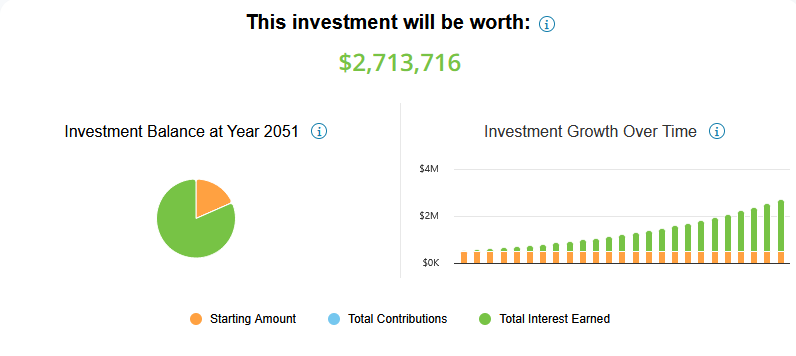
If we earn 7% and never add any more to it, after 25 years it will grow to $2,713,716. That is a tidy sum.
Now let’s compare this to our worst case mortgage scenario where we just paid the minimum mortgage amount over 25 years. The loan will cost us $803,081.
$2,713,716 – $803,081 = $1,910,635
If we choose to pay off the mortgage, instead of investing the money, we give up almost $2 million dollars!
This is the power of compound interest.
This is thinking like a rich person.
Shifting Thinking is Hard
As I mentioned already, I do not fault my daughter for paying off her student loans aggressively. Truth be told, her numbers would be a lot smaller than my example, so much less “opportunity” up for grabs. There is something to be said for the simplicity and peace of mind gained from busting your debt. These are real. Sleeping soundly every night is important.
We had similar focus early in our lives. When we received a small inheritance, we opted to pay off my student loans in full.
We wanted to be debt free, so we focused hard on budgeting and paid off the mortgage on our first home in under 10 years.
It felt good to “save” the interest fees we would have incurred on our loans. But I didn’t run the numbers. I was focused on the fees we would save and I didn’t consider the opportunity cost we were giving up to be debt free.
And that’s all okay. By busting our debt, we were still winning at life. Sure we didn’t make the most optimally perfect decision. Instead we were excited to save towards a common goal and see our mortgage balance fall away. Paying off debt was rewarding and it expanded our capacity to take on different opportunities later in life.
Since then, however, we’ve become a little more savvy.
At one point, we financed a car when the car company offered a 0% interest loan. We had the money to pay in full but we wanted to let the money grow over the term of the loan, because the loan was “free” money.
Currently, we’re choosing to slow roll a mortgage. The loan rate is a low 2.89% and our investments returns are around 11%. I don’t need an online calculator to know it’s a no brainier to keep our money invested.
This, of course, only works if you invest the money you would have spent. If you spend it, you dig yourself into a debt hole which is an awful place to be! You want to be wise with your money to win the money game.
But even knowing the math, it’s not easy to stay the course. I still carry a deep instinct to be debt free. When that feeling starts to creep in, I just remind myself to think like a rich person.