
Learning to Think Like Rich People
Published: 2026-06-12
My youngest daughter said the coolest thing last night.
“Now that I know more about money, I probably paid my student loans off too fast.”
Let me give you context. She’s just gone back to school for more training in her chosen field and is navigating the world of OSAP loans, grants, and applying for her last RESP payout. As this is her second time around, she’s already versed in the machine that is the educational financial system.
The first time she signed for OSAP loans, from the get go, she was bound and determined to bust that debt asap. And she did a fantastic job. Throughout her learning years, she budgeted carefully and made choices with her money that enabled her to pay her loans in short order after graduation. As her parents, we were really proud of her for completing her post secondary program and for being so money conscious. She set herself a goal and she totally smashed it!
Fast forward to current day. She’s gotten the rare opportunity to walk the same path again.
It was a delight to hear her insight on managing her loans. Do I think she should regret busting her debt fast? Nope, I’m still a proud Mom. Do I think she’s on to something? 100%, yes!
She’s graduated her thinking from someone who sees debt strictly as a burden to someone who understands that borrowed money has the power to work for her and elevate her net worth.
She’s thinking about opportunity cost.
She’s thinking like a rich person.
It’s Just Math
And here’s where the math comes in. Let me walk you through a scenario to show you why my daughter is exactly right.
Debt, when incurred for an investment like a home or post secondary education, let’s you have your cake and eat it too. In the case of a mortgage, you get your house now and then pay for it over time. The amount you borrowed is called the principle. The interest that you pay is the “fee” you surrender to the money lender in addition to paying back the principle.
The interest fees you pay are based on an interest rate. This is also called your mortgage rate. Hopping over to the TD mortgage rates page, the current posted mortgage rate is 4.861%, so we will use this in our scenario.
Let’s pop open a handy Mortgage Calculator hosted by Government Canada.(Links to this calculator and more are listed on the Handy Links section of my Resources page)
We’re taking out a $500k mortgage that will be paid back (aka amortized) over 25 years with a 5 year term. We’re going to save money by opting into the Accelerated Bi-weekly payment, which ensures you are paying 26 times a year rather than 24 times a year if you pay twice monthly or 12 times a year if you are paying monthly.
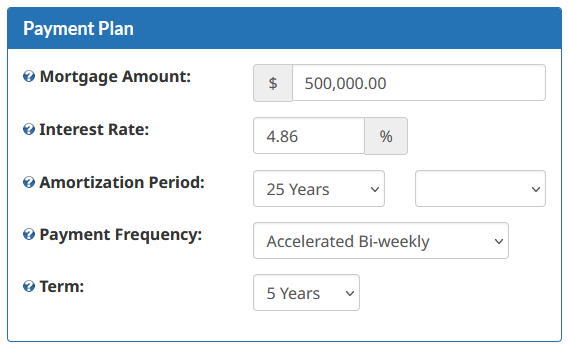
Now let’s hit calculate and see what we get.
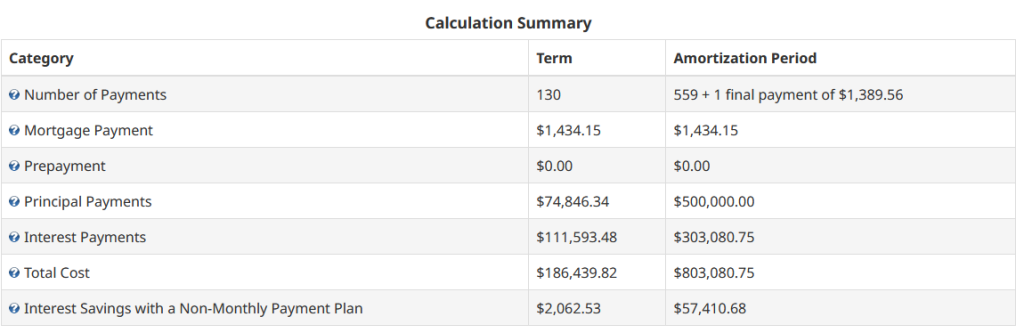
The output shows how much we will pay over the term vs the life of the loan.
If you understand what a “term” is, please skip to the next paragraph. For everyone else, here’s how to understand the term in relation to mortgages. Mortgages can take decades to pay back. A bank does not want to lock into a low mortgage rate for 25 years. A buyer does not want to lock into a high mortgage rate for 25 years. To allow both parties to renegotiate, mortgages are split up into milestones called terms. A term can be short, like 6 months, but commonly are 3 or 5 years. At the start of each term, your interest rate is known. Once the term ends, you need to make a new agreement with your loan provider for a new term to set your new interest rate and other possibly other repayment details. When your term is up, you have the option to shop around to find the best possible rate with another provider and you pay off the mortgage completely or move to another lender without penalties.
Let’s focus on the second results column, titled Amortization Period, which shows info for the entire life of the loan. For simplicity, we’re going to ignore things like down payments (we would, of course, choose to pay 20% down to avoid CMHC insurance costs). The calculator assumes that our interest rate will remain 4.86% for the entire 25 year life of the loan. This is unlikely, but it’s giving us a number to work with that’s “close enough” to make smart decisions.
So, after 25 years, we pay back our $500,000 principle. We also pay an eye watering $303,081 to the bank in interest. But here’s where we pat ourselves on the back for choosing the accelerated bi-weekly. The last row in the table confirms that by paying 26 times a years rather than 12, we’ve saved ourselves over $57,000 over the life of the loan. Nice.
Now let’s pretend the day that we sign our mortgage papers, we win the lottery (woohoo!) And guess what? It’s $500k, the exact same amount that we needed to buy our house.
Now we have choices!
We could incur some fees and pay off the loan right away.
Or we could pay off our mortgage over the current term. We would increase our bi-weekly payments to the max amount allowed (most banks let you go up to double) and make the maximum pre-payment every year, for 5 years of the term (for example, TD lets you prepay up to 15% of the loan principle per year). At the end of the 5 year term, we pay off the remaining principle. This will save us the most in interest costs and fees and get us mortgage free.

That all sounds super smart, but there is another option! We might choose to not pay our mortgage off aggressively. Instead, we keep our mortgage and invest the $500k in a self managed diversified portfolio.
Understanding what we would gain by investing that money is called the Opportunity Cost. We have the opportunity to put that money to work for us.
Let’s use this handy investment calculator provided by SmartAsset (also linked from the Handy Links section of my Resources page)
We’re going assume we put the entire $500k into an investment that earns us 7% return. I’ve chosen 7% as this is a very common and conservative investment interest rate used for long term planning. We will not add any more money to the investment and we will let it grow for 25 years (the same life of our mortgage loan).
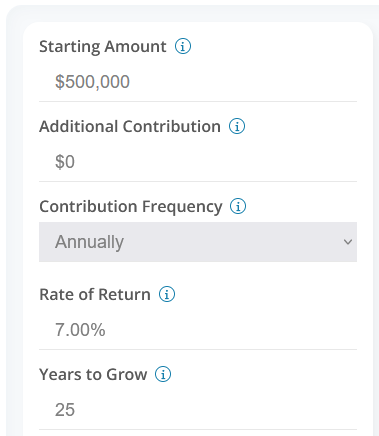
How did we do?
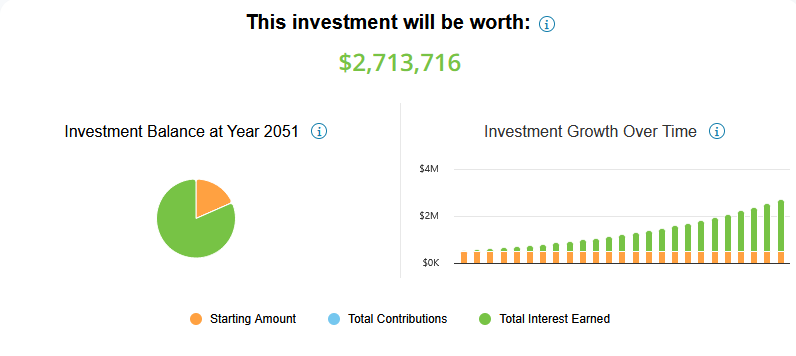
If we earn 7% and never add any more to it, after 25 years it will grow to $2,713,716. That is a tidy sum.
Now let’s compare this to our worst case mortgage scenario where we just paid the minimum mortgage amount over 25 years. The loan will cost us $803,081.
$2,713,716 – $803,081 = $1,910,635
If we choose to pay off the mortgage, instead of investing the money, we give up almost $2 million dollars!
This is the power of compound interest.
This is thinking like a rich person.
Shifting Thinking is Hard
As I mentioned already, I do not fault my daughter for paying off her student loans aggressively. Truth be told, her numbers would be a lot smaller than my example, so much less “opportunity” up for grabs. There is something to be said for the simplicity and peace of mind gained from busting your debt. These are real. Sleeping soundly every night is important.
We had similar focus early in our lives. When we received a small inheritance, we opted to pay off my student loans in full.
We wanted to be debt free, so we focused hard on budgeting and paid off the mortgage on our first home in under 10 years.
It felt good to “save” the interest fees we would have incurred on our loans. But I didn’t run the numbers. I was focused on the fees we would save and I didn’t consider the opportunity cost we were giving up to be debt free.
And that’s all okay. By busting our debt, we were still winning at life. Sure we didn’t make the most optimally perfect decision. Instead we were excited to save towards a common goal and see our mortgage balance fall away. Paying off debt was rewarding and it expanded our capacity to take on different opportunities later in life.
Since then, however, we’ve become a little more savvy.
At one point, we financed a car when the car company offered a 0% interest loan. We had the money to pay in full but we wanted to let the money grow over the term of the loan, because the loan was “free” money.
Currently, we’re choosing to slow roll a mortgage. The loan rate is a low 2.89% and our investments returns are around 11%. I don’t need an online calculator to know it’s a no brainier to keep our money invested.
This, of course, only works if you invest the money you would have spent. If you spend it, you dig yourself into a debt hole which is an awful place to be! You want to be wise with your money to win the money game.
But even knowing the math, it’s not easy to stay the course. I still carry a deep instinct to be debt free. When that feeling starts to creep in, I just remind myself to think like a rich person.
If you enjoyed this post, please subscribe to the weekly MWM email.
Crushing the Marshmallow Test
Published: 2026-05-08
My husband and I are a little too good at the marshmallow test. By which I mean, we can take our natural skills in delayed gratification a bit too far.
The marshmallow test, in case you’re not familiar, is a psychology experiment from the 70s that studied delayed gratification in 6 year old kids. If kids were able to restrain themselves from eating treats while unsupervised for a period of time, they would earn double their rewards. Or “fail” the test and eat their treat early and get no extra treats, screwing over their future selves.
If you think about this in terms of personal finance, it’s basically the power to wait until you can afford something before you buy it. In today’s world of credit cards, pay day loans, lines of credit, and online buy-now-pay-later services, there are so many ways to buy things before you can afford. Lenders want to make your buying experience as frictionless as possible to allow them to make money while you to treat yourself to x, y, and z product.
But like those eager kids who ate the treat early, paying for stuff with credit that you cannot afford is screwing over your future self. Debt is an anchor that drags you down. It slows down the rate at which you can reach your financial goals. In the worst scenario, it can take goals completely off the table for you. Interest payments on debt are a bill that you are handing over to your future self, who will have to work harder and longer to pay more for the treat that you get to enjoy today. Buying stuff feels good in the moment. Since the interest bill comes later, most people don’t quantify the true cost of stuff that they put on a credit card. When they don’t pay their balance in full before the grace period, interest is the hidden tax on everything you buy. Canadians know that you always have to round up the price tag to include sales taxes. However, with sales tax you know the exact percentage you need to factor in. With credit card interest, how much you pay depends on how long until the debt is paid off. At an average credit card interest rate of 20%–25%, a purchase will cost double in approximately 3 to 4 years if you only make minimum payments. Oof! Was that $8 sub that you bought today really worth making your future self pay $16 for? And do you really still want to be paying for it years from now?
Nature vs Nurture
So how does delayed gratification show up in my life and when did it start? As a teenager I remember choosing to walk halfway across the city to save $0.50 on bus fare. As I became a young adult, I remember comparison shopping for the cheapest shoes I could find and frequenting thrift stores. My ability to budget and save was strong as a kid.
It wasn’t until I moved out at the tender age of 18 that I started to flirt with debt. By that time I was already a mom, having had my daughter at 17. Originally I moved out on my own, but it was only a matter of months until my daughter’s father (now my husband) joined me and we became an instant family of three, living below the poverty line.
A lot of new adult expenses (rent, transportation, food, etc.) coupled with access to new forms of credit (credit cards, store cards, and student loans) was a dangerous cocktail. We often lived in overdraft, for which I could tell myself that “we had no choice”. Perhaps, perhaps not. We lived simply, but we did buy stuff on credit instead of waiting. We bought a stereo before we could purchase it out right (no one needs a stereo). We didn’t eat out often, but we did sometimes. We bought each other birthday and Christmas presents. We had pets, which made life more expensive than it needed to be. Nothing too extreme, but when you’re poor, even small stuff can drive you into a cycle of debt. When you don’t have a lot and can’t see a brighter future, buying things that you just want is seductive. Especially things that you can’t afford and, deep down, you know you shouldn’t buy. It’s like eating cookies when you’re on a diet. When willpower cracks, you can tell yourself all sorts of things to justify that sweet treat. But you always have to deal with the sugar hang over the next day.
It’s a Money Muscle
It was 5 or 6 years later when we finally got serious with our money. At our “rock bottom” we had a mortgage, a HeLoc, a student loan, and over $10k in consumer debt.
We were in our mid twenties when we finally decided we were done with debt. We wanted it gone and we needed a plan. We needed to bulk up our money muscles. To do that, we built our household budget based on our goal to become debt free. We allocated every extra penny to paying off our debts asap. Our early budget was pretty extreme. At one point (maybe early 2000s?) our monthly household budget was $20 for entertainment. Woohoo. Yes, that’s household (with two kids), not per person. We didn’t have any budget allocated for alcohol (that was a need, not a want); I remember buying my husband a case of beer for his Christmas present as a big treat. We didn’t have money to buy xbox games, so we would rent them for a fraction of the cost. We spent many hours at the library and would all read for entertainment. It definitely wasn’t glamorous, but we had a good life and we were putting our future selves first. And, as the debt balances came down, it actually felt good to live without. We stopped using all credit cards. We prioritized doing things for free. We loved our local libraries. We went to the park. We were finally winning the marshmallow test.
How that showed up in our children
My kids were between 2 and 7 when we started our debt free journey. For them, I think watching us be intentional with our money is all that they’ve ever known. And today, both my kids are extremely proficient budgeters. Like, extremely proficient – to the point that, sometimes I wonder if we broke them a little bit.
Of course, I say that tongue in cheek! I see them flexing money budgeting muscles all the time and it brings me joy. As MoneyWiseMom, I’m extremely proud of my kids and how they make the most of their money. They budget for big expenses. They don’t overspend at the holidays. They second hand shop. When they take on debt, like student loans, they pay it off aggressively. They live below their means and save for their futures.
What could be wrong with be intentional with money?
The Dark Side of Extreme Frugality
As life went on, our financial lives naturally improved. We stuck to our budget, crushed the debt, and started investing. Along the way, we advanced in our careers and started to earn raises and bonuses. When our income went up, we would revisit our household budget and allocate money intentionally, based on our current life goal, to up our budget. We would ask ourselves, how should we up our budget so that we feel “rich”. Our lux categories were entertainment, alcohol, and vacations (no surprise as these are the categories that were heavily constrained early on in our marriage!). And because we lived so constrained for so long, even a small bump in these line items felt amazing! What do you mean we can just go to the movies? How rich are we, lol?
Fast Forward to Today
Over the past year, we’ve done a major life reset. Just over a year ago, I left my high paying tech job and intentionally left the workforce to live a life of financial independence (what can I say, all that saving and investing really worked!). As part of our big life reset, we choose to go back to basics with a pretty frugal budget. In 2024, we didn’t think twice about eating out or how much we spent at the grocery store. Today, we thoughtfully plan our meals and shop based on sales. We choose to go back to feeling a wee bit constrained so that we would focus on people and experiences over money and things.
And we may be a little too good at it. We currently have a pretty humble budget for miscellaneous expenses. We draw on that money for extras, like when buying a new cell phone or kitchen gadget. We’ve keep a list of things we want to buy next. It has about ten items on it right now. At the current rate, it will take years to build up the money to go out and buy all that stuff.
Our tendency to “just wait” to buy things may be bit out of wack. Two weeks ago, we decided that only having one cutting board was not working for us. This week, I finally convinced my husband to just get a second one, even though we’re overspent on our misc exp budget right now. And even though we were “going wild” just buying it, he still flexed his frugal money muscles and found one for half off in the Ikea “As Is” section. Which I fully support, by the way. It was the right purchase for the right amount and we shopped to our values by choosing a bamboo cutting board that was the right size for what we wanted and I know that it will be used every week for years to come! And of course, we’re still going to pay off our full credit card balance this month. We haven’t paid credit card interest in decades, and we won’t be going back to that old life.
Final Thoughts
In our mid forties, we discovered that we still had our money muscles that we developed up in our twenties. But the dark side is, we might over built those muscles at the expense of flexibility. I know that today sometimes we stress ourselves out sticking exactly within budget. In truth, our budget is an arbitrary rule we’ve created for ourselves. We value a stress free life and we’re still working on finding the right balance that works for us. But it’s a pretty great life and I wouldn’t really want it any other way.
If you enjoyed this post, please subscribe to the weekly MWM email.
Build Your Financial House
Published: 2026-03-08
If you want to build an awesome life, you need to build an awesome house. Financially speaking.
Let’s think about your financial house from a bird’s eye view. Let’s fly way way way up and then turn to peer down at the ground. Can you see your house? I can. It’s a beautifully carved marble building on a lush field of green and yellow. It’s sturdy and strong and secure. It’s built to last the ages. And it’s based on four pillars.
The pillars of your financial house are:
- A Spending Plan – Live within a spending plan that allocates a healthy balance of money for housing, transportation, life, future, and, if needed, debt busting.
- Emergency Savings – A multi layer safety net to protect yourself from unforeseen events that risk bringing down your financial house.
- Zero Debt – Debt is an anchor that drags you down. You need to bust all high interest consumer debt as quickly as you can. Save yourself!
- Investments – Buy a diversified portfolio – as much as you can afford, every month, without fail, into boring stuff that has low management fees. We’ll talk about knowing what you can afford in a future post!
These four focus areas are your building blocks for financial security.
Zooming out paints the picture of what you want and creates the blueprint of what you need. With your blueprint in hand, your next steps will be to zoom in and start building from your plan. In future posts, I’ll help you construct each pillar, methodically and systematically.
But, for now, don’t over think it! Enjoy the view and know that once all these pieces are in place, you will have put your financial house in order.
As a closing thought, let me mention that, on top of our four pillars, stands financial independence (FI). People reach FI when their investments provide more income than their projected expenses. If they accomplish this surplus before the generally accepted age of retirement, they can retire early (RE). This is the basis for FIRE, an extreme personal finance movement, which marries FI with RE. Online discussions concerning FIRE include big feelings and heated debates. The great news is that you don’t need to choose right now if you want to pursue FIRE. By building your financial house based on the pillars I’ve listed above, you’ve created a foundation for FIRE, should you ever want to pursue it! The only difference is that you would adjust your spending plan to focus more on the future to make investing a priority over spending.