
Investing ABCs: Net Worth
Published: 2026-06-19
This is my first post in my foundational knowledge series for investing. This series is for anyone who wants to start investing, but doesn’t know the first thing about how to begin. You don’t need to read this series in order, but you should read and learn all the ABCs before venturing forth to buy investment products.
Our topic today is understanding your Net Worth, how to calculate it, and how to use it to build wealth. Figuring out your net worth is not complicated and should take you less than 15 minutes (you may need to log into some apps and grab some balances, if you want to be 100% accurate).
The Math
Net Worth = Total Assets – Total Liabilities
Start by downloading my Net Worth Tracker from my Resources page or create your own spreadsheet.
If you are building your own, make a new table and list all the assets that you own, like a primary residence, other property, vehicles, savings account balances, investment accounts, pensions, etc. In a column next to each asset, jot down its market value. Market value is what you could sell them for today. Make a Total Assets row at the bottom and sum up the value of all your assets.
In a second table, list all your liabilities, which is everything you owe. Those will be mortgages, student loans, car loans, credit card balances, store card balances, Buy Now Pay Later balances (i.e. Klarna), personal loans, pay day loans, etc. Make a Total Liabilities row at the bottom and sum up the value of all your liabilities.
Subtract you total liabilities (everything that you owe) from your total assets (everything that you have) and voila, you now know your Net Worth.
Why It Matters
Knowledge is power. Without it, you are just driving blind.
Everyone intuitively knows that to build wealth you will need to make more money than you spend. While technically correct, this is a narrow view of wealth building which locks people into a “paycheck to paycheck” mentality. People limited to this mindset are like someone driving a car while only looking 3 meters ahead of themselves the entire drive and no help from a navigation system. As your Money Wise Mom, I want you to have a longer view. I want you thinking BIG PICTURE. I want you looking down the road to clearly see where your choices are leading you.
Let’s do a thought experiment and chart your financial life line’s trajectory (a.k.a. your trend line). You don’t need to bust out another spreadsheet to follow along (unless you really want to). You can do this in your head.
Your ultimate goal is to identify your choices that have lead to your current net worth and what future choices you can make to build a better tomorrow.
Key Take Away: Your financial life line is your net worth mapped over the course of your life.
Envision your financial life as a graph line on a chart. The X axis is your age and the Y axis is your net worth. In Year 0 you were born. Fortunately, as a Canadian, you were born with a blank slate, financially speaking. Babies have no debt and, typically, no assets. We all start at coordinates “0,0” on our financial life charts.
Now picture your financial life line extending out from year 0 up to today.
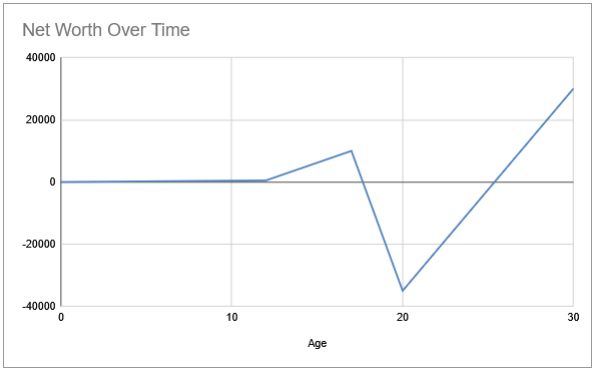
For most of us, it’s a flat line in our youth. As babies, we have parents or guardians who provide food, shelter, and the necessities of life. Some of us are privileged with parents who save money on our behalf for our education. This would nudge your line upwards. We get our first job and we start having choices. We might spend or save our income. It may nudge our line upwards a tiny wee bit, but typically everyone stays pretty close to zero during their first 16 years of life. Things start to get more exciting as we enter our late teenage years. We get to make even more choices! Some of those choices nudge our financial life lines up and others push it down. Earn a scholarship? Your line bumps up. Take on student loans? Your line dips down. Apply for your first credit card but don’t pay it off? Your line dips some more. When you get your first “real” job, the line hopefully climbs up thanks to savings from more income and, perhaps, a pension plan. Other choices will drag your line down, like financing a car or taking on other debts to support yourself as a fully baked adult.
The point is, your financial life line trends up and down, depending on the choices that you make. What direction is your financial life line heading right now? Is it on an upwards trajectory? How steep is the line? Are there choices that you’ve made that are dragging it down?
The car you buy, the partner you pick, the career you choose, where you live, and the debt you choose to take on – these are the very big life decisions that significantly impact your financial life line. If we want to build wealth, these big choices have far bigger impact than the many small spending decisions you probably focus on day to day.
Living within a balanced budget is good for you, but focusing solely on your spending habits does not build your wealth. You need goals that increase your net worth over time. You need your financial life line to trend up.
Predicting Your Future
Let’s take our thought experiment a step further. Picture your financial life line extending out from today until the day you die.
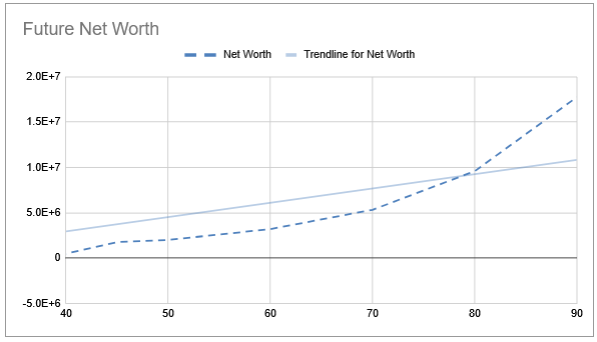
What do you want it to look like? Is the trajectory of your financial past going to lead you to a future you want? If you make no changes today, is the line trending up or down? It’s not likely to be a flat line. Life is a constant churn of change.
Predicting your own future is actually really hard. No one knows how long we have on this earth and what fun surprises are coming our way. But we can all predict that we will die, one day. Nobody gets out of here alive. You probably don’t want to work until the day you die. Let’s assume you are lucky enough to live long enough to retire one day. At what age do you want to stop working? Are you happy with the traditional 65-70 years old or do you want to retire younger? Will your financial life line rise high enough to provide a comfortable lifestyle in your sunset years? How do you know how much is enough? Do you want to leave a financial legacy for others or do you want to spend you wealth down to zero? So many big questions!
I hope this little thought experiment has helped you think about your money a bit differently than before. Your Net Worth over time is really powerful concept to understand. If you can start thinking about your net worth over years and decades, rather than just your monthly budget, you gain the wisdom to make decisions that impact your wealth. You set your future self up for success by making choices now to point your trend line up.
A Penny For Your Thoughts
Did this post make you think differently about your money over time? Does your past financial life line look like mine (flat line until about age 16)? Is there anything in my post that was unclear or confusing? Drop me a comment below!