
Investing ABCs: Investment Accounts Part 2
Published: 2026-09-11
This Investing ABCs series is for anyone who wants to start investing, but doesn’t know the first thing about how to begin. You don’t need to read this series in order, but you should read and learn all the ABCs before venturing forth to buy investment products.
This is a continuation of my post Investing ABCs: Investment Accounts
Why This Stuff is Important
One of the biggest barriers to managing your own investments is all the acronyms floating around. All those letters (TFSA, RRSP, FHSA) are confusing, overwhelming, and intimidating. It’s not easy or intuitive to understand the different types of investment products or how they help you. I am here to tell you that it’s definitely not you, it’s the financial system.
I can’t say that the confusing nature of the financial system is by design, per say. However, it certainly keeps you dependent on “financial experts”. Unfortunately, there is a big lack of transparency from everybody. Most “experts” are actually salespeople who have incentives and an unspoken agenda that is not obvious or disclosed. Banks offer a service, but they also want to increase their profits. Financial platforms, like Robinhood , Questrade, and Wealthsimple, offer similar services as well as incentives, but they also want to sell you their products to increase their profits.
The best I can do is arm you with knowledge. A little bit of knowledge will help develop your “gut”. My mother used to tell me when I was growing up: “Always trust your gut!”. I think it was pretty sound advice.
And here is my advice to you: Never do anything with your money that you don’t understand!
A Quick Recap
Here’s a quick review the four types of investment accounts we’ve already introduced.
- TFSA – Tax Free Savings Account. You put in money you’ve already paid taxes on but you never pay income tax again on that money or the money earned inside your TFSA. You are only allowed to contribute when you are 18 or older and only up to your total contribution allowance, which increments annually and is tracked by the CRA.
- RRSP – Registered Retirement Savings Plan. You put in money you’ve already paid taxes but then the CRA gives you tax money back through your income tax return, so you have actually contributed pre-tax money. The total amount you can contribute each year is based on a percentage of your income and is tracked by the CRA. Every dollar you contribute reduces your taxable income for the current year. Money invested inside your RRSP ideally grows over time until you decide to retire and need to start withdrawing your money. Those withdrawals are taxable income. Typically you will be in a lower income tax bracket when you are retired. You no longer have employment income. Since you are making a lot less when retired, you should be in a lower tax bracket than when you were working. By contributing to an RRSP, you can reduce the total income tax you’ll have to pay over your life time while squirrelling away money for the future.
- RESP – Registered Education Savings Plan. You contribute to an RESP for someone else, typically your kid or a grandkid. The Canadian government will match a percentage of your contributions with grants. The withdrawn funds may only be used to pay for eligible education expenses.
- Non Registered Account – These accounts are not registered with CRA and have no contribution limits. They do not give you any tax advantages or refunds. You are always investing with after tax money. You typically only want to open a non registered account after leveraging registered accounts, as registered accounts provide financial benefits, each in their own special way.
Even More Investment Account Types
Yup, there are EVEN MORE Investment Account types. Many of these are less talked about but it’s beneficial to be familiar with them.
Remember, these are just account types. They are not investment products. After you open an investment account, for most of these, you still then need to buy investment products using your contributed money.
| Account Type | Description | Requirements | Pros | Cons | How To Use |
|---|---|---|---|---|---|
| FHSA | First Home Savings Account Tax-free savings account for a first home | • Canadian resident • First-time home buyer • Age 18–71 | • Contributions are tax-deductible • Qualifying withdrawals are tax-free • Unused funds can transfer to an RRSP | • Annual and lifetime contribution limits • Must be used for a qualifying home (scroll to Qualifying Home here) | • Contribute and invest • Withdraw tax-free for an eligible home purchase |
| Pension Plan through an Employer | Retirement plan funded by an employer and/or employee | • Must work for a participating employer • Follow the plan’s eligibility rules | • Employer contributions • Regular retirement income • Possible investment and tax advantages | • Limited investment control • Benefits may be restricted when leaving the job • Contributions reduce take-home pay | • Enrol through your employer • Make required contributions • Receive a pension or transfer the value when leaving |
| LIRA | Locked-In Retirement Account Locked-in account holding money transferred from an employer pension | • You don’t open an LIRA directly, you convert a Pension Plan into an LIRA (for example when you leave a company) • Cannot normally make new contributions | • Tax-deferred growth • Control over investments • Pension funds remain protected for retirement | • Withdrawals are locked in • Limited early-access options • Must eventually convert to a LIF or annuity | • Transfer eligible pension funds into a LIRA • Invest until retirement • Convert to a LIF or annuity |
| RRIF | Registered Retirement Income Fund Account that converts retirement savings into income | • You don’t open an RRIF directly, you convert an RRSP into an RRIF • Must be opened by the end of the year you turn 71 | • Flexible withdrawals • Tax-deferred growth • No maximum annual withdrawal | • Annual minimum withdrawals are required • Withdrawals are taxable • Large withdrawals may increase tax or affect benefits | • Transfer RRSP funds to a RRIF • Withdraw at least the required minimum each year |
| LIF | Life Income Fund Retirement-income account for locked-in pension funds; similar to a RRIF | • You don’t open an LIF directly, you convert an LIRA into an LIF • Must follow provincial or federal pension rules | • Tax-deferred growth • Investment choice • Provides retirement income | • Annual minimum and maximum withdrawals • Withdrawals are taxable • Rules vary by jurisdiction | • Convert a LIRA to a LIF at retirement • Withdraw within the permitted annual limits |
| Annuity | • Insurance contract that provides regular income, often for life | • Purchase with a lump sum • May use RRSP, RRIF, or locked-in pension funds | • Predictable income • Can provide lifetime payments • Reduces investment-management responsibility | • Limited access to the original money • Less flexibility than investment accounts • Inflation may reduce purchasing power • Payments may be taxable | • Use retirement savings to purchase an annuity • Choose lifetime or fixed-term payments • Receive regular income according to the contract |
Clear as Mud
Congratulations on making it this far! I know it’s a lot.
Remember, your goal is not to be a financial expert (yet!). You do not need to memorize all this stuff. The first step is to just be familiar with the menu of different investment account types. Over time you will grow into a better understanding of what each account type is and how you can use them to boost your net worth over time.
We have now reviewed ten different investment account types. You won’t need to use them all. However, savvy Canadians will use a variety of these within their lifetime to reduce their income tax burden and increase their wealth.
I want to here from you
I want some honest feedback. Leave me a comment. Did you learn anything from this post? Or did it all fly over your head?
If you enjoyed this post, please subscribe to the weekly MWM email.
Investing ABCs: Types of Investment Products
Published: 2026-08-21
This Investing ABCs series is for anyone who wants to start investing, but doesn’t know the first thing about how to begin. You don’t need to read this series in order, but you should read and learn all the ABCs before venturing forth to buy investment products.
Never do anything with your money that you don’t understand. This is easy to say, but tricky to achieve because when you are just getting starting, you don’t even know what you don’t know, ya know?
One big barrier to taking control of your money is that you will need to learn a few new words and some new concepts. In today’s post, I’ll explain four common types of investment products that you likely have already heard about but may not understand what they exactly are or how they exactly work.
Stocks, Bonds, ETFs, and Index Funds.
These are not the only investment products you can buy; we will start with these four and I promise to talk about even more types of investment products in a future post.
The Two Building Blocks: Stocks vs. Bonds
Stocks and Bonds are the two most basic assets types in investing.
1. Stocks (Ownership)
When you buy a stock, you are buying a slice of ownership in a specific company. Companies sell their stocks on a stock exchange in order to raise funds for their business operations. With those funds, the company wants to grows its revenue either directly (by selling stuff) or by innovating (by promising something cool in the future). When they are successful, the value of each stock increases and you may receive cash payouts called dividends. However, if the company fails or runs into trouble, your share value drops. Buying a stock is like buying one specific apartment in a city. If the neighbourhood booms, your property value soars. If the building falls into disrepair, you take the loss.
IMHO, buying individual stocks is gambling and should be avoided. I would only buy an individual stock if I had “play” money that I didn’t care about losing. Understanding stocks and how they work is still very important (more on that below). However, you want your path to growing wealth to be as boring and and predictable as possible. No one has a crystal ball and nothing in investing is guaranteed, but we can make smart decisions and grow our wealth with relativity low risk.
2. Bonds (Loans)
Governments and corporations sell bonds to borrow money from investors. When you buy a bond, you are lending them money. They will use your money to fund public projects, bridge budget deficits, expand operations, or refinance existing debts. Bonds are a promise to pay back the loan at a later date. As the lender, the borrower promises to pay you regular interest over a set period and return your original principal once the bond matures. Bonds generally offer lower returns than stocks, but they are much less volatile. Buying a bond is like acting as a money lender. You don’t own a physical asset, you are lending money now to receive a steady, predictable mortgage payments from the borrower.
The Relationship & Strategy Between Stocks and Bonds
In an investors portfolio, stocks and bonds serve complementary roles.
- Stocks provide growth, but come with risk and volatility
- Bonds provide stability, they returns are more certain but no potential for extra growth
Historically, stocks and bonds move in opposite directions during market swings.
A classic investment strategy is to hold a mix of stocks and bonds. The percentage of stocks vs bonds is a personal choice, but a very common, middle of the road strategy, is to hold 60% stocks and 40% bonds in your portfolio. The higher your risk tolerance and the longer your time horizon, you might choose a higher percentage of stocks. Younger investors with decades ahead usually hold more stocks for maximum growth, while investors closer to retirement hold more bonds to preserve capital. You just don’t want to be “all in” on the stock market right before you need to pull money out. If the market has a crash (the real estate bubble, COVID, politics, an AI bubble) you either want time to ride it out until the market returns to “normal” or not to be holding more safe stuff so that you are not exposed to too much volatility.
The Bundles: ETFs and Index Funds
Buying individual stocks and bonds requires heavy research and carries high risk. If you put all your money into one company and it goes bankrupt, you lose everything.
Once upon a time, dealing with specific stocks and bonds directly was the only way to be a capital investor. But in our modern times, there is a much better option! Financial institutions have created bundled funds. Bundles now make it really easy for you, the investor, to own a fully diversified global portfolio, containing stocks and bonds from every major financial market, in just one fund. And, that fund can be extremely low cost to own. Check out my post on MER to understand why that’s kinda a big deal.
There a couple of different types of bundled funds that you should be aware of.
3. ETFs (Exchange-Traded Funds)
An ETF is actually a bundle of dozens, hundreds, or even thousands of individual stocks or bonds. When you buy one share of an ETF, you instantly gain exposure to every asset inside that basket. What makes an ETF unique is how it is bought and sold: it trades on a public exchange like an individual stock, meaning its price updates in real time throughout the trading day. However, instead of buying one unit of one company, you are buying one unit of thousands of companies. Buying an ETF is like buying an entire neighbourhood of apartment buildings in a city. If the neighbourhood booms, your property value soars. But if only one apartment stays empty, you will have thousands of other apartments still making you income. ETFs smooths out the risk of buying individual stocks because each unit’s value is linked to the success of many companies, not just one.
4. Index Funds
An index fund is an investment strategy designed to track a specific slice of the market (an “index”) rather than trying to pick winning investments. For example, an S&P 500 index fund simply buys shares in the 500 largest publicly traded companies in the United States.
Here is where beginners often get confused: An index fund describes what the fund does (tracks a market index), while an ETF describes how it is traded. You can buy an index fund structured as a mutual fund (which trades once per day at market close) or structured as an ETF (which trades continuously throughout the day).
| Investment Type | What Is It? | Primary Goal | Trading Style |
| Stock | Single company ownership | High growth potential | Real-time during market hours |
| Bond | Loan to a company or government | Capital preservation & regular income | Variable / Over-the-counter |
| ETF | A bundled basket of investments | Instant diversification | Real-time on stock exchanges |
| Index Fund | A fund tracking a market benchmark | Matching broad market returns at low cost | Once daily (Mutual Fund) or real-time (ETF) |
3 Key Takeaways
- Individual assets do different jobs: Stocks offer wealth growth but come with high volatility; bonds offer predictable income and stability during market downturns.
- Diversification beats stock-picking: Buying individual stocks is risky. Broad-market ETFs and index funds allow you to own hundreds of companies simultaneously, spreading out your risk.
- Keep fees low and stay long-term: Passive index ETFs generally charge tiny fraction-of-a-percent management fees compared to traditional actively managed funds. Keeping management costs low ensures more of your money compounds over time.
If you enjoyed this post, please subscribe to the weekly MWM email.
Investing ABCs: MER, the Silent Wealth Killer
Published: 2026-08-07
This Investing ABCs series is for anyone who wants to start investing, but doesn’t know the first thing about how to begin. You don’t need to read this series in order, but you should read and learn all the ABCs before venturing forth to buy investment products.
When taking control of your financial future through self-directed passive investing, your approach should be to eliminate expensive middleman fees, invest globally across all major markets, and grow your wealth over time.
It’s important to understand that even if you skip the traditional financial advisor and buy ETFs online for “free”, you are still paying an underlying fee.
Enter the Management Expense Ratio (MER). MER is an annual fee you must pay to own Exchange-Traded Funds (ETFs) or mutual funds. All ETF and mutual fund investment products include MER fees. MER is expressed as an annual percentage of the fund’s total assets under management. A “high” MER will be 2% (or higher!) while a “low” MER is around 0.10%.
Even a “high” MER might seem like a tiny fractional percentage on a fund fact sheet, so why should you care? In truth, MER is arguably the single most important variable under your direct control as a passive investor.
Understanding what MER is, how it works, and why it drastically impacts long-term wealth accumulation will make you a wiser investor and help you win the money game.
MER is a hidden fee
MER is a silent wealth killer and it’s critical that you give it careful attention when building your portfolio.
Instead of sending you an annual invoice, fund providers deduct this fee automatically from each fund’s assets behind the scenes. This makes MER invisible unless you actively look for it.
MER is composed of two components:
- Management Fee: The fee paid to the fund company to pay portfolio managers, analysts, and cover institutional administration.
- Operating Expenses & Taxes: Administrative overhead, legal, auditing, regulatory filing fees, and applicable taxes (such as GST/HST in Canada).
Out performance is Rare; Fees Are Guaranteed
Active fund managers charge higher fees because they claim they will beat market performance through stock picking or market timing. However, historical data busts this as a myth and a fairy tale. Decades of data demonstrates that 80% to 90% of actively managed funds fail at their quest to beat their benchmark over a 10 to 15 year horizon. No one owns a crystal ball, so eventually managers get it wrong, plus high fees drag down performance. You always pay MER fees, regardless of how well the fund performed.
Passive investing aims to match market performance at the absolute lowest cost possible. You are not trying to beat the market (that is gambling!) you just want to ride the wave of average market returns. According to this guy, over the last 50 years Canada has posted a 10.3% nominal return and US has posted over 13%. That’s pretty darn great! As a passive investor with index funds, you accept these market returns as the growth you should see in your portfolio.
The primary factor determining whether your net returns beat some other investor holding the exact same index is what you are losing to in fees. This is why, when selecting the investment products to buy for your portfolio, the closer you can get your MER to zero, the more you guarantee that you keep virtually all of a market’s underlying return.
Fund Fees Vary, Buyer Beware
Not all funds are created equal. Knowing what constitutes a “good” MER helps you evaluate investment options:
| Investment Type | Typical MER Range | What You Are Paying For |
| Broad Market Passive ETFs | 0.03% – 0.25% | Automated indexing tracking major benchmarks (e.g., S&P 500, Total World). |
| All-in-One Asset Allocation ETFs | 0.15% – 0.25% | Complete, auto-rebalancing multi-asset portfolios (stocks + bonds). |
| Robo-Advisor Portfolios | 0.40% – 0.70% | ETF fees plus automated platform management and digital advice. |
| Actively Managed Mutual Funds | 1.50% – 2.50%+ | Human management, marketing, dealer trailers, and active trading costs. |
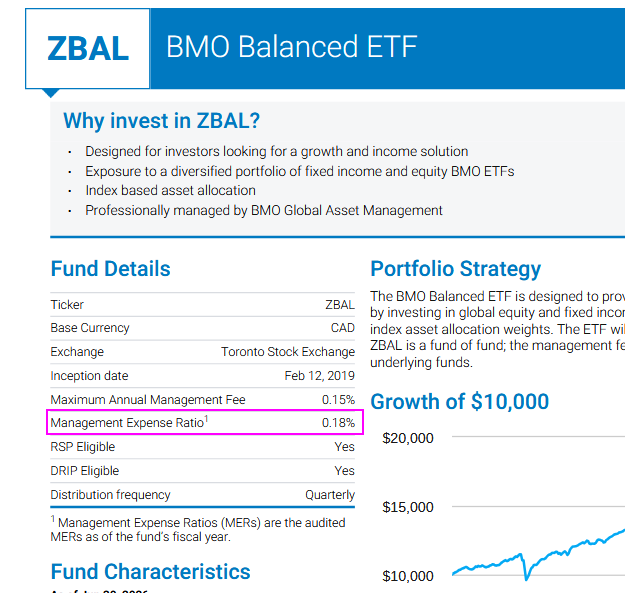
The MER for all funds can be found on their fact sheet. You can easily find the fact sheet for most funds be searching in an internet browser with the fund’s ticker symbol with the words “fact sheet”.
For example, check out the fact sheet for ZBAL here or search for it yourself with “ZBAL fact sheet”. Do you see where the MER is listed?
The Anti-Compounding Effect
To understand the true impact of MER, you should understand the double-edged sword of compounding. Just as compound interest accelerates wealth creation, compound investment fees accelerate wealth destruction.
When a fund charges a 2.00% MER, you are not simply losing 2% of your money that year; you lose the future growth that 2% would have generated for decades to come.
A Tale of Two Investors
Consider two investors, Maya and Liam. Both invest a lump sum of $100,000 into equity funds that achieve an average gross market return of 7% per year over 30 years.
- Maya chooses low-cost, self-directed passive indexing ETFs with an average MER of 0.10%.
- Liam stays in traditional, actively managed equity mutual funds with an MER of 2.00%.
Maya's Net Annual Return: 7.00% - 0.10% = 6.90%
Liam's Net Annual Return: 7.00% - 2.00% = 5.00%
Here is how their initial $100,000 grows over 30 years:
| Time Horizon | Maya (0.10% MER) | Liam (2.00% MER) | The “Fee Gap” Lost to Liam |
| 10 Years | $194,884 | $162,889 | $31,995 |
| 20 Years | $379,799 | $265,330 | $114,469 |
| 30 Years | $740,166 | $432,194 | $307,972 |
Don’t be a Liam
Despite starting with the exact same principal and achieving the exact same market performance before fees:
- Maya ends up with $740,166.
- Liam ends up with $432,194.
- Liam surrendered over $307,000—or roughly 41% of his potential final wealth—solely to fees.
A seemingly small 1.90% difference in annual fees compounded into a life-changing financial loss. For a self-directed investor, reducing your MER from 2.00% down to 0.10% effectively buys you years of additional retirement freedom.
Top 3 Takeaways for Self-Directed Investors
- MER is an Invisible Drain on Your Capital: Management Expense Ratios are subtracted daily behind the scenes before performance figures are reported. Check a fund’s fact sheet to know the exact percentage you are paying.
- Compound Fees Destroy Wealth Exponentially: A fee that sounds small on paper (like 1.5% to 2.0%) can consume over 30% to 40% of your long-term wealth accumulation due to lost opportunity costs and missed compound growth.
- Controlling Fees is Your Greatest Competitive Advantage: You cannot control global markets, inflation, or central bank interest rates. Controlling your MER by choosing broad-market, low-cost ETFs (targeting under 0.20% MER) is the single most reliable way to maximize your net investment returns.
If you enjoyed this post, please subscribe to the weekly MWM email.
Investing ABCs: Investment Accounts
Published: 2026-07-24
This Investing ABCs series is for anyone who wants to start investing, but doesn’t know the first thing about how to begin. You don’t need to read this series in order, but you should read and learn all the ABCs before venturing forth to buy investment products.
As I mentioned in my post You Can Manage Your Own Investments, if you can shop online, you have all the proficiency you need to open and use an account for investing. If you are totally new to investing, this primer is here to help you understand what a brokerage account is, what an investment account is, and a few of the most common types of investment accounts that you can open.
Brokerage Accounts
People who want to manage their own investments need a brokerage account.
There are many institutions that offer brokerage services where you can open an account. You might choose from online only providers like Questrade or Wealthsimple or one of the Canadian big 5 banks: Royal Bank of Canada (RBC), Toronto-Dominion Bank (TD), Bank of Montreal (BMO), Canadian Imperial Bank of Commerce (CIBC), and The Bank of Nova Scotia (Scotiabank).
A brokerage account is an account that you open with a provider. Once you have your brokerage account, you open one or more different types of investment accounts inside your brokerage account.
Let’s compare this to bank accounts, which you may have had since you were a kid. When you want a savings account, you open a personal banking account with the bank and they add a savings account to your personal banking account. A savings account is simple; it only holds cash.
When you want an investment account, you open a brokerage account with a provider (a.k.a a broker, which might be a bank) and request that they add an investment account to your brokerage account. Investment accounts are structured a little differently from a chequing or savings account. An investment account includes a cash portion plus your investment holdings. Inside your investment account you buy investment products. Investment accounts come in different types. You might recognize their acronyms: RRSP, TFSA, FHSA, RESP, LiRA, etc.
Here is a visual representation of what holding different accounts looks like. In the example, “Heather McNeil” has some of the most common types of accounts with TD Bank: a savings account, a spending account, a TFSA, and an RRSP. Notice that the investment accounts include cash and the investment holdings that Heather has purchased.
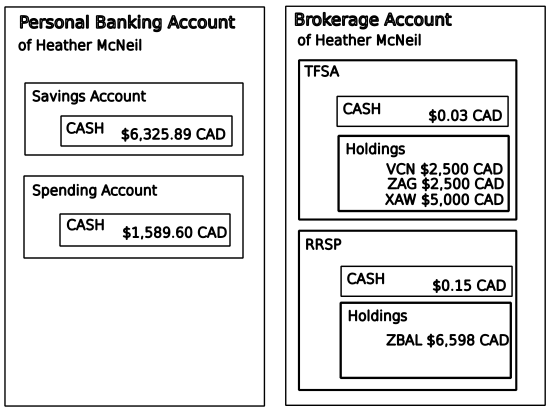
Deep Dive Note: When opening an investment account, you must specify which type you want. You cannot change the type of investment account after you’ve requested it, just like you cannot change your savings account into a chequing account. You would need to open the new chequing account, transfer your funds, and then close the savings account. Different types of investment accounts exist because each one has different tax advantage and rules for their contribution limits. You cannot turn a TFSA into an RRSP, but you might have a strategy to migrate money overtime from one to another. You can hold the same holdings inside your investment accounts. For example, you can own ZBAL inside your TFSA, RRSP, and FHSA.
Just like a bank account, you can have brokerage accounts at as many institutions as you like. If you don’t like the service you are getting at one provider, you can take your business to another provider. Just be prepared to pay admin fees when you leave.
Important: Brokerage fees vary across providers. Before opening a brokerage account, read the provider’s website to understand if they charge a flat fee per trade and if it’s a set amount when you buy products or if they have a percentage based fee when you sell products. You should also know if there is a minimum balance at which they reduce or waive certain fees.
My experience working with traditional banks is that they are still fairly paper driven, move slow, are prone to administrative hiccups, and you will have to call them to get support. The experience may not be smooth or user friendly. We used TD as our brokerage for most of our adult life. We switched to Wealthsimple a year ago and have found the user experience to be head and shoulders above working with a bank. Wealthsimple even paid for the admin fees TD charge to migrate our investment accounts.
Investment Accounts
There are two main categories of investment accounts. They are either a registered account or a non registered account. A registered account gives you a tax advantage while a non registered account does not. The type of tax advantage a registered account gives you is based on it’s type. Common registered account types are FHSA, TFSA or RRSP.
Regardless of the category and type of investment accounts, once you’ve opened your investment account, they all operate the same in relation to purchasing and selling investment products. They all include a cash portion and your holdings.
A non registered account will not provide you any tax refund today or any direct tax break in the future. In a non registered account, you purchase investments with money that you’ve already paid income taxes against. When you want to cash out your non registered investments, the growth (a.k.a capital gains) is reported as income on your income taxes. If you lose money when sell your investments, you report the loss on your income taxes. A loss reduces your taxable income.
Registered accounts (a.k.a tax advantaged investment accounts) have the same structure as your standard investment account. They have a cash component which you use to buy your investment products (a.k.a holdings). Registered accounts give you special advantages, either by reducing your taxable income now or by eliminating income taxes on future gains. All registered investment accounts are subject to tracking by the CRA for tax purposes; the brokerage is responsible for submitting reports about your contributions to the CRA.
Two of the biggest hurdles to getting started with investing is
1) knowing which type of registered account to invest in first and
2) deciding which investment products to buy.
Investment Account Types
| Account Type | Description | Requirements | Pros | Cons | How To Use |
|---|---|---|---|---|---|
| Non Registered Account | Contributions are after income tax dollars. You do not get a tax break | You must have a valid social insurance number (SIN) You must be 18 years of age or older. | You can invest your money in investment products. | No special tax advantages or tax refunds. | If you max out your contribution room on your tax-advantaged account types, your extra money must be invested through a non-registered account. |
| TFSA | Tax Free Savings Account Registered,Tax Advantaged Account Contributions are after income tax dollars. You do not get a tax break today, however growth within this account and all money withdrawn is never subject to income tax. | You must have a valid social insurance number (SIN) You must be 18 years of age or older You must only contribute up to your maximum contribution limit | Tax-Free growth and withdrawals forever Flexible for many goals due to a wide range of investment options Withdrawals create new contribution room in the following calendar year No max age Withdrawals don’t affect government benefits Annual contribution room carries forward No income requirement to contribute Estate Planning Benefits: If you designate your spouse as a “successor holder,” the TFSA can seamlessly transfer to them upon your death, maintaining its tax-free status. | Contributions are not tax-deductible Steer clear of over-contribution penalties There is no tax write off if you incur investment losses Be aware that foreign investments can be subject to withholding taxes from the foreign nation Your account is not protected from creditors (in most cases) It can be misused as a “Savings Account” only Potential for “Business Income” Scrutiny by the CRA if you trade inside it a lot (day trading) Possible to introduce complexity with multiple accounts across multiple institutions | A great fund for holding high growth investments (equity). If you believe your earning potential will significantly increase in future years or you are in a low tax bracket, focus on TFSA before RRSPs |
| RRSP | Registered Retirement Savings Plan Registered,Tax Advantaged Account Designed to help individuals save for retirement while offering significant tax advantages The underlying premise of an RRSP is that you contribute when you are in a higher tax bracket (during your working years) and withdraw when you are in a lower tax bracket (in retirement, when your income is typically lower). This can result in paying less overall tax on your savings. | You must be a resident of Canada You need a valid Social Insurance Number. You must have “earned income” to generate RRSP contribution room You must file a tax return Minimum Age: There is no minimum age to open an RRSP, as long as you have earned income and file a tax return. However, some financial institutions might have their own age of majority requirements to open certain investment accounts. Maximum Age: You can contribute to your RRSP up until December 31 of the year you turn 71. After this date, you can no longer contribute to your own RRSP, and you must convert it into a Registered Retirement Income Fund (RRIF), purchase an annuity, or withdraw the funds (which would be fully taxable) | Every dollar you contribute reduces your taxable income for the yearInvestments within your RRSP grow tax-free. You don’t pay any tax on the interest, dividends, or capital gains earned inside the plan until you withdraw the money.Potential for Lower Lifetime Tax RateSpousal RRSP OpportunitiesGenerally, funds held within an RRSP are protected from creditors in the event of bankruptcyHome Buyers’ Plan (HBP) allow you to withdraw up to $60,000 (as of 2024) from your RRSP to use as a down payment for a first home, tax-free, provided you repay the amount within 15 yearsLifelong Learning Plan (LLP): You can withdraw up to $10,000 per year, to a maximum of $20,000, to finance eligible full-time education or training for yourself or your spouse/common-law partner, tax-free, provided you repay the amount within 10 years.Contribution Room Carries Forward: If you don’t use all your available RRSP contribution room in a given year, it carries forward indefinitely, allowing you to catch up on contributions in future years. | All withdrawals from an RRSP (except for those under the HBP or LLP, which require repayment) are considered fully taxable income in the year they are withdrawn. This is the “tax deferral” part of the equation.Impact on Income-Tested Benefits: Withdrawals from an RRSP (and later, a RRIF) are considered income and can reduce your eligibility for income-tested government benefits in retirement, such as Old Age Security (OAS) and Guaranteed Income Supplement (GIS). This is a significant concern for lower-income retireesMandatory Conversion and Minimum Withdrawals: By December 31 of the year you turn 71, your RRSP must be converted into a Registered Retirement Income Fund (RRIF) or used to purchase an annuity. Once converted to a RRIF, you are required to withdraw a minimum amount each year, which is taxable, regardless of whether you need the income or not. These minimum withdrawal rates increase with age.Lost Contribution Room on Withdrawal: Unlike a TFSA, if you make a withdrawal from your RRSP (outside of the HBP or LLP), that contribution room is lost forever and does not get re-added in future years.Withholding Tax on Withdrawals: When you withdraw funds from an RRSP before it’s converted to a RRIF (and even from a RRIF beyond the minimum withdrawal), a withholding tax is applied at the time of withdrawal. While this is a pre-payment of taxes, it means you don’t get the full amount upfront.Less Flexible for Short-Term Goals: Because withdrawals are taxable and result in lost contribution room, RRSPs are generally not ideal for short-term savings goals where you might need access to your money before retirement.Tax Refund Management: While the tax deduction is a pro, if you don’t reinvest your tax refund back into your RRSP (or another savings vehicle), you are effectively losing out on some of the long-term benefits of the plan. Spending the refund diminishes the overall tax efficiency. | A great fund for long term retirement savings and for reducing your total income tax over your lifetime If you are focusing on equity investments in your TFSA to maximize growth, consider keeping stable investments, like bonds, in your RRSP If you believe you’re at the height of your earning potential and can use an RRSP to lower your tax bracket, prioritize RRSP contributions. Have the self discipline to always invest the annual tax refund. |
| RESP | Registered Education Savings Plan Registered,Tax Advantaged Account Designed to allow adults to save for the education of minors. | You and the minor must each have a valid social insurance number (SIN) You must be 18 years of age or older. | The Canadian government adds grants on top of money you’ve contributed annually. | Funds may only be used to pay for eligible education expense. If the beneficiary does not pursue post-secondary education, there may be limitations on accessing the funds. | A great way to grow money over time to help someone else pursue post secondary education. |
Investment Products
Investment products, referred to as your holdings, is the stuff that you buy inside your investment account. Ideally, it’s the stuff that pays you dividends and grows in value over time. Examples of investment products are ETFs (Exchange Traded Funds), Stocks, Bonds, Mutual Funds, and GICs (Government Income Certificates).
We will take a closer look at investment products in a future post. In the meantime, let me know where you are on the path to managing your investments. Do you already own investment accounts? Are they self-directed or managed by a provider? If you have investment accounts, do you know what you are holding in them?
If you enjoyed this post, please subscribe to the weekly MWM email.
Investing ABCs: Growth Part 2 – But wait, there’s more!
Published: 2026-07-03
This is my third post in my foundational knowledge series for investing. This series is for anyone who wants to start investing, but doesn’t know the first thing about how to begin. You don’t need to read this series in order, but you should read and learn all the ABCs before venturing forth to buy investment products.
When you step into the world of investing, there is a fun perk that you can’t get anywhere else. That perk is called a dividend.
A dividend is a portion of a company’s profit paid out to its shareholders. Determined by the board of directors, they act as a reward for investing and are typically distributed on a regular schedule (e.g., quarterly or annually) in the form of cash (or additional stock). The promise of dividend payouts entices investors to buy and hold shares in the company.
I am always delighted by dividend payments. They are little bonus injections of cash that feel like bonus money. After switching to Wealthsimple almost a year ago, I receive email notifications each time I get a payout. Seeing those happy little notices appear in my inbox still hasn’t gotten old.
In reality though, these payments are not a surprise at all. I already know an estimated amount I should expect and the frequency in which they should arrive. But if you don’t get joy from the little things in life, than what’s the point of even living? Right?
Take a look at the ETF funds that we invest in, as an example. I’ll break down why we settled on these funds in a future post. For now, we’re going to look at their Dividend yield (payouts). The Annual Dividend Rate is how much you should expect your dividend payout to be, per share you own, over the year. Most funds pay out dividends more frequently than annually, so the annual amount gets portioned out over the course of the year. How often is the Frequency, which is also how often I get those fun emails from Wealthsimple ringing my “I just got paid” bell.
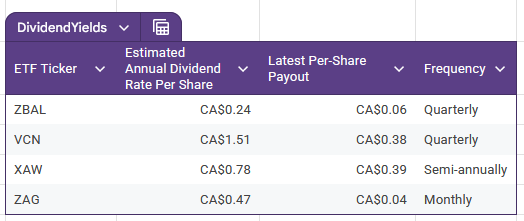
You can take this information and calculate the dividend payout, based on how many shares you own. Let’s assume we own 1000 shares of VCN.
1,000 shares of VCN x $1.51 CAD/share = $1,510 CAD annually, paid $380 quarterly
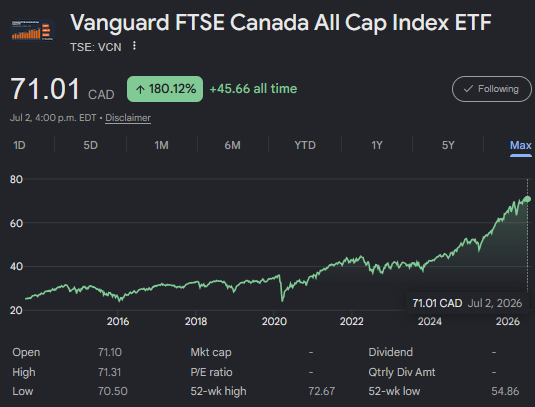
Note that dividends are above and beyond the growth I described in my last post Investing ABCs: Growth. Let’s look at the growth over time of the VCN fund. In 2013, one share was worth just over $25. Today, that same share is worth $71 . So, in addition to each share being worth more over time, you get dividend payouts along the way. The more shares you own, the bigger the dividend payout.
Smart investors take the free money they’ve earned through dividends and reinvest them. Most brokerages (the place online where you buy your investment products like ETFs, stocks, and bonds) offer you a feature called DRIP.
DRIP stands for Dividend ReInvestment Plan.
To set up a DRIP, you update your preferences in your brokerage account once to automatically purchase more shares with future dividend payouts. Remember that lovely curved growth chart I showed you in my last post? A DRIP is the same concept; your wealth over time gets a boosts because you are compounding your growth. You wealth curve will be steeper. When you use your dividends to by more shares, the increase in shares means a larger dividend payout next time. A larger dividend payout then allows you to buy more shares, increasing the total shares that you own, and you earn an even bigger dividend payout the next time, etc. etc. .
Some investors are considered Dividend Investors. Their portfolios aim to make steady passive income from dividend payouts, replacing the need for employment income. To be clear, that is not the path that we have chosen. As much as I love those little bonus payments, they are not our primary wealth building strategy. But every little boost counts towards growing our wealth.
Do you already own investments? Do you know if they pay dividends and what their yield and frequency is?
If you enjoyed this post, please subscribe to the weekly MWM email.
Investing ABCs: Growth
Published: 2026-06-26
This is my second post in my foundational knowledge series for investing. This series is for anyone who wants to start investing, but doesn’t know the first thing about how to begin. You don’t need to read this series in order, but you should read and learn all the ABCs before venturing forth to buy investment products.
The Magic of Compound Interest
Money + Time = Magic
Ahhhh, the wonder of compound interest. When I first started saving in a simple savings account, I loved seeing “free money” roll into my account every month in the form of interest. Sure it was less than the cost of a cup of coffee, but it was money that I now had and I hadn’t had to show up to work to earn. This is most peoples first experience with interest. Interest earned on your savings account is money coming in, rather than those high interest charges on your credit cards which is money going out. In a way, interest is a money game of life. Earning interest is winning. Paying interest is losing (usually – read Learning to Think Like Rich People to understand more context).
Compound interest takes winning at money to another level. It is money earned on both your original money AND on the interest you have already earned. This is growth and it is the “magic” of compounding. Over time, your money begins to multiply your wealth exponentially instead of linearly. This is how you win the money game.
Here is a very simple example of compound interest.
You invest $100 at 10% interest and never add any more money.
- Year 1: You make 10% on your $100 = $10 interest. (Total: $110)
- Year 2: You make 10% on your new $110 = $11 interest. (Total: $121) <== Instead of earning the same $10 as year 1, your interest just earned you an extra dollar. Over time, that extra dollar snowballs.
- Year 3: 10% of $121.00 = $12.10 interest (Total: $133.10)
- Year 4: 10% of $133.10 = $13.31 interest (Total: $146.41)
- Year 5: 10% of $146.41 = $14.64 interest (Total: $161.05)
- Year 6: 10% of $161.05 = $16.11 interest (Total: $177.16)
- Year 7: 10% of $177.16 = $17.72 interest (Total: $194.87)
- Year 8: 10% of $194.87 = $19.49 interest (Total: $214.36)
- Year 9: 10% of $214.36 = $21.44 interest (Total: $235.79)
- Year 10: 10% of $235.79 = $23.58 interest (Total: $259.37)
Build a Money Engine
By the time I was 15, I was already keenly aware that my time was finite and that I would have to acquire money to live on by some means. If I just traded my labour for money, i.e. by earning a pay cheque for working 9-5 Monday through Friday, there would be a hard ceiling to how much money I could ever bring in. For example, if I made $37 an hour, for 40 hours a week, that’s a hard cap at $1480 weekly income (Yes, I am ignoring taxes and other stuff that get skimmed off the top of take home pay for simplicity!).
I also dreaded how much time I would have to spend sitting at a desk. Forty hours a week felt like a high price to pay. A better way to win at life would be to build a money engine that makes money for me 24/7/365 through growth, freeing up my time to do as I pleased. I didn’t know it when I was 15, but this is the concept of Financial Independence.
Enter compounding growth. The more you can feed your money engine, the harder compounding can work for you and the faster your wealth will grow.
It’s easiest to see what I mean with a few fun graphs.
Scenario 1: Go to Work Until you Die
Earn $1480 a week for 40 years, but without any savings and, therefore, no compound magic of any sort.
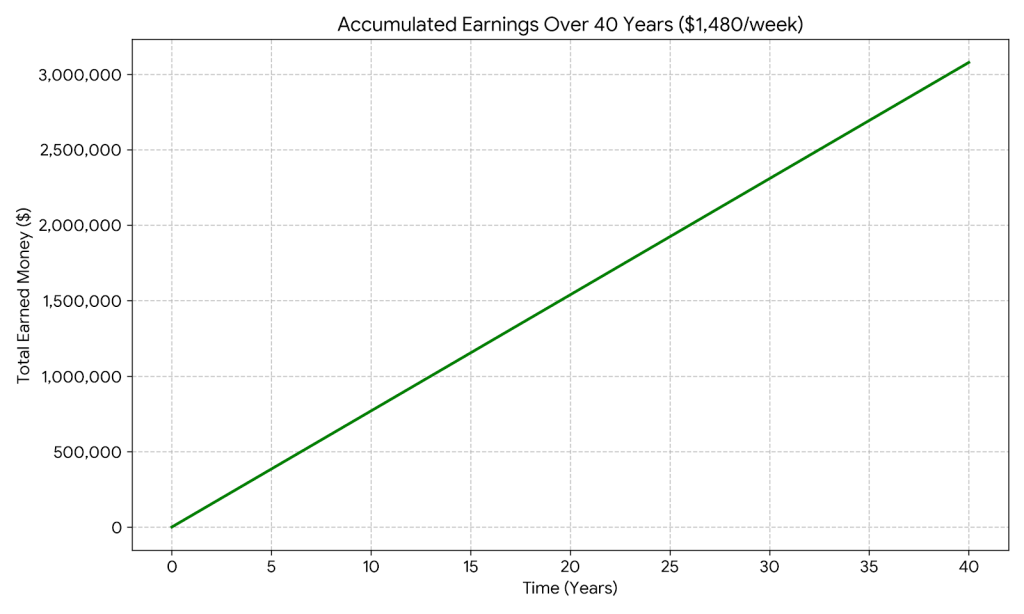
Weekly Earnings: $1,480
Annual Earnings (52 weeks): $1,480 x 52 = $76,960
Total Earnings after 40 Years: $76,960 x 40 = $3,078,400
Over $3 Million is a hefty amount. but, to be clear, this is not your net worth over time. This is not how much you would earn over 40 years at a $37/hr wage. It is how much you traded 4 decades of your life to bring in. Note that the line is straight. This is what not having a money engine looks like.
Scenario 2: Invest 10%
Now let’s add in the magic and assume that we are putting 10% of our earnings, $148 a week, into an investment that grows at 7% annually.
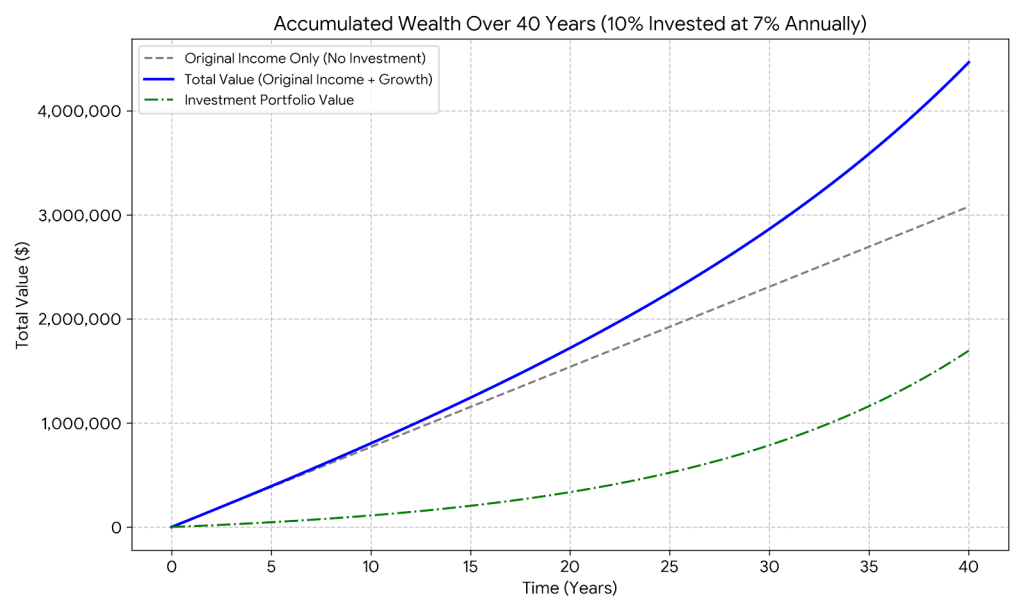
Total Income Earned: Over 40 years, your total gross income remains $3,078,400.
Cash Retained (90%): You keep $1,332 per week for regular spending or savings, which totals $2,770,560.00 over 40 years.
Principal Invested (10%): You contribute $148 per week into the investment, which amounts to a total out-of-pocket contribution of $307,840.00.
$3,078,400.00 (Income from wage) + $1,386,787.52 (Growth Earned) = $4,465,187.52
Notice that our wealth line is starting to curve up! The steeper you can make your line bend, the more growth you have. This is what a working money engine looks like!
Scenario 3: Invest 25%
Finally, let’s assume you follow the MWM Budget and are investing 25% of your take home pay.
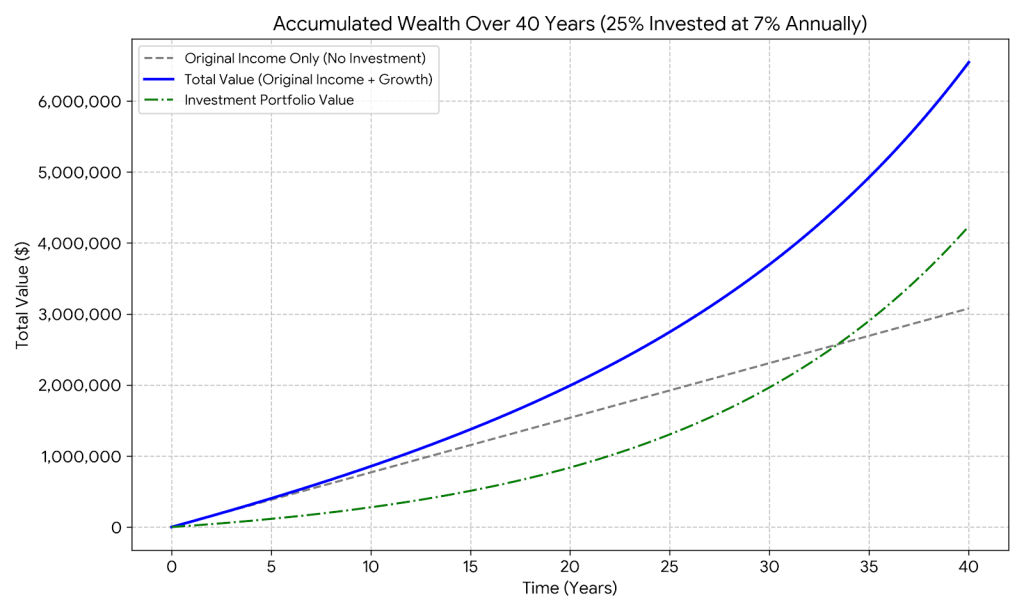
Total Income Earned: Over 40 years, your total gross income remains $3,078,400.
Cash Retained (75%): You keep $1,110 per week for regular spending/savings, which totals $2,308,800.00 over 40 years.
Principal Invested (25%): You contribute $370 per week into the investment, which amounts to an out-of-pocket contribution of $769,600.00.
Total Portfolio Value: Compounding annually at 7%, your investment portfolio grows to an impressive $4,236,568.80
$3,078,400.00 (Income from wage) + $3,466,968.80 (Growth Earned) = $6,545,368.80
Now that is a money engine firing on all cylinders! We have effectively double our earnings over our working lifetime.
One fun thing to note from this chart. Take a look at year 34. Do you see what I see? It’s the point at which the investment portfolio value overtakes the value of your lifetime earned income. This is the moment your money engine is working harder than you are and is what we love to see! If you could invest more money sooner (which would bend your curve even steeper), you could pull that timeline forward and find financial independence sooner.
Comparison Summary
Here is how the three investment rates compare after 40 years:
- 0% Invested: Total earnings of $3,078,400
- 10% Invested: Total earnings of $4,465,187.52$ (Portfolio is $1.69 Million)
- 25% Invested: Total value of $6,545,368.80$ (Portfolio is $4.24 Million)
Why Not Win?
It’s wild to me that more people are not harnessing the power of compound growth through investing. Especially people just entering the workforce. I want to run up to every young person and shake them by the shoulders. They have so much time. They have so much potential. But, sadly, most people do not understand the magic of compounding. It’s not intuitive and honestly, even as someone who’s built a money engine and now depends on it 100% to live, it’s still wild to think about. It still feels like a fairy tale.
But it’s not fantasy, it’s math. And you don’t just have take my word for it; have some fun with an investment calculator and play with your own numbers. How big can you make your money engine?
If you enjoyed this post, please subscribe to the weekly MWM email.
Investing ABCs: Net Worth
Published: 2026-06-19
This is my first post in my foundational knowledge series for investing. This series is for anyone who wants to start investing, but doesn’t know the first thing about how to begin. You don’t need to read this series in order, but you should read and learn all the ABCs before venturing forth to buy investment products.
Our topic today is understanding your Net Worth, how to calculate it, and how to use it to build wealth. Figuring out your net worth is not complicated and should take you less than 15 minutes (you may need to log into some apps and grab some balances, if you want to be 100% accurate).
The Math
Net Worth = Total Assets – Total Liabilities
Start by downloading my Net Worth Tracker from my Resources page or create your own spreadsheet.
If you are building your own, make a new table and list all the assets that you own, like a primary residence, other property, vehicles, savings account balances, investment accounts, pensions, etc. In a column next to each asset, jot down its market value. Market value is what you could sell them for today. Make a Total Assets row at the bottom and sum up the value of all your assets.
In a second table, list all your liabilities, which is everything you owe. Those will be mortgages, student loans, car loans, credit card balances, store card balances, Buy Now Pay Later balances (i.e. Klarna), personal loans, pay day loans, etc. Make a Total Liabilities row at the bottom and sum up the value of all your liabilities.
Subtract you total liabilities (everything that you owe) from your total assets (everything that you have) and voila, you now know your Net Worth.
Why It Matters
Knowledge is power. Without it, you are just driving blind.
Everyone intuitively knows that to build wealth you will need to make more money than you spend. While technically correct, this is a narrow view of wealth building which locks people into a “paycheck to paycheck” mentality. People limited to this mindset are like someone driving a car while only looking 3 meters ahead of themselves the entire drive and no help from a navigation system. As your Money Wise Mom, I want you to have a longer view. I want you thinking BIG PICTURE. I want you looking down the road to clearly see where your choices are leading you.
Let’s do a thought experiment and chart your financial life line’s trajectory (a.k.a. your trend line). You don’t need to bust out another spreadsheet to follow along (unless you really want to). You can do this in your head.
Your ultimate goal is to identify your choices that have lead to your current net worth and what future choices you can make to build a better tomorrow.
Key Take Away: Your financial life line is your net worth mapped over the course of your life.
Envision your financial life as a graph line on a chart. The X axis is your age and the Y axis is your net worth. In Year 0 you were born. Fortunately, as a Canadian, you were born with a blank slate, financially speaking. Babies have no debt and, typically, no assets. We all start at coordinates “0,0” on our financial life charts.
Now picture your financial life line extending out from year 0 up to today.
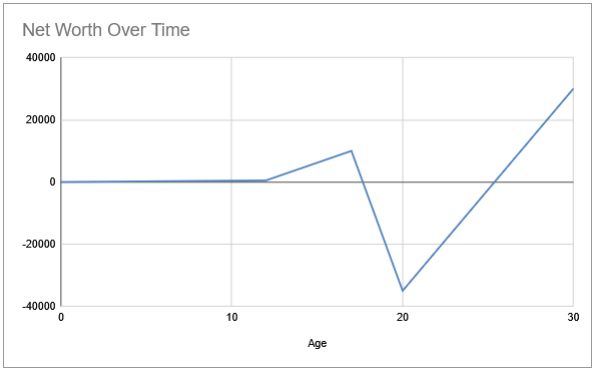
For most of us, it’s a flat line in our youth. As babies, we have parents or guardians who provide food, shelter, and the necessities of life. Some of us are privileged with parents who save money on our behalf for our education. This would nudge your line upwards. We get our first job and we start having choices. We might spend or save our income. It may nudge our line upwards a tiny wee bit, but typically everyone stays pretty close to zero during their first 16 years of life. Things start to get more exciting as we enter our late teenage years. We get to make even more choices! Some of those choices nudge our financial life lines up and others push it down. Earn a scholarship? Your line bumps up. Take on student loans? Your line dips down. Apply for your first credit card but don’t pay it off? Your line dips some more. When you get your first “real” job, the line hopefully climbs up thanks to savings from more income and, perhaps, a pension plan. Other choices will drag your line down, like financing a car or taking on other debts to support yourself as a fully baked adult.
The point is, your financial life line trends up and down, depending on the choices that you make. What direction is your financial life line heading right now? Is it on an upwards trajectory? How steep is the line? Are there choices that you’ve made that are dragging it down?
The car you buy, the partner you pick, the career you choose, where you live, and the debt you choose to take on – these are the very big life decisions that significantly impact your financial life line. If we want to build wealth, these big choices have far bigger impact than the many small spending decisions you probably focus on day to day.
Living within a balanced budget is good for you, but focusing solely on your spending habits does not build your wealth. You need goals that increase your net worth over time. You need your financial life line to trend up.
Predicting Your Future
Let’s take our thought experiment a step further. Picture your financial life line extending out from today until the day you die.
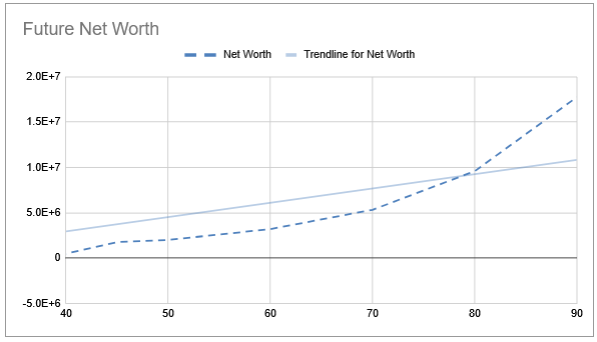
What do you want it to look like? Is the trajectory of your financial past going to lead you to a future you want? If you make no changes today, is the line trending up or down? It’s not likely to be a flat line. Life is a constant churn of change.
Predicting your own future is actually really hard. No one knows how long we have on this earth and what fun surprises are coming our way. But we can all predict that we will die, one day. Nobody gets out of here alive. You probably don’t want to work until the day you die. Let’s assume you are lucky enough to live long enough to retire one day. At what age do you want to stop working? Are you happy with the traditional 65-70 years old or do you want to retire younger? Will your financial life line rise high enough to provide a comfortable lifestyle in your sunset years? How do you know how much is enough? Do you want to leave a financial legacy for others or do you want to spend you wealth down to zero? So many big questions!
I hope this little thought experiment has helped you think about your money a bit differently than before. Your Net Worth over time is really powerful concept to understand. If you can start thinking about your net worth over years and decades, rather than just your monthly budget, you gain the wisdom to make decisions that impact your wealth. You set your future self up for success by making choices now to point your trend line up.
A Penny For Your Thoughts
Did this post make you think differently about your money over time? Does your past financial life line look like mine (flat line until about age 16)? Is there anything in my post that was unclear or confusing? Drop me a comment below!