
Confidence
Published: 2026-09-25
It takes a certain amount of confidence to make big money decisions.
I recall discussing retiring early with my husband, who looked me square in the eyes and said “Just don’t make me become a Walmart greeter, k?”. By which he meant, make sure your plan is rock solid and we won’t screw our future selves.
Gulp. Cool, no pressure, right?

His fear was that our plan would fail and we would have to go to back to work doing something we hate. My fear was that we would live a life of austerity but then not save up enough fast enough to retire early in a significant way. I did not want to live a life restricted in my 30s and 40s only to realize I only shaved 5 years off of my retirement date.
A Progression of Planning
I’ve used different systems over the years to motivate and guide our big money decisions. Having a plan that is mapped out by way of a spreadsheet has been my guiding light and essential to achieving our money goals.
The Debt Busting Years
In our debt repayment years, I was obsessed with Microsoft Money. This product no longer exists, but it was fantastic! Not only did it track our budget, it graphed all our debt repayment schedules over time, making it easy to see at glance exactly when we would be debt free. It also let us run scenarios, like what would happen if we upped our mortgage payment by $50 a week.
Having the ability to run scenarios made it easy to build a plan with my husband. Seeing the impact from paying off debt faster in terms of saving time and interested charges was very motivating. We were happy to lock in a spending plan that got us to our goal faster.
Want to build your own debt busting plan? Check out my Debt Busting section on my Handy Links page for online tools to track and run scenarios on paying down debt. Drop me a comment if you try it and let me know your impression.
The Saving Years
After our debt was handled, we transitioned to our saving years. I built a simple spreadsheet to project at what age we would hit our “number”.
If you are into FIRE (Financial Independence, Retire Early), you might already have a “number” that you are working towards. In FIRE, your “number” is a target amount in savings (a.k.a your nest egg) that is big enough to to cover your daily expenses from your investment gains.
In our debt busting years, we followed the Life of Pie method, meaning we had been saving 10% along side paying down debt with at least 15% of our net income. This meant we had a small nest egg already accumulated. This was my “ground zero nest egg” and which become seed money for my spreadsheet calculation. I then mapped for every year how much we would have based on 7% investment growth with a monthly savings rate of $2250. Our safe drawdown rate is 4% of our nest egg. After setting up our base case, I copied the table and made versions that showed how much faster we would reach our number with a savings rate to $3000, $4000, etc.
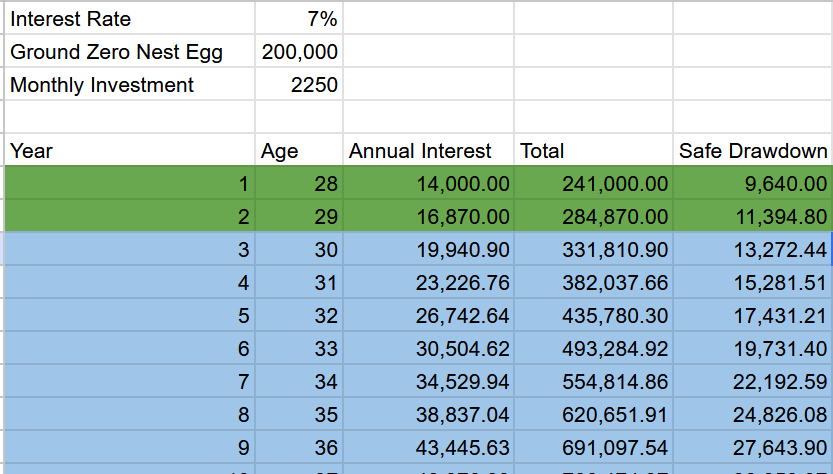
Seeing the year we should theoretically be able to leave our day jobs was very motivating! It still didn’t feel real, but we knew the numbers on the page couldn’t lie.
It’s worth noting that in our saving years, we adjusted the Life of Pie method and accelerated our savings rate, sometimes as high as 50% of our income. If you don’t care about retiring early, this is not something you need to worry about at all! Just follow the Life of Pie method, and you will be totally fine with a pretty fantastic life. But if you are FIRE curious, I highly recommend reading The Shockingly Simple Math Behind Early Retirement by Mr Money Mustache. This blog post changed my life! Then go ahead and devour the rest of his blog. It’s well worth the read!
Now a days there are much more sophisticated tools online that make my simple little spreadsheet look basic. If you are interested in trying some out, see an investment calculator called Smartasset, linked under my Handy Links under Investing, or the web app Projection Lab, linked under my Handy Links under Wealth Management. While these are very cool, you could also keep it basic like we did, and just build yourself a tidy little spreadsheet.
The FIRE Years
We are now in our FIRE years. We’ve retired early and now we need to manage and protect the nest egg so that it lasts into our traditional retirement years and beyond.
This is the probably the most nerve wracking phase. In order to pull the trigger and leave our day jobs, we REALLY needed to see the numbers mapped out.
To help us, about 3 or 4 years before we planned to retire at 45, I built an uber spreadsheet, which I will call our Projections spreadsheet. We still use it to this day to make big (and scary) money decisions.
Our Projections file maps out our annual income and expenses from the current year until we’re 95 years old. It also maps out our annual net worth, tracking assets and liabilities over time. Our expenses increase every year based on value for inflation, which we’ve set at 3%. Our investments grow annually based on a value for ROI (return on investment), which we’ve set at 7%. It also shows us the impact, over time, of drawing from our investment accounts, which will give us income now that we don’t have day jobs.
Our file is both simple and not simple, at the same time. It’s evolved heavily over the years, especially as we came closer to leaving our jobs. For us, it’s a guiding light that lets us know we’re gonna be okay. It’s also a tool that we call on when we have to make big life decisions. For example, when we returned to Canada, we used it decide where we could live and keep on budget. In this past year, we used it help us decide how much we could afford to spend on travel. We can’t account for everything in our monster of a spreadsheet, but we can get pretty darn close. That being said, FIRE is not for the faint of heart! If you want to FIRE, you need to know your numbers inside and out.
Bone Shaker
Last week we received some impactful news. Our tenant, who was renting out our “forever” home while we were in Australia, has given their notice. When we returned to Canada, we made a big life decision not to evict them immediately and continue renting while we spent time in another part of the country. Losing renters means that we are losing a revenue stream that helped offset some (not all) of the carrying costs for us to keep that property. In our dream scenario, our tenants would have stuck around for another year. With the big news, we need to re-assess our life plans going forward.

Queue the panic alarms? Actually, not at all. Sure, the news is a bit stressful, mostly as an interruption in the status quo of our lives. But we have a baseline plan, and now we just need to review and adjust accordingly. So we dusted off our trusty Projection spreadsheet and mapped out what this means for us financially, based on what we know today. And guess what? We should be okay. Our Projections have given us the confidence to know that we don’t need to rush into any panic based decisions. We will want to make some adjustments over the next 5 to 10 years and next year we won’t plan a big vacation like this year, but that doesn’t feel like a great sacrifice right now.
Confidence (Question Mark)
Where does confidence come from? To be clear, even with our spreadsheets and our life planning, it’s not all smooth sailing all the time. We still can get queasy stomachs about what the future will hold. But all we can do is make the best decisions we can with what we know today. That’s all any of us can do, really. For us, confidence comes from being organized, disciplined, and based on real numbers that make sense.
What’s Your Take?
Have you had to deal with a big financial change? Did you have a system in place? Were you able to lean on an emergency fund? Drop me a comment or an email, I would love to hear what you would do!
If you enjoyed this post, please subscribe to the weekly MWM email.
PSA: Set your survivor and beneficiary on your registered accounts
Published: 2026-08-14
If you have a TFSA or an RRSP, or you are considering opening one, this public service announcement is for you! I will focus on my experience with Wealthsimple, but even if your registered account sits somewhere else, this is still a call to action to review your account information on file with your financial institution.
Last year I moved my investment accounts from TD to Wealthsimple and, so far, the experience has been really positive. Except for one, kinda big (in my mind) thing.
Wealthsimple does not prompt you to set your registered investment accounts successor holder and/or beneficiary.
Registered accounts come in many flavours. You might recognize their acronyms: RRSP, TFSA, FHSA, RESP, and LiRA. (See my glossary for definitions).
In my experience, I opened registered investment accounts with Wealthsimple wihout having to specify a successor or a beneficiary. I only went looking at my accounts after a youtube video sparked my curiosity to check these settings and I found nothing had been defined. When I created my accounts, designating these important roles was not top of my mind, so it wasn’t done!
Why You Should Care
We’re all going to die someday. Most of us will leave behind loves ones who must deal with all the stuff we’ve accumulated over our lifetime, including our bank and investment accounts.
Just like writing a will, ensuring your registered accounts have up to date information defining who gets them when you die is a small gift you are giving to someone you love. It means there is less hassle and red tape transferring your money to the person you want to gift it to when you die.
Taking 10 now minutes now to jump online and check these settings will save a lot of time and hassle for your executor once you are gone.
If you want a deeper dive, these articles do a nice job outlining what happens should you die without having your registered account’s paperwork in order:
- https://will-kit.ca/tfsa-beneficiary-rules-canada/
- https://www.claret.ca/publications/naming-tfsa-successor-holder/
- https://lawyerinfo.ca/guides/ontario/wills-estate-ontario/probate-trust-ontario/dealing-with-a-deceaseds-tfsa-and-rrsp-in-ontario-probate/
It’s Not All About You (Or Maybe It Is)
Getting your paperwork is in order is the right thing to do and you should do it for your loved ones.
But you matter too! You also want to ensure your significant other(s) have their paperwork in order. Odds are, you will be the one left to pick up the pieces when they are gone. Do yourself a big favour and ask your partner(s) to confirm that you have been designated as the successor or beneficiary on their registered accounts.
Which Accounts Need What?
Different accounts need different people defined in specific roles. This article does a nice deep dive into registered accounts, plus other really important stuff like life insurance policies and pensions.
Here’s a quick chart to help you wrap your head around what you need to set for each type of registered account:
| Account Type | Role You Want to Define | What the Role Means |
|---|---|---|
| RRSP | Beneficiary | Receives the proceeds of your RRSP upon your death. This avoids probate. |
| RRIF | Successor Annuitant or Beneficiary | A successor annuitant continues receiving payments; a beneficiary receives a lump sum. |
| TFSA | Successor Holder or Beneficiary | A successor holder takes over the account without affecting TFSA room; a beneficiary receives a lump sum. |
| RESP | Successor Subscriber | Not a beneficiary, the appointed person to manage the RESP on behalf of the child. |
| FHSA | Successor Holder or Beneficiary | It depends. Check out “Types of Beneficiaries” and “Survivors” on this canada.ca page to understand the different cases. |
Yes, you must check every one of your registered accounts separately across all financial institutions.
Pro Tip: Create a spreadsheet listing all of your registered accounts across all institutions. Check or update each account and list who you’ve defined in specific roles. Referring back to this list in future will be much easier than going back to each account. Remember to review this spreadsheet as needed. For example, if you break up with your partner, or they pass away, you will want to update your account paperwork again.
Update your Wealthsimple Registered Accounts
For Wealthsimple clients, here is their guide on configuring your accounts. It explains the criteria of who can be named as survivors and/or beneficiaries (a very important distinction that you should understand before you begin): https://help.wealthsimple.com/hc/en-ca/articles/360058456753-Add-a-beneficiary-or-successor-to-your-registered-account
I found that the instructions for adding a beneficiary a bit lacking. Note that you must be on the web portal via a browser. At the time of this writing, the option doesn’t exist in the mobile app (I’m using the Android app).
- Login via a web portal and click into the specific registered account
- Click on the gear icon, and choose “Manage Beneficiaries” from the pop up menu
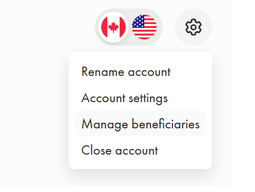
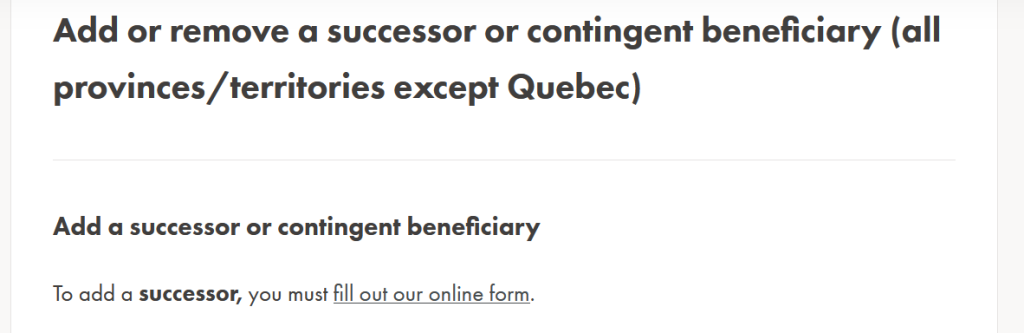
While you can manage beneficiaries online in your account info, you must follow different instructions to add a successor. Note that you need to use a specific online form.
Key Take Aways
- Call to Action: Ensure you and, if you have one, your significant other, have defined survivor-ship and beneficiaries so that whenever the inevitable happens (death comes for us all), accessing your major investment funds does not become a burden of red tape and delays during the worst of times.
- Everyone with a registered account, no matter which financial institution the accounts reside in, should ensure beneficiaries (or equivalent) are up to date
- You must check every account separately. Do your future self a favour and make a spreadsheet with each registered account and who you’ve designated. You can review it as needed, for example if you break up with your partner
If you enjoyed this post, please subscribe to the weekly MWM email.
Investing ABCs: MER, the Silent Wealth Killer
Published: 2026-08-07
This Investing ABCs series is for anyone who wants to start investing, but doesn’t know the first thing about how to begin. You don’t need to read this series in order, but you should read and learn all the ABCs before venturing forth to buy investment products.
When taking control of your financial future through self-directed passive investing, your approach should be to eliminate expensive middleman fees, invest globally across all major markets, and grow your wealth over time.
It’s important to understand that even if you skip the traditional financial advisor and buy ETFs online for “free”, you are still paying an underlying fee.
Enter the Management Expense Ratio (MER). MER is an annual fee you must pay to own Exchange-Traded Funds (ETFs) or mutual funds. All ETF and mutual fund investment products include MER fees. MER is expressed as an annual percentage of the fund’s total assets under management. A “high” MER will be 2% (or higher!) while a “low” MER is around 0.10%.
Even a “high” MER might seem like a tiny fractional percentage on a fund fact sheet, so why should you care? In truth, MER is arguably the single most important variable under your direct control as a passive investor.
Understanding what MER is, how it works, and why it drastically impacts long-term wealth accumulation will make you a wiser investor and help you win the money game.
MER is a hidden fee
MER is a silent wealth killer and it’s critical that you give it careful attention when building your portfolio.
Instead of sending you an annual invoice, fund providers deduct this fee automatically from each fund’s assets behind the scenes. This makes MER invisible unless you actively look for it.
MER is composed of two components:
- Management Fee: The fee paid to the fund company to pay portfolio managers, analysts, and cover institutional administration.
- Operating Expenses & Taxes: Administrative overhead, legal, auditing, regulatory filing fees, and applicable taxes (such as GST/HST in Canada).
Out performance is Rare; Fees Are Guaranteed
Active fund managers charge higher fees because they claim they will beat market performance through stock picking or market timing. However, historical data busts this as a myth and a fairy tale. Decades of data demonstrates that 80% to 90% of actively managed funds fail at their quest to beat their benchmark over a 10 to 15 year horizon. No one owns a crystal ball, so eventually managers get it wrong, plus high fees drag down performance. You always pay MER fees, regardless of how well the fund performed.
Passive investing aims to match market performance at the absolute lowest cost possible. You are not trying to beat the market (that is gambling!) you just want to ride the wave of average market returns. According to this guy, over the last 50 years Canada has posted a 10.3% nominal return and US has posted over 13%. That’s pretty darn great! As a passive investor with index funds, you accept these market returns as the growth you should see in your portfolio.
The primary factor determining whether your net returns beat some other investor holding the exact same index is what you are losing to in fees. This is why, when selecting the investment products to buy for your portfolio, the closer you can get your MER to zero, the more you guarantee that you keep virtually all of a market’s underlying return.
Fund Fees Vary, Buyer Beware
Not all funds are created equal. Knowing what constitutes a “good” MER helps you evaluate investment options:
| Investment Type | Typical MER Range | What You Are Paying For |
| Broad Market Passive ETFs | 0.03% – 0.25% | Automated indexing tracking major benchmarks (e.g., S&P 500, Total World). |
| All-in-One Asset Allocation ETFs | 0.15% – 0.25% | Complete, auto-rebalancing multi-asset portfolios (stocks + bonds). |
| Robo-Advisor Portfolios | 0.40% – 0.70% | ETF fees plus automated platform management and digital advice. |
| Actively Managed Mutual Funds | 1.50% – 2.50%+ | Human management, marketing, dealer trailers, and active trading costs. |
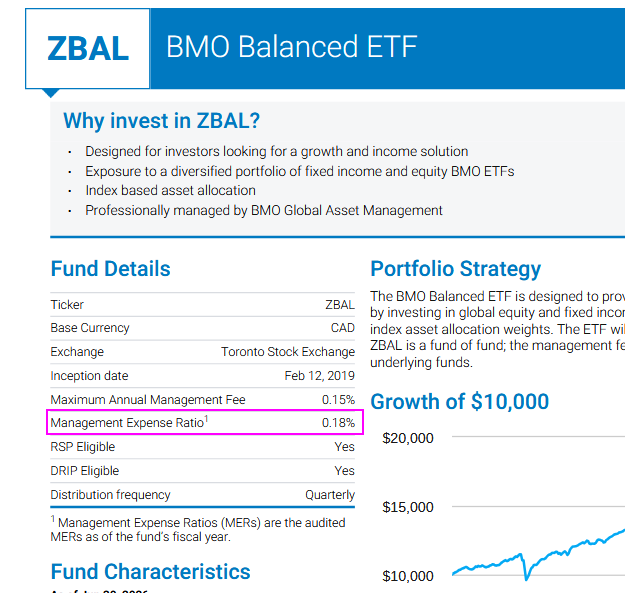
The MER for all funds can be found on their fact sheet. You can easily find the fact sheet for most funds be searching in an internet browser with the fund’s ticker symbol with the words “fact sheet”.
For example, check out the fact sheet for ZBAL here or search for it yourself with “ZBAL fact sheet”. Do you see where the MER is listed?
The Anti-Compounding Effect
To understand the true impact of MER, you should understand the double-edged sword of compounding. Just as compound interest accelerates wealth creation, compound investment fees accelerate wealth destruction.
When a fund charges a 2.00% MER, you are not simply losing 2% of your money that year; you lose the future growth that 2% would have generated for decades to come.
A Tale of Two Investors
Consider two investors, Maya and Liam. Both invest a lump sum of $100,000 into equity funds that achieve an average gross market return of 7% per year over 30 years.
- Maya chooses low-cost, self-directed passive indexing ETFs with an average MER of 0.10%.
- Liam stays in traditional, actively managed equity mutual funds with an MER of 2.00%.
Maya's Net Annual Return: 7.00% - 0.10% = 6.90%
Liam's Net Annual Return: 7.00% - 2.00% = 5.00%
Here is how their initial $100,000 grows over 30 years:
| Time Horizon | Maya (0.10% MER) | Liam (2.00% MER) | The “Fee Gap” Lost to Liam |
| 10 Years | $194,884 | $162,889 | $31,995 |
| 20 Years | $379,799 | $265,330 | $114,469 |
| 30 Years | $740,166 | $432,194 | $307,972 |
Don’t be a Liam
Despite starting with the exact same principal and achieving the exact same market performance before fees:
- Maya ends up with $740,166.
- Liam ends up with $432,194.
- Liam surrendered over $307,000—or roughly 41% of his potential final wealth—solely to fees.
A seemingly small 1.90% difference in annual fees compounded into a life-changing financial loss. For a self-directed investor, reducing your MER from 2.00% down to 0.10% effectively buys you years of additional retirement freedom.
Top 3 Takeaways for Self-Directed Investors
- MER is an Invisible Drain on Your Capital: Management Expense Ratios are subtracted daily behind the scenes before performance figures are reported. Check a fund’s fact sheet to know the exact percentage you are paying.
- Compound Fees Destroy Wealth Exponentially: A fee that sounds small on paper (like 1.5% to 2.0%) can consume over 30% to 40% of your long-term wealth accumulation due to lost opportunity costs and missed compound growth.
- Controlling Fees is Your Greatest Competitive Advantage: You cannot control global markets, inflation, or central bank interest rates. Controlling your MER by choosing broad-market, low-cost ETFs (targeting under 0.20% MER) is the single most reliable way to maximize your net investment returns.
If you enjoyed this post, please subscribe to the weekly MWM email.
Investing ABCs: Investment Accounts
Published: 2026-07-24
This Investing ABCs series is for anyone who wants to start investing, but doesn’t know the first thing about how to begin. You don’t need to read this series in order, but you should read and learn all the ABCs before venturing forth to buy investment products.
As I mentioned in my post You Can Manage Your Own Investments, if you can shop online, you have all the proficiency you need to open and use an account for investing. If you are totally new to investing, this primer is here to help you understand what a brokerage account is, what an investment account is, and a few of the most common types of investment accounts that you can open.
Brokerage Accounts
People who want to manage their own investments need a brokerage account.
There are many institutions that offer brokerage services where you can open an account. You might choose from online only providers like Questrade or Wealthsimple or one of the Canadian big 5 banks: Royal Bank of Canada (RBC), Toronto-Dominion Bank (TD), Bank of Montreal (BMO), Canadian Imperial Bank of Commerce (CIBC), and The Bank of Nova Scotia (Scotiabank).
A brokerage account is an account that you open with a provider. Once you have your brokerage account, you open one or more different types of investment accounts inside your brokerage account.
Let’s compare this to bank accounts, which you may have had since you were a kid. When you want a savings account, you open a personal banking account with the bank and they add a savings account to your personal banking account. A savings account is simple; it only holds cash.
When you want an investment account, you open a brokerage account with a provider (a.k.a a broker, which might be a bank) and request that they add an investment account to your brokerage account. Investment accounts are structured a little differently from a chequing or savings account. An investment account includes a cash portion plus your investment holdings. Inside your investment account you buy investment products. Investment accounts come in different types. You might recognize their acronyms: RRSP, TFSA, FHSA, RESP, LiRA, etc.
Here is a visual representation of what holding different accounts looks like. In the example, “Heather McNeil” has some of the most common types of accounts with TD Bank: a savings account, a spending account, a TFSA, and an RRSP. Notice that the investment accounts include cash and the investment holdings that Heather has purchased.
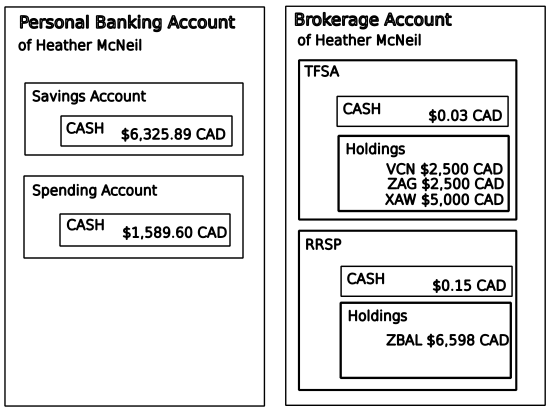
Deep Dive Note: When opening an investment account, you must specify which type you want. You cannot change the type of investment account after you’ve requested it, just like you cannot change your savings account into a chequing account. You would need to open the new chequing account, transfer your funds, and then close the savings account. Different types of investment accounts exist because each one has different tax advantage and rules for their contribution limits. You cannot turn a TFSA into an RRSP, but you might have a strategy to migrate money overtime from one to another. You can hold the same holdings inside your investment accounts. For example, you can own ZBAL inside your TFSA, RRSP, and FHSA.
Just like a bank account, you can have brokerage accounts at as many institutions as you like. If you don’t like the service you are getting at one provider, you can take your business to another provider. Just be prepared to pay admin fees when you leave.
Important: Brokerage fees vary across providers. Before opening a brokerage account, read the provider’s website to understand if they charge a flat fee per trade and if it’s a set amount when you buy products or if they have a percentage based fee when you sell products. You should also know if there is a minimum balance at which they reduce or waive certain fees.
My experience working with traditional banks is that they are still fairly paper driven, move slow, are prone to administrative hiccups, and you will have to call them to get support. The experience may not be smooth or user friendly. We used TD as our brokerage for most of our adult life. We switched to Wealthsimple a year ago and have found the user experience to be head and shoulders above working with a bank. Wealthsimple even paid for the admin fees TD charge to migrate our investment accounts.
Investment Accounts
There are two main categories of investment accounts. They are either a registered account or a non registered account. A registered account gives you a tax advantage while a non registered account does not. The type of tax advantage a registered account gives you is based on it’s type. Common registered account types are FHSA, TFSA or RRSP.
Regardless of the category and type of investment accounts, once you’ve opened your investment account, they all operate the same in relation to purchasing and selling investment products. They all include a cash portion and your holdings.
A non registered account will not provide you any tax refund today or any direct tax break in the future. In a non registered account, you purchase investments with money that you’ve already paid income taxes against. When you want to cash out your non registered investments, the growth (a.k.a capital gains) is reported as income on your income taxes. If you lose money when sell your investments, you report the loss on your income taxes. A loss reduces your taxable income.
Registered accounts (a.k.a tax advantaged investment accounts) have the same structure as your standard investment account. They have a cash component which you use to buy your investment products (a.k.a holdings). Registered accounts give you special advantages, either by reducing your taxable income now or by eliminating income taxes on future gains. All registered investment accounts are subject to tracking by the CRA for tax purposes; the brokerage is responsible for submitting reports about your contributions to the CRA.
Two of the biggest hurdles to getting started with investing is
1) knowing which type of registered account to invest in first and
2) deciding which investment products to buy.
Investment Account Types
| Account Type | Description | Requirements | Pros | Cons | How To Use |
|---|---|---|---|---|---|
| Non Registered Account | Contributions are after income tax dollars. You do not get a tax break | You must have a valid social insurance number (SIN) You must be 18 years of age or older. | You can invest your money in investment products. | No special tax advantages or tax refunds. | If you max out your contribution room on your tax-advantaged account types, your extra money must be invested through a non-registered account. |
| TFSA | Tax Free Savings Account Registered,Tax Advantaged Account Contributions are after income tax dollars. You do not get a tax break today, however growth within this account and all money withdrawn is never subject to income tax. | You must have a valid social insurance number (SIN) You must be 18 years of age or older You must only contribute up to your maximum contribution limit | Tax-Free growth and withdrawals forever Flexible for many goals due to a wide range of investment options Withdrawals create new contribution room in the following calendar year No max age Withdrawals don’t affect government benefits Annual contribution room carries forward No income requirement to contribute Estate Planning Benefits: If you designate your spouse as a “successor holder,” the TFSA can seamlessly transfer to them upon your death, maintaining its tax-free status. | Contributions are not tax-deductible Steer clear of over-contribution penalties There is no tax write off if you incur investment losses Be aware that foreign investments can be subject to withholding taxes from the foreign nation Your account is not protected from creditors (in most cases) It can be misused as a “Savings Account” only Potential for “Business Income” Scrutiny by the CRA if you trade inside it a lot (day trading) Possible to introduce complexity with multiple accounts across multiple institutions | A great fund for holding high growth investments (equity). If you believe your earning potential will significantly increase in future years or you are in a low tax bracket, focus on TFSA before RRSPs |
| RRSP | Registered Retirement Savings Plan Registered,Tax Advantaged Account Designed to help individuals save for retirement while offering significant tax advantages The underlying premise of an RRSP is that you contribute when you are in a higher tax bracket (during your working years) and withdraw when you are in a lower tax bracket (in retirement, when your income is typically lower). This can result in paying less overall tax on your savings. | You must be a resident of Canada You need a valid Social Insurance Number. You must have “earned income” to generate RRSP contribution room You must file a tax return Minimum Age: There is no minimum age to open an RRSP, as long as you have earned income and file a tax return. However, some financial institutions might have their own age of majority requirements to open certain investment accounts. Maximum Age: You can contribute to your RRSP up until December 31 of the year you turn 71. After this date, you can no longer contribute to your own RRSP, and you must convert it into a Registered Retirement Income Fund (RRIF), purchase an annuity, or withdraw the funds (which would be fully taxable) | Every dollar you contribute reduces your taxable income for the yearInvestments within your RRSP grow tax-free. You don’t pay any tax on the interest, dividends, or capital gains earned inside the plan until you withdraw the money.Potential for Lower Lifetime Tax RateSpousal RRSP OpportunitiesGenerally, funds held within an RRSP are protected from creditors in the event of bankruptcyHome Buyers’ Plan (HBP) allow you to withdraw up to $60,000 (as of 2024) from your RRSP to use as a down payment for a first home, tax-free, provided you repay the amount within 15 yearsLifelong Learning Plan (LLP): You can withdraw up to $10,000 per year, to a maximum of $20,000, to finance eligible full-time education or training for yourself or your spouse/common-law partner, tax-free, provided you repay the amount within 10 years.Contribution Room Carries Forward: If you don’t use all your available RRSP contribution room in a given year, it carries forward indefinitely, allowing you to catch up on contributions in future years. | All withdrawals from an RRSP (except for those under the HBP or LLP, which require repayment) are considered fully taxable income in the year they are withdrawn. This is the “tax deferral” part of the equation.Impact on Income-Tested Benefits: Withdrawals from an RRSP (and later, a RRIF) are considered income and can reduce your eligibility for income-tested government benefits in retirement, such as Old Age Security (OAS) and Guaranteed Income Supplement (GIS). This is a significant concern for lower-income retireesMandatory Conversion and Minimum Withdrawals: By December 31 of the year you turn 71, your RRSP must be converted into a Registered Retirement Income Fund (RRIF) or used to purchase an annuity. Once converted to a RRIF, you are required to withdraw a minimum amount each year, which is taxable, regardless of whether you need the income or not. These minimum withdrawal rates increase with age.Lost Contribution Room on Withdrawal: Unlike a TFSA, if you make a withdrawal from your RRSP (outside of the HBP or LLP), that contribution room is lost forever and does not get re-added in future years.Withholding Tax on Withdrawals: When you withdraw funds from an RRSP before it’s converted to a RRIF (and even from a RRIF beyond the minimum withdrawal), a withholding tax is applied at the time of withdrawal. While this is a pre-payment of taxes, it means you don’t get the full amount upfront.Less Flexible for Short-Term Goals: Because withdrawals are taxable and result in lost contribution room, RRSPs are generally not ideal for short-term savings goals where you might need access to your money before retirement.Tax Refund Management: While the tax deduction is a pro, if you don’t reinvest your tax refund back into your RRSP (or another savings vehicle), you are effectively losing out on some of the long-term benefits of the plan. Spending the refund diminishes the overall tax efficiency. | A great fund for long term retirement savings and for reducing your total income tax over your lifetime If you are focusing on equity investments in your TFSA to maximize growth, consider keeping stable investments, like bonds, in your RRSP If you believe you’re at the height of your earning potential and can use an RRSP to lower your tax bracket, prioritize RRSP contributions. Have the self discipline to always invest the annual tax refund. |
| RESP | Registered Education Savings Plan Registered,Tax Advantaged Account Designed to allow adults to save for the education of minors. | You and the minor must each have a valid social insurance number (SIN) You must be 18 years of age or older. | The Canadian government adds grants on top of money you’ve contributed annually. | Funds may only be used to pay for eligible education expense. If the beneficiary does not pursue post-secondary education, there may be limitations on accessing the funds. | A great way to grow money over time to help someone else pursue post secondary education. |
Investment Products
Investment products, referred to as your holdings, is the stuff that you buy inside your investment account. Ideally, it’s the stuff that pays you dividends and grows in value over time. Examples of investment products are ETFs (Exchange Traded Funds), Stocks, Bonds, Mutual Funds, and GICs (Government Income Certificates).
We will take a closer look at investment products in a future post. In the meantime, let me know where you are on the path to managing your investments. Do you already own investment accounts? Are they self-directed or managed by a provider? If you have investment accounts, do you know what you are holding in them?
If you enjoyed this post, please subscribe to the weekly MWM email.
Life of Pie: Future
Published: 2026-05-01
This is post #4 in my Life of Pie series. If you’ve new here, I recommend that you read my previous post Building Your Financial House, which gives you a high level picture of healthy finances, and then I’m Ready Now What?, which preps you for the posts in this series. I recommend that you jump back to those posts once you’re ready to begin making positive changes in your life!
Here are my previous posts in this series:
The Future slice, IMHO, is the best slice of all the slices! This one has the power to change your life for the better and in a really big way. Your Future slice includes your safety net (a.k.a. your emergency fund) and your investments, which is how you grow your money engine. Your money engine allows your future self, one day, to stop trading their time for money (a.k.a. working). In between saving for disasters and saving for financial independence, you might also choose to save for major expenses like a down payment on a house or post secondary education. Everything in this slice is about building a better future. How cool is that?
Some key concepts for success.
- Funding your future is not negotiable. Even if you have debt, you save. This is the path to a balanced financial life.
- Your savings are a monthly bill that you pay yourself. Automate it so that it comes out of your spending account the day after you get paid.
- Keep your Emergency Fund in a separate, no fee, high interest savings account. There are many to choose from, just do a quick search online.
- Never do anything with your savings that you don’t understand. That includes sending it to “some money guy” who “handles” all your investing for you.
- Money + Time is magic! Compound interest is the growth that you need in your life. If you are not putting money aside now, you are missing out in a major way.
Choose Your Level
This slice comes in beginner, normal, and advanced modes.
Beginner: If you have debt, your financial house is on fire, and prioritizing getting rid of it forever is critical. But setting up your Emergency Fund is also critical, as is putting money away now for your future self. Your strategy should be do a little of all these things, as they are all important. Once you are out of debt, you can contribute to your future in a more meaningful way. In Beginner Mode, your target for Future is 10%.
Reality Check: I want to add a note here for those who are struggling. If you can get your financial life in balance and your Life of Pie slices are relatively on target, then great! However, I’ve lived below the poverty line and I’ve had to survive on overdraft (so gross, I know!). I know that sometimes after covering the essentials, money can be impossibly tight. I urge you to do what you can, no mater how little. During our tightest times, we put a meager $20 a month away in our emergency fund. Savings is a muscle. Just like going to the gym, the most important thing is to show up and do what you can. Showing up for your future means putting something away every month. If it’s very small, your goal will be to increase that amount as your financial life improves. Focus on ways to reduce expenses and increase your income to get your Future slice up to at least beginner mode.
Normal: When you are debt free, you have the power to supercharge your future! You can now divert the 15% that would have gone to debt payments to yourself! Huzzah!
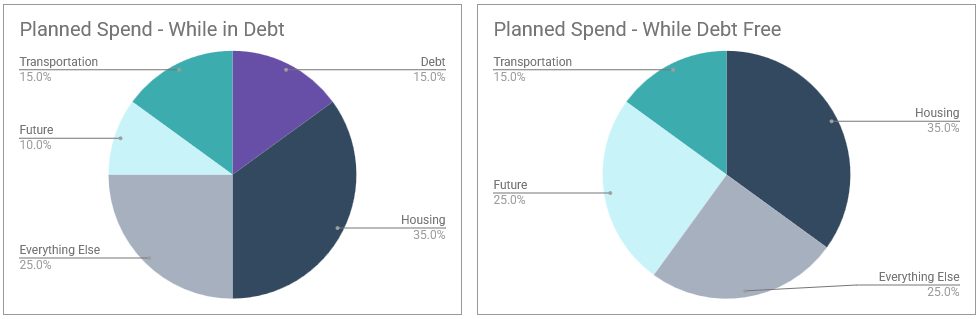
Advanced: Do you recall how I said in Life of Pie: Housing that “Life is squishy, and your pie will likely never be 100% perfect.”? Once you’ve got your financial life dialed in, you might explore increasing your Future slice to be even bigger! The bigger this slice, the faster you reach your goals. This is not required for a healthy financial life, but for me, understanding this option was a game changer and it allowed my husband and I to reach financial independence by the time we were each 45. If this sounds interesting to you, I encourage you to read the blog post that changed my life in a big way “The Shockingly Simple Math Behind Early Retirement” by Mr. Money Moustache. It’s his writings that educated me the most and opened my eyes to an alternative lifestyle that really resonated with my value system. In our most plush days, my husband and I would squirrel away around 60% of our income to Future (a.k.a our investments). The key is, in your working years you always save at least 10%-25%. However, as you win at life, you can choose to reduce other slices and put even more. You get to decide for yourself how much is enough.
Cool Story, Bro. Now What?
The deeper strategies on how to allocate your future savings warrants it’s own post. For now, you should accomplish three actions
- Update your spending plan based on whichever “mode” fits your life right now. If you are using the MWM Budget Tracker the beginner and normal modes are there by default.
- Setup a separate no fee, high interest, savings account for your emergency savings. If you don’t know or have investments, then just shove all your Future money into savings for now.
- Automate your savings. If you have a regular pay day, schedule a transfer to your savings account a day or two after it hits your spending account.
Now give yourself a high five and go play some video games! You did great things today.
If you enjoyed this post, please subscribe to the weekly MWM email.
Build Your Financial House
Published: 2026-03-08
If you want to build an awesome life, you need to build an awesome house. Financially speaking.
Let’s think about your financial house from a bird’s eye view. Let’s fly way way way up and then turn to peer down at the ground. Can you see your house? I can. It’s a beautifully carved marble building on a lush field of green and yellow. It’s sturdy and strong and secure. It’s built to last the ages. And it’s based on four pillars.
The pillars of your financial house are:
- A Spending Plan – Live within a spending plan that allocates a healthy balance of money for housing, transportation, life, future, and, if needed, debt busting.
- Emergency Savings – A multi layer safety net to protect yourself from unforeseen events that risk bringing down your financial house.
- Zero Debt – Debt is an anchor that drags you down. You need to bust all high interest consumer debt as quickly as you can. Save yourself!
- Investments – Buy a diversified portfolio – as much as you can afford, every month, without fail, into boring stuff that has low management fees. We’ll talk about knowing what you can afford in a future post!
These four focus areas are your building blocks for financial security.
Zooming out paints the picture of what you want and creates the blueprint of what you need. With your blueprint in hand, your next steps will be to zoom in and start building from your plan. In future posts, I’ll help you construct each pillar, methodically and systematically.
But, for now, don’t over think it! Enjoy the view and know that once all these pieces are in place, you will have put your financial house in order.
As a closing thought, let me mention that, on top of our four pillars, stands financial independence (FI). People reach FI when their investments provide more income than their projected expenses. If they accomplish this surplus before the generally accepted age of retirement, they can retire early (RE). This is the basis for FIRE, an extreme personal finance movement, which marries FI with RE. Online discussions concerning FIRE include big feelings and heated debates. The great news is that you don’t need to choose right now if you want to pursue FIRE. By building your financial house based on the pillars I’ve listed above, you’ve created a foundation for FIRE, should you ever want to pursue it! The only difference is that you would adjust your spending plan to focus more on the future to make investing a priority over spending.