
Life of Pie: Debt
Published: 2026-04-16
This is post #3 in my Life of Pie Series. Ideally you have already read my previous posts Building Your Financial House, which gives you a high level picture of healthy finances, and then I’m Ready Now What?, which gets you prepped for the posts in this series. If you haven’t read both of those, I recommend that you jump back to them now before proceeding.
You can read my previous posts in this series here:
Today we are going to tackle the big, bad, D word. Money can come with big feelings, which is especially true when dealing with our debt. Remember, we strive to be intentional with our money and want to make decisions that serve us well now and in our future. We don’t want to be reactive or blinded by emotions. It’s worth taking a moment of self-reflection to understand how you feel about debt. Do you have debt and tend to avoid dealing with it? Do you dread getting bills in the mail? Does debt make you nervous or sick to your stomach? Does your debt control you or do you control your debt?

Debt is a tool that will harm you if you don’t understand how to use it. Ironically, when you are struggling with bills or unable to live within your means, you’re best off avoiding debt at all costs; this is the opposite of what most people do. Conversely, when you are flush with cash and living large, using debt wisely can boost your wealth building powers; this can feel unnatural to people who’ve worked hard to bust debt or have spent their lives avoiding it. Think of it as the Nanny McPhee rule of thumb. If you feel like you have no choice but to go into debt to purchase something, odds are you should be going without until you can afford it. If you don’t need to go into debt but have the option, you can run the numbers and make a logical decision. It can make financial sense if the debt enables you to direct cash on hand towards more lucrative pursuits. This is a more advanced concept that we’ll put to the side for now. I’ll revisit it for you with a deep dive in a future blog post.
The “Debt” portion of your money pie has some unique properties.
- The MWM Life of Pie budget pulls mortgage payments into the Housing slice and car leases or car loans into the Transportation slice. While these are debts, we separate these two obligations specifically to encourage being intentional with your money for a well balanced life.
- Within the debt slice we track all credit cards, store cards, student loans, pay day loans, buy now pay later schemes, (i.e. Klarna), personal loans, RRSP loans, and lines of credit or HELOCs. Hopefully you already took inventory of your debts in MWM Homework Day 0 and can now easily update your copy of the MWM Budget Tracker with your monthly debt obligations.
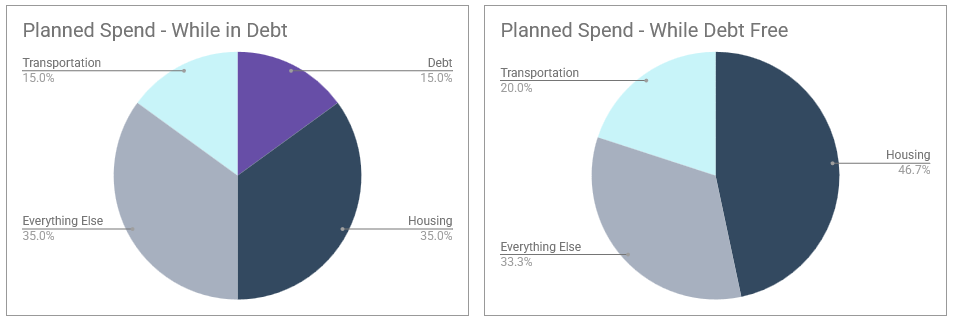
- If you have debt, your MWM monthly spending target is 15%
- Your % MUST be enough to cover your minimum debt payments. If that’s over 15% of your monthly income, that’s a pretty big deal. You owe more than you can comfortably afford.
- For now, note that a debt busting repayment plan ideally gets you debt free in 3 years or less; We’ll go over debt busting techniques in a future blog post.
- You will not be able to get ahead on paying down debt unless you’re paying off your minimums plus additional payments to reduce your total balance owing.
Check In: How Did you Do?
Check your “Debt” slice against the MWM model budget. How did you make out?
I don’t have any debt – Amazing! You are debt free! Congratulations!!! You do not need a debt slice at all. In your case, the 15% that you would have needed to pay back debt will be added to your “Future” pie slice and will make all your money goals happen faster! Woowhoo! To dig into that gem, check out my next post in the Life of Pie series.
I have debt, but my minimums are less than 15% of my income – The good news is that you are on target. If your minimum payments obligations are less than 15%, keep your budget padded to 15% rather than reducing it. Use the extra money towards paying off your highest interest debt faster.
I am over target :/ – If your percentage is over 15%, your financial house is on fire! This is an emergency and you should take drastic measures until you can get your budget back on track. Emergency measures may include
- earning more money by working more at your main gig or by taking on a side hustle
- selling things for cash
- advising friends and family that for birthday and holiday gifts you need money more than things right now
- cutting back on all or most discretionary spending
Remember, emergency measures should be temporary. Once your debt levels are within 15% of your normal income, you can ease off and breathe a bit easier.