
Travel Budgeting Tip: Track As You Go
Published: 2026-10-22
In a previous post, I shared with you the system we use to budget for travel.
A quick recap:
- Have a system for vacation savings. For example, move money every month into a seperate account.
- Build a budget for your trip. Decide before you start booking tickets if you can afford the trip you want to take.
- Save up, then spend. Having vacation money saved up before you leave is the best way to skip money stress. No guilt travel is the best travel!
We are currently on the final days of our Sweden trip. I am writing this post from an Airbnb in downtown Copenhagen, sipping my morning coffee, full from a yummy homemade breakfast of eggs and avocado toast. Sadly, I am without my beloved hot sauce, but sometimes you just have to make due when you are on the road.
It’s been a great trip! We reconnected with some old friends, ate and drank our fill, and visited so many cool historical sites.
Living in the moment, I find it’s easy to feel a bit overwhelmed with so much spending. Converting prices on the fly can be a bit tricky and we have been tapping our cards left and right.
Luckily, we keep our cool by sticking to our travel budget. We chose to stay in control by tracking our spending as we go.
Each evening, when we’re back at our accommodations, we take 2 minutes to update our tracking spreadsheet before settling in. We use saved receipts if we paid cash or we use the days transactions from our Wise app if we paid by card.
It only takes a couple of minutes. And it means that we know 100% on a daily basis if we are under or over spent. And, since we know we are under budget, we can enjoy a guilt free final dinner out on our last day before heading home.
If you enjoyed this post, please subscribe to the weekly MWM email.
Confidence
Published: 2026-09-25
It takes a certain amount of confidence to make big money decisions.
I recall discussing retiring early with my husband, who looked me square in the eyes and said “Just don’t make me become a Walmart greeter, k?”. By which he meant, make sure your plan is rock solid and we won’t screw our future selves.
Gulp. Cool, no pressure, right?

His fear was that our plan would fail and we would have to go to back to work doing something we hate. My fear was that we would live a life of austerity but then not save up enough fast enough to retire early in a significant way. I did not want to live a life restricted in my 30s and 40s only to realize I only shaved 5 years off of my retirement date.
A Progression of Planning
I’ve used different systems over the years to motivate and guide our big money decisions. Having a plan that is mapped out by way of a spreadsheet has been my guiding light and essential to achieving our money goals.
The Debt Busting Years
In our debt repayment years, I was obsessed with Microsoft Money. This product no longer exists, but it was fantastic! Not only did it track our budget, it graphed all our debt repayment schedules over time, making it easy to see at glance exactly when we would be debt free. It also let us run scenarios, like what would happen if we upped our mortgage payment by $50 a week.
Having the ability to run scenarios made it easy to build a plan with my husband. Seeing the impact from paying off debt faster in terms of saving time and interested charges was very motivating. We were happy to lock in a spending plan that got us to our goal faster.
Want to build your own debt busting plan? Check out my Debt Busting section on my Handy Links page for online tools to track and run scenarios on paying down debt. Drop me a comment if you try it and let me know your impression.
The Saving Years
After our debt was handled, we transitioned to our saving years. I built a simple spreadsheet to project at what age we would hit our “number”.
If you are into FIRE (Financial Independence, Retire Early), you might already have a “number” that you are working towards. In FIRE, your “number” is a target amount in savings (a.k.a your nest egg) that is big enough to to cover your daily expenses from your investment gains.
In our debt busting years, we followed the Life of Pie method, meaning we had been saving 10% along side paying down debt with at least 15% of our net income. This meant we had a small nest egg already accumulated. This was my “ground zero nest egg” and which become seed money for my spreadsheet calculation. I then mapped for every year how much we would have based on 7% investment growth with a monthly savings rate of $2250. Our safe drawdown rate is 4% of our nest egg. After setting up our base case, I copied the table and made versions that showed how much faster we would reach our number with a savings rate to $3000, $4000, etc.
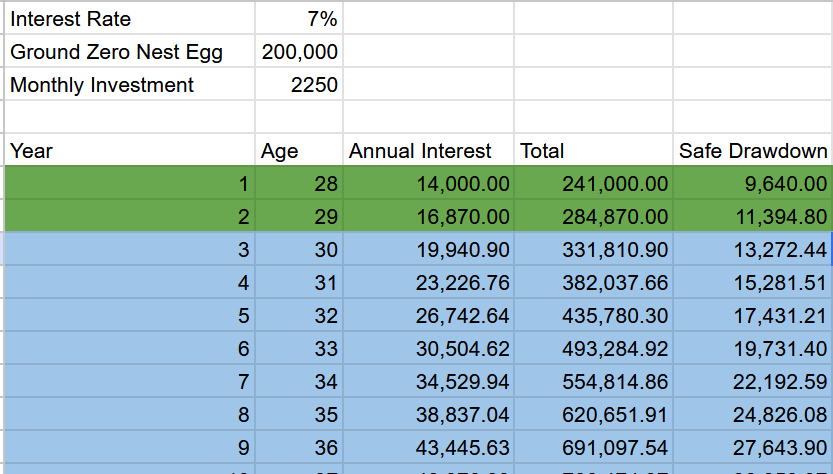
Seeing the year we should theoretically be able to leave our day jobs was very motivating! It still didn’t feel real, but we knew the numbers on the page couldn’t lie.
It’s worth noting that in our saving years, we adjusted the Life of Pie method and accelerated our savings rate, sometimes as high as 50% of our income. If you don’t care about retiring early, this is not something you need to worry about at all! Just follow the Life of Pie method, and you will be totally fine with a pretty fantastic life. But if you are FIRE curious, I highly recommend reading The Shockingly Simple Math Behind Early Retirement by Mr Money Mustache. This blog post changed my life! Then go ahead and devour the rest of his blog. It’s well worth the read!
Now a days there are much more sophisticated tools online that make my simple little spreadsheet look basic. If you are interested in trying some out, see an investment calculator called Smartasset, linked under my Handy Links under Investing, or the web app Projection Lab, linked under my Handy Links under Wealth Management. While these are very cool, you could also keep it basic like we did, and just build yourself a tidy little spreadsheet.
The FIRE Years
We are now in our FIRE years. We’ve retired early and now we need to manage and protect the nest egg so that it lasts into our traditional retirement years and beyond.
This is the probably the most nerve wracking phase. In order to pull the trigger and leave our day jobs, we REALLY needed to see the numbers mapped out.
To help us, about 3 or 4 years before we planned to retire at 45, I built an uber spreadsheet, which I will call our Projections spreadsheet. We still use it to this day to make big (and scary) money decisions.
Our Projections file maps out our annual income and expenses from the current year until we’re 95 years old. It also maps out our annual net worth, tracking assets and liabilities over time. Our expenses increase every year based on value for inflation, which we’ve set at 3%. Our investments grow annually based on a value for ROI (return on investment), which we’ve set at 7%. It also shows us the impact, over time, of drawing from our investment accounts, which will give us income now that we don’t have day jobs.
Our file is both simple and not simple, at the same time. It’s evolved heavily over the years, especially as we came closer to leaving our jobs. For us, it’s a guiding light that lets us know we’re gonna be okay. It’s also a tool that we call on when we have to make big life decisions. For example, when we returned to Canada, we used it decide where we could live and keep on budget. In this past year, we used it help us decide how much we could afford to spend on travel. We can’t account for everything in our monster of a spreadsheet, but we can get pretty darn close. That being said, FIRE is not for the faint of heart! If you want to FIRE, you need to know your numbers inside and out.
Bone Shaker
Last week we received some impactful news. Our tenant, who was renting out our “forever” home while we were in Australia, has given their notice. When we returned to Canada, we made a big life decision not to evict them immediately and continue renting while we spent time in another part of the country. Losing renters means that we are losing a revenue stream that helped offset some (not all) of the carrying costs for us to keep that property. In our dream scenario, our tenants would have stuck around for another year. With the big news, we need to re-assess our life plans going forward.

Queue the panic alarms? Actually, not at all. Sure, the news is a bit stressful, mostly as an interruption in the status quo of our lives. But we have a baseline plan, and now we just need to review and adjust accordingly. So we dusted off our trusty Projection spreadsheet and mapped out what this means for us financially, based on what we know today. And guess what? We should be okay. Our Projections have given us the confidence to know that we don’t need to rush into any panic based decisions. We will want to make some adjustments over the next 5 to 10 years and next year we won’t plan a big vacation like this year, but that doesn’t feel like a great sacrifice right now.
Confidence (Question Mark)
Where does confidence come from? To be clear, even with our spreadsheets and our life planning, it’s not all smooth sailing all the time. We still can get queasy stomachs about what the future will hold. But all we can do is make the best decisions we can with what we know today. That’s all any of us can do, really. For us, confidence comes from being organized, disciplined, and based on real numbers that make sense.
What’s Your Take?
Have you had to deal with a big financial change? Did you have a system in place? Were you able to lean on an emergency fund? Drop me a comment or an email, I would love to hear what you would do!
If you enjoyed this post, please subscribe to the weekly MWM email.
Be Methodical
Published: 2026-07-31
A few weeks ago my husband looked up from his computer at me and said “It wasn’t supposed to be this easy.”
We were looking at our long term financial projections together and discussing future scenarios. The “It” he was referring to was retiring at the ripe old age of 45.
Was it easy? Kinda yeah, but also kinda no. When you are saving for the future the steps are basic.
Step 1: Save and invest money every month
Step 2: There is no step two.
That’s essentially all you need to do, when you boil it all down to basics.
To save, you must spend less than you make every month. Give every dollar a job by having a spending category for Future money. Be intentional with how much you want to commit every month and do this before you set your spending categories for discretionary stuff, like entertainment or eating out. Your Future money is transferred every month automatically to your savings and investments, like a bill you pay yourself. The best investments, in my opinion, are passive and are a balanced portfolio in a set ratio of growth stuff and safe stuff that is built on global markets with low fees.
Then you just rinse and repeat for a few decades or so. That’s really all we did.
However, while the steps are simple, the execution is not easy. We live in a world that is designed to make spending (and overspending) too easy and wants to turn us all into dissatisfied customers. The key to my family’s success has been to build in simple but effective systems that counter mindless consumerism.
The Systems that we Built
We’re both very systems oriented. We both like doing something better, or more efficiently, or simpler. So we used that to our advantage when it came to money.
Here are some of our systems that made living below our means feel easy.
#1 Meal Planning
For decades, we have taken time together to plan our meals for the upcoming week. We write down what meals we want every day and, as we write down the meal, we list out the ingredients we need to buy with a running tally of what each will cost. And, since we’re both computer nerds, I have spreadsheets back to January 1st 2010 to prove it. Go ahead and ask me what I had for dinner at any point between then and now. I likely can tell you, along with how much it cost to make!
Some of the benefits of meal planning include
- The cost of our weekly meals stay within our weekly food budget.
- Being intentional and agreeing on when to eat out; We like cooking at home together, so eating out or ordering in food is generally reserved for special occasions. What we make tastes better anyway!
- We plan to eat our leftovers and very, very, rarely throw away food.
- We work the current week’s sales into our plan and use that to guide what meals we will make.
- If you are feeling too busy or too lazy, you can copy last week’s meal plan and just tweak as needed. (or see what you ate two years ago and copy/paste that into this week)
- We plan our food around life events. We note down significant events in our weekly food plan so that we are planning food that is convenient based on time constraints and our location
- We spend time together making our food and sit together to eat it. This adds a lot of joy to our lives!
- We can meal prep for the week, if we want to. It’s sometimes easier to make a big batch of food on the weekend and portion it out for meals over the week.
#2 Planned Spending
We’ve operated from a spending plan (a.k.a budget) since we moved into our first apartment together. But a budget is not a system. The system is how we use our spending plan to make decisions together.
- Build a budget that you can live on based on your income and expenses and commit to it.
- Live life, spending money as planned.
- When you get a raise, review the spending plan together and decide if you will save/invest more to reach your goals faster or allocate the money to specific budget line or a mix of those two choices.
- When you want to make a life change, like finance a car or buy a house or move somewhere new, make a copy of your spending plan and plunk in the new numbers. Does the budget balance without sacrificing your saving and investing goals?
#3 Where is it going to live?
One of our house rules is that we won’t acquire stuff unless we already know where it’s going to be stored in our home. Sometimes that means we need to reduce other items to make room for new to us things. Sometimes it means we choose to not acquire the thing.
Our system is to set our intention to not own too many things, and then we check in with each other before making a purchase.
#4 Evaluating Joy
How much time working was required to afford the item you want? For example, how many hours of work did it take to afford eating at that restaurant? Did you enjoy it? Was it worth it?
Our system is to set our intention to appreciate our discretionary spending. We talk about money choices on a monthly basis and decide if there are spending habits we want to focus on or let go.
We don’t buy coffee, except on a road trips. We like the stuff we make at home, it doesn’t produce disposable waste, and it costs a fraction of buying from a shop.
When we were first married, I loved the idea of fresh flowers. They seemed like a luxury, and for a young couple living below to poverty line, they were! But over time, I found they were not bringing me joy in the same way anymore. I didn’t want flowers that lasted a week and then died. I preferred potted plants, which last longer and are less expensive over time.
We evaluate joy on the big stuff too. At one point, we considered buying a camp (a.k.a. cottage). But maintaining a second property would have been drudgery and would have required a significant chunk of our take home pay (which translated to time we would have had to commit to working). Through that lens, we knew renting a camp on occasion would bring us more joy than owning one.
#5 Fill up life with Free First
There are so many cool things to fill up your time with! If you want to spend less, so that you can save more, lean into filling up your calendar with free (or very low cost) stuff first. The “system” here is to be intentional; make a list of activities that you are looking forward to for the next season and then block in time in your calendar to do some of them. You may find that you are so busy with free/low cost activities that you really have to find time for any expensive excursions.
- Play cards
- Go to the library, Read books
- Practice yoga by following free YouTube videos
- Go on a hike with friends
- Take your kids and/or pets to the park
- Wander around your downtown
- Go to street fairs and festivals in your town
- Swim at a public beach
- Have a friend over for tea
- Host a table top game night
- Play free online games with friends
- Play D&D with friends
- Practice playing music or singing
- Draw or paint
- Go to an art gallery or a museum
- Learn a new language with a free app
===
These are some of my systems that let me live more intentionally. What systems do you have?
If you enjoyed this post, please subscribe to the weekly MWM email.
We’ve Started a Generosity Budget
Published: 2026-07-10
Budgeting is kinda like working out.
At first it sucks. A lot.
It takes time to build your money muscles.
But if you can keep showing up and putting in the work, eventually, you start to see the gains. And, eventually, you might even kinda, sorta, start to like it.
Starting a budget from scratch is work. Sticking to it is discipline. Fine tuning it is dedication.
Building your money muscles is important. You will depend on them to do the heavy lifting when it’s time to make life choices. From spending to saving to investing, these habits should be cultivated with care and intention.
But you can go to far. Like a body building who can barely turn their head anymore, you can over develop muscles and loose flexibility.
My husband and I may be at risk of over development. We’ve lived and thrived by assigning every dollar a job. We’ve fine tuned and adjusted out spending plan thoughtfully for decades. Generally it’s served us well. We discuss and negotiate changes to our spending plan at our monthly money meeting. We don’t impulse buy. We have mine and yours money. It’s structured. It’s simple. It’s a well oiled machine.
But it’s also a bit rigid. In our early marriage, we were focused on busting our debt. Then we started to focus on building our nest egg. We picked a lifestyle we were comfortable with and that kept our cost of living in line with our values and our goal to retire early.
The thing is, when you give every dollar a job and you want to retire early, you get pretty good at living without. We chose to be a one vehicle family. We chose to limit our holiday spending. If our clothing budget was maxed out, we chose to wait until there was room in the budget again to buy more stuff.
Living this way spills over to social life. We were generous with our time. We’ve always said yes to helping friends and family move. We’ve pitched in on home renos. We’ve helped dig garden beds and erect retaining walls. But we wouldn’t, as a general rule, be dropping by with a Timmies for everyone.
We found ways to work social spending into our budget. We hosted an annual boxing day house party. It was an all day open house and we offered food and drinks, inviting all our friends over to play cards and tabletop games. At our 25th anniversary, we rented out the back of a pool hall, flew our daughter and her partner in, and hosted a pool tournament, covering everyone’s drink and food for the night. We love that style of generosity.
But smaller acts of generosity, until recently, did not have a place in our budget. The only bucket we had, was Miscellaneous Spending, which is our catch all money for everything from hand cream to rechargeable batteries. This meant we rarely spent money on small acts of kindness, mostly because it just wasn’t something that we thought about intentionally. Our money muscles were too puffed and our wallets just were not flexible in that way.
It’s been on my mind recently. I want to be less transactional and feel freer to perform small acts of kindness. I believe your planned spending is a reflection of your values. Value cars? Your budget will illustrate that. Value clothes? Your budget will prove it. Value eating out? You budget will show that too.
I want to be someone who can fund small acts of kindness and I want my budget to show it.
So, last month, I proposed that we add a Generosity line to our planned spending budget. We agreed to have a modest amount available to allow us to be generous in a spontaneous way. It’s early days, but we’ve both already dipped into our generosity fund on separate occasions, which was great. However, we didn’t spend it to zero, indicating that we have room to stretch ourselves more. We need to build up that money muscle.
We will continue to work at it, and I will keep you posted.
How does generosity show up in your life?
If you enjoyed this post, please subscribe to the weekly MWM email.
Life of Pie: Life
Published: 2026-05-10
This is post #5 in my Life of Pie series. If you’ve new here, I recommend that you read two posts before jumping into this series. Building Your Financial House gives you a high level picture of healthy finances, and I’m Ready Now What? includes actions to prep you for the posts in this series. I recommend that you jump back to those posts once you’re ready to begin making positive changes in your life!
Here are my previous posts in this series:
We’ve come to our fifth and final slice of pie, which I call Life. The Life slice is everything not already accounted for in your spending plan. It includes food, alcohol, holiday spending, gifts, clothing, subscriptions, vacations, and everything else you spend money on.
If you’ve been keeping track of your portion sizes, you will already know that your Life slice target size is 25% of your total income. If you haven’t already, you should now update your spending plan and add a Life category. If you are using the MWM Budget Tracker the beginner and normal modes are there by default.
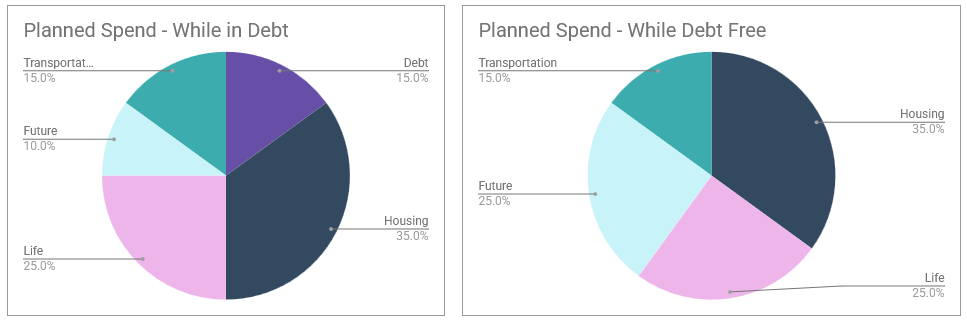
As I’ve mentioned before, your spending plan may not completely match our Money Wise Mom targets. However, here are some guidelines to help give you some perspective.
- Under 25% – It’s unlikely that you spend less than 25% on Life unless you’re doing it intentionally. We all need to live and we all like our creature comforts. We exist in a consumerist world and from the moment we open our eyes and check our phones to when our head hits the pillow at night, we are inundated with ads and nudges designed to make us spend, spend, spend!
To be clear, spending your money on Life is a good thing. Everyone needs balance and this category has the power to bring you joy beyond the bare necessities. Spending under 25% is an indicator that you are restricting your budget.
If you are in debt and motivated to bust it fast, you might restrict your life spending voluntarily for a set period of time. It’s okay to grind it out, as long as you have a clear debt repayment plan with a defined timeline. Typically I recommend creating a debt payment plan you can achieve in three years or less. If you want to grind, I feel that more than 12 months of restricted spending becomes unsustainable.
There is one other situation that warrants intentionally reducing your Life spending. If you find yourself in a financial emergency, like losing your primary income, the Life category is the one with the most fat to trim. If you’re between jobs, you might shift from a normal spending plan to an emergency spending plan, which is designed to stretch your emergency fund for as long as possible. Cutting out gifts, holiday spending, vacations, and other optional things will give you more time to find another source of income. - Over 25% – Overspending on Life may indicate that you are doing really well or that the roof of your financial house is on fire. We have to look to the other slices of your pie to get the full picture. If your housing and/or transportation spending is low and you have no debt, those slices will be reduced and you might redirect those dollars into Life. You should also have a healthy grasp on your Future slice and be saving and investing wisely. Do not screw over your future self so that you can eat out every day. Remember, you are looking for balance.
Alternatively, if you spend over 25% on Life and you have debt or your Future slice is missing, your financial house is on fire! It’s time for action. You need to get your budget in order and you must change your spending habits. Failing to do this means you cannot not have a happy, balanced, financial life.
To Track or Not To Track
You probably will not be surprised when I tell you that I am a tracker. I like spreadsheets and goals and projections. Since I was a teenager I’ve tracked my spending. If you are like me, you will want an app or a spreadsheet and you will enjoy taking the time categorize where all your money goes every month.
However, maybe you are not like me. Perhaps tracking your spending is a habit that just doesn’t work for you. If that’s the case, I recommend you simplify your spending system.
For me and my husband, we buy all our life stuff on a credit card that gives us 2% cash back. We always pay our monthly balance in full. We do not pay credit card interest.
Note: If you are beginner level, this method is not for you. Even I, who’s been tracking money closely for over 30 years, can get surprised at how big the credit card bill is when it arrives.
We host our own budget tracking software called Actual Budget (we’ve used simple spreadsheets and other apps in the past) which is not perfect but it allows us to categorize every transaction and all the data is stored locally. We pay a small annual fee for a third party service called SimpleFIN which acts as a bridge between our budget software and our credit and bank accounts. SimpleFIN allows us to import every transaction into Actual Budget on demand. We don’t need to use SimpleFIN, as we could manually import all our transactions, however, theoretically, it’s saving us time and hassle. Honestly though, how much time and hassle saved is debatable – all our financial accounts have multi factor authentication enabled which SimpleFIN cannot bypass which IS a hassle and takes time.
Anyways, if you are not into tracking every transaction there is an incredibly simple and fool proof method to ensure you do not overspend. Some people call it the jar method and some people call it the envelope method.
The Jar Method
When we were in our debt busting years, we followed the Jar Method. It’s a simple system where you live on cash. It is impossible to overspend if you follow this method correctly. The basic approach is this
- When you get paid, you withdraw the 25% that you are planning to spend on Life
- Put the money in a jar on top of your fridge
- Spend this money for life stuff
- If you spend all the money, you have to wait until next month!
- If you have money left over, you can leave it to accumulate and spend it in the future
You only need one jar but I recommend that you have a few to balance your spending. Our big categories are Vacations, Food, Clothing, Gifts, Christmas, Roller Derby, Entertainment (his and hers), and Misc Spending. We do not take a vacation every month, however we allocate money to this category every month until it’s pooled up enough to use.
If you want to go above and beyond, place receipts spent into the jar. Then once a month, before you replenish the cash, take out all your receipts and jot down in your budget tracker where the money went. This is a simple step if you want to start tracking your spending. You may also be amazed at how quickly you forget what you bought over the past four weeks!
If you are not a fan of living on cash, you could simulate the jar method by moving 25% of your pay to a separate bank account and spend it from there. Some institutions allow you to have multiple accounts or allow you to “earmark” money into categories inside one savings account. The key is that you move only the 25% amount that you plan to spend down over the next 30 days.
How Rich Do You Feel?
How you feel about your money is a shifty thing. Feeling like you don’t have enough money sucks. The Life slice can get pretty emotional. The key is to be intentional with your spending. Want to know a trick that’s served us well over the years? Any time we adjust our Life budget, we ask ourselves “What would make us feel rich?”. Once upon a time, we had debt to pay off and low income and therefore, no room for alcohol in our budget. Eventually we busted our debt and earned more. We then got to sit down together and decide where to up our spending. Yeehaw! Going from nothing to something felt luxurious!
We also periodically trim back on spending that we no longer care about. At some point, we agreed that eating out didn’t really bring us joy. So we ditched planning to spend on that but planned a good sized food budget so that we could eat out once in a blue moon but make yummy meals at home together, which we loved.
Your spending habits and priorities will change over time. Your spending plan should be updated as well to put more money towards things that bring you joy and limit or remove spending that you no longer care about.
If you enjoyed this post, please subscribe to the weekly MWM email.
Life of Pie: Future
Published: 2026-05-01
This is post #4 in my Life of Pie series. If you’ve new here, I recommend that you read my previous post Building Your Financial House, which gives you a high level picture of healthy finances, and then I’m Ready Now What?, which preps you for the posts in this series. I recommend that you jump back to those posts once you’re ready to begin making positive changes in your life!
Here are my previous posts in this series:
The Future slice, IMHO, is the best slice of all the slices! This one has the power to change your life for the better and in a really big way. Your Future slice includes your safety net (a.k.a. your emergency fund) and your investments, which is how you grow your money engine. Your money engine allows your future self, one day, to stop trading their time for money (a.k.a. working). In between saving for disasters and saving for financial independence, you might also choose to save for major expenses like a down payment on a house or post secondary education. Everything in this slice is about building a better future. How cool is that?
Some key concepts for success.
- Funding your future is not negotiable. Even if you have debt, you save. This is the path to a balanced financial life.
- Your savings are a monthly bill that you pay yourself. Automate it so that it comes out of your spending account the day after you get paid.
- Keep your Emergency Fund in a separate, no fee, high interest savings account. There are many to choose from, just do a quick search online.
- Never do anything with your savings that you don’t understand. That includes sending it to “some money guy” who “handles” all your investing for you.
- Money + Time is magic! Compound interest is the growth that you need in your life. If you are not putting money aside now, you are missing out in a major way.
Choose Your Level
This slice comes in beginner, normal, and advanced modes.
Beginner: If you have debt, your financial house is on fire, and prioritizing getting rid of it forever is critical. But setting up your Emergency Fund is also critical, as is putting money away now for your future self. Your strategy should be do a little of all these things, as they are all important. Once you are out of debt, you can contribute to your future in a more meaningful way. In Beginner Mode, your target for Future is 10%.
Reality Check: I want to add a note here for those who are struggling. If you can get your financial life in balance and your Life of Pie slices are relatively on target, then great! However, I’ve lived below the poverty line and I’ve had to survive on overdraft (so gross, I know!). I know that sometimes after covering the essentials, money can be impossibly tight. I urge you to do what you can, no mater how little. During our tightest times, we put a meager $20 a month away in our emergency fund. Savings is a muscle. Just like going to the gym, the most important thing is to show up and do what you can. Showing up for your future means putting something away every month. If it’s very small, your goal will be to increase that amount as your financial life improves. Focus on ways to reduce expenses and increase your income to get your Future slice up to at least beginner mode.
Normal: When you are debt free, you have the power to supercharge your future! You can now divert the 15% that would have gone to debt payments to yourself! Huzzah!
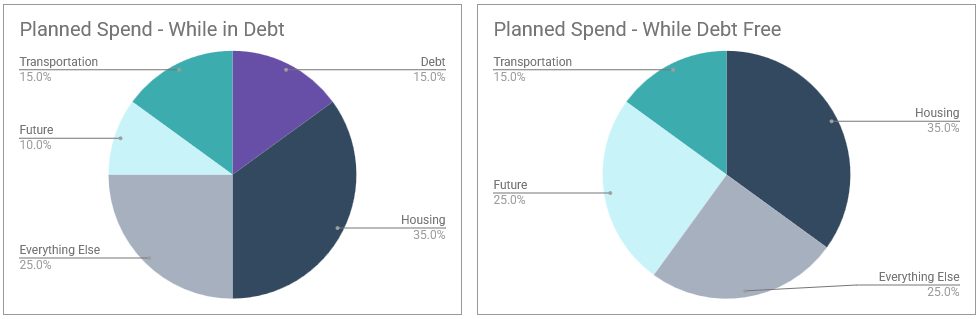
Advanced: Do you recall how I said in Life of Pie: Housing that “Life is squishy, and your pie will likely never be 100% perfect.”? Once you’ve got your financial life dialed in, you might explore increasing your Future slice to be even bigger! The bigger this slice, the faster you reach your goals. This is not required for a healthy financial life, but for me, understanding this option was a game changer and it allowed my husband and I to reach financial independence by the time we were each 45. If this sounds interesting to you, I encourage you to read the blog post that changed my life in a big way “The Shockingly Simple Math Behind Early Retirement” by Mr. Money Moustache. It’s his writings that educated me the most and opened my eyes to an alternative lifestyle that really resonated with my value system. In our most plush days, my husband and I would squirrel away around 60% of our income to Future (a.k.a our investments). The key is, in your working years you always save at least 10%-25%. However, as you win at life, you can choose to reduce other slices and put even more. You get to decide for yourself how much is enough.
Cool Story, Bro. Now What?
The deeper strategies on how to allocate your future savings warrants it’s own post. For now, you should accomplish three actions
- Update your spending plan based on whichever “mode” fits your life right now. If you are using the MWM Budget Tracker the beginner and normal modes are there by default.
- Setup a separate no fee, high interest, savings account for your emergency savings. If you don’t know or have investments, then just shove all your Future money into savings for now.
- Automate your savings. If you have a regular pay day, schedule a transfer to your savings account a day or two after it hits your spending account.
Now give yourself a high five and go play some video games! You did great things today.
If you enjoyed this post, please subscribe to the weekly MWM email.
Life of Pie: Debt
Published: 2026-04-16
This is post #3 in my Life of Pie Series. Ideally you have already read my previous posts Building Your Financial House, which gives you a high level picture of healthy finances, and then I’m Ready Now What?, which gets you prepped for the posts in this series. If you haven’t read both of those, I recommend that you jump back to them now before proceeding.
You can read my previous posts in this series here:
Today we are going to tackle the big, bad, D word. Money can come with big feelings, which is especially true when dealing with our debt. Remember, we strive to be intentional with our money and want to make decisions that serve us well now and in our future. We don’t want to be reactive or blinded by emotions. It’s worth taking a moment of self-reflection to understand how you feel about debt. Do you have debt and tend to avoid dealing with it? Do you dread getting bills in the mail? Does debt make you nervous or sick to your stomach? Does your debt control you or do you control your debt?

Debt is a tool that will harm you if you don’t understand how to use it. Ironically, when you are struggling with bills or unable to live within your means, you’re best off avoiding debt at all costs; this is the opposite of what most people do. Conversely, when you are flush with cash and living large, using debt wisely can boost your wealth building powers; this can feel unnatural to people who’ve worked hard to bust debt or have spent their lives avoiding it. Think of it as the Nanny McPhee rule of thumb. If you feel like you have no choice but to go into debt to purchase something, odds are you should be going without until you can afford it. If you don’t need to go into debt but have the option, you can run the numbers and make a logical decision. It can make financial sense if the debt enables you to direct cash on hand towards more lucrative pursuits. This is a more advanced concept that we’ll put to the side for now. I’ll revisit it for you with a deep dive in a future blog post.
The “Debt” portion of your money pie has some unique properties.
- The MWM Life of Pie budget pulls mortgage payments into the Housing slice and car leases or car loans into the Transportation slice. While these are debts, we separate these two obligations specifically to encourage being intentional with your money for a well balanced life.
- Within the debt slice we track all credit cards, store cards, student loans, pay day loans, buy now pay later schemes, (i.e. Klarna), personal loans, RRSP loans, and lines of credit or HELOCs. Hopefully you already took inventory of your debts in MWM Homework Day 0 and can now easily update your copy of the MWM Budget Tracker with your monthly debt obligations.
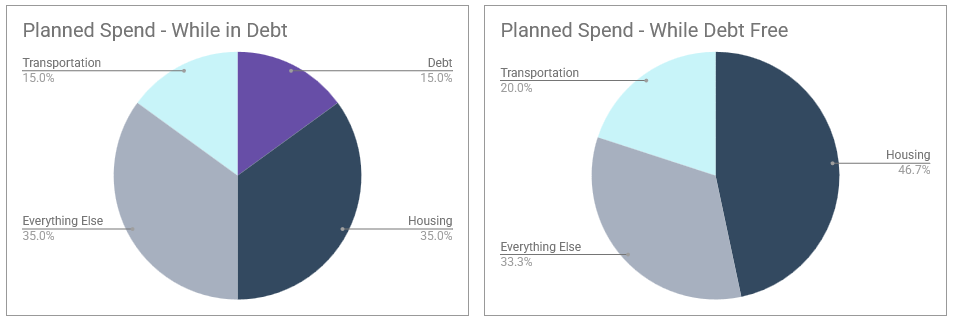
- If you have debt, your MWM monthly spending target is 15%
- Your % MUST be enough to cover your minimum debt payments. If that’s over 15% of your monthly income, that’s a pretty big deal. You owe more than you can comfortably afford.
- For now, note that a debt busting repayment plan ideally gets you debt free in 3 years or less; We’ll go over debt busting techniques in a future blog post.
- You will not be able to get ahead on paying down debt unless you’re paying off your minimums plus additional payments to reduce your total balance owing.
Check In: How Did you Do?
Check your “Debt” slice against the MWM model budget. How did you make out?
I don’t have any debt – Amazing! You are debt free! Congratulations!!! You do not need a debt slice at all. In your case, the 15% that you would have needed to pay back debt will be added to your “Future” pie slice and will make all your money goals happen faster! Woowhoo! To dig into that gem, check out my next post in the Life of Pie series.
I have debt, but my minimums are less than 15% of my income – The good news is that you are on target. If your minimum payments obligations are less than 15%, keep your budget padded to 15% rather than reducing it. Use the extra money towards paying off your highest interest debt faster.
I am over target :/ – If your percentage is over 15%, your financial house is on fire! This is an emergency and you should take drastic measures until you can get your budget back on track. Emergency measures may include
- earning more money by working more at your main gig or by taking on a side hustle
- selling things for cash
- advising friends and family that for birthday and holiday gifts you need money more than things right now
- cutting back on all or most discretionary spending
Remember, emergency measures should be temporary. Once your debt levels are within 15% of your normal income, you can ease off and breathe a bit easier.
If you enjoyed this post, please subscribe to the weekly MWM email.
I’m Ready! Now What?
Published: 2026-03-16
Cool, you just read my last blog post building your financial house and you’re ready to “get better at money”! But what now?
Rest assured, we will dive into our first pillar, which is our spending plan, in due course. Before we deep dive into that topic, let’s set you up for success. Here are a few tips and a little bit of homework so that when we start building our spending plan, you will really be ready to go.
Set Yourself Up for Success
Your calendar is a reflection of what matters to you. If you care about fitness, you will have dedicated time for activities that make you sweat. If you care about your friends, you might have a standing monthly brunch meetup. The same is true for money. If you want to get serious about your money, you’re going to start setting aside time to deal with it.
Prep Work
- Block out 1 hour of focus time
- Pick a time when you will have the energy to focus and a place to work that is distraction free.
Pro Tip #1: When planning focus time, be realistic and be intentional. Planning to dive into money stuff at 8pm on Thursday night after an exhausting day is not ideal.
Pro Tip #2: Commit to focus time. Set your phone to do not disturb and shutdown your email. I have a timer on my phone called “Focus Time” which helps me remain dedicated to the planned task and pulls me out when my time is up. - Pick a location. Choose a quiet spot where you can truly focus. If you can access most of you financial information from a personal laptop or your phone, you might go to the library for an hour. Or, consider heading into work early one day. Or simply find a room at home where you can shut the door. The key is to find a distraction free location, just know that you will need access to your financial accounts and bills.
- Book it in. Now let’s make it official and add it to your calendar. Call it “MWM Homework Day 0”. Do it now. I will wait.
- Pick a time when you will have the energy to focus and a place to work that is distraction free.
MWM Homework Day 0 – Gathering Intel
You did it! You dedicated time to “get better with money”. Don’t forget to set your focus timer and let’s begin.
- Create a worksheet. Either on a piece of paper or create a new spreadsheet.
- Create a section for Income
- Write down your monthly net income.
- If you get a salary with a relatively stable pay cheque, you just need a recent pay-stub. Or check deposits made to your bank account.
- If you have a variable income (tips, gig work, varying hours), I recommend that you grab your last 12 months of income (pay stubs, invoices, income transactions from your bank account). Add up the 12 months and divide by 12. This gives you a reasonable number to expect on a monthly basis.
- You know your situation best. Your goal is pick a reasonable monthly income that you can safely expect to earn every month.
- If you are in a household with multiple earners, jot down the income for each person separately. If you don’t know what their income is, make a follow up action item for yourself. You need to gather this information to make a spending plan for your household.
- For many people, income from employment may be their only source. If you have other income streams (dividends from investments, rental income, government grants or programs, spousal support, etc.) add entries for these as well. If these are not regular monthly amounts, you can add up what you would have received over the past 12 months and divide by 12 to give you a monthly estimate to work with for now.
- Write down your monthly net income.
- Below is the list of information you are going to gather. This is a generic list, so skip any information that is not applicable to you. For example, if you don’t own a car, you will skip “Car Insurance”. You will find this information in physical documents or digital copies.
For each item in this list, add an entry on your worksheet with the monthly value. If something is paid annually, either make note of that or use the divide by 12 trick to estimate your monthly expense.
- Monthly rental or mortgage payment (you likely can jot this down off the top of your head, but if you’re unsure, check your bank transactions)
- Condo or Homeowner Association (HOA) Fees
- Home or Tenant Insurance Bill
- Automobile Insurance bill
- Car loan(s) (either from a monthly statement, your original loan schedule, or the per-authorized transaction from your bank transactions)
- Other transportation costs. For each of these ones, total up your bank transactions from the last 3 months and divide by 3.
- Transit Costs (bus, Uber, train, metro, taxi, Lyft, Uride, etc)
- Fuel or EV charging costs )
- Tolls
- Parking Fees
- One recent utility bill for Water, Hydro/Electricity, Gas, and household Internet
- Your last statements for all your credit accounts. Remember to include
- Credit cards (Visa/Mastercard)
- Retail store charge cards
- Pay day loan statements
- Medical debt payments
- Personal loans (jot down the total amount you owe and what you pay back monthly)
- A list of any buy now, pay later outstanding balances. (BNPL, Pay in 4, Afterpay, Klarna, Affirm, Sezzle, Zip)
- A recent mobile phone bill
Stop the clock, you’re done! Give yourself a HUGE pat on the back for the amazing work! I’m very proud of you. That was a lot of deep dive work and I know gathering all that information can be daunting. Keep worksheet intel handy; we’ll be using them to build a spending plan to check if your money life is in balance.
If you enjoyed this post, please subscribe to the weekly MWM email.
Build Your Financial House
Published: 2026-03-08
If you want to build an awesome life, you need to build an awesome house. Financially speaking.
Let’s think about your financial house from a bird’s eye view. Let’s fly way way way up and then turn to peer down at the ground. Can you see your house? I can. It’s a beautifully carved marble building on a lush field of green and yellow. It’s sturdy and strong and secure. It’s built to last the ages. And it’s based on four pillars.
The pillars of your financial house are:
- A Spending Plan – Live within a spending plan that allocates a healthy balance of money for housing, transportation, life, future, and, if needed, debt busting.
- Emergency Savings – A multi layer safety net to protect yourself from unforeseen events that risk bringing down your financial house.
- Zero Debt – Debt is an anchor that drags you down. You need to bust all high interest consumer debt as quickly as you can. Save yourself!
- Investments – Buy a diversified portfolio – as much as you can afford, every month, without fail, into boring stuff that has low management fees. We’ll talk about knowing what you can afford in a future post!
These four focus areas are your building blocks for financial security.
Zooming out paints the picture of what you want and creates the blueprint of what you need. With your blueprint in hand, your next steps will be to zoom in and start building from your plan. In future posts, I’ll help you construct each pillar, methodically and systematically.
But, for now, don’t over think it! Enjoy the view and know that once all these pieces are in place, you will have put your financial house in order.
As a closing thought, let me mention that, on top of our four pillars, stands financial independence (FI). People reach FI when their investments provide more income than their projected expenses. If they accomplish this surplus before the generally accepted age of retirement, they can retire early (RE). This is the basis for FIRE, an extreme personal finance movement, which marries FI with RE. Online discussions concerning FIRE include big feelings and heated debates. The great news is that you don’t need to choose right now if you want to pursue FIRE. By building your financial house based on the pillars I’ve listed above, you’ve created a foundation for FIRE, should you ever want to pursue it! The only difference is that you would adjust your spending plan to focus more on the future to make investing a priority over spending.