
Investing ABCs: Investment Accounts
Published: 2026-07-24
This Investing ABCs series is for anyone who wants to start investing, but doesn’t know the first thing about how to begin. You don’t need to read this series in order, but you should read and learn all the ABCs before venturing forth to buy investment products.
As I mentioned in my post You Can Manage Your Own Investments, if you can shop online, you have all the proficiency you need to open and use an account for investing. If you are totally new to investing, this primer is here to help you understand what a brokerage account is, what an investment account is, and a few of the most common types of investment accounts that you can open.
Brokerage Accounts
People who want to manage their own investments need a brokerage account.
There are many institutions that offer brokerage services where you can open an account. You might choose from online only providers like Questrade or Wealthsimple or one of the Canadian big 5 banks: Royal Bank of Canada (RBC), Toronto-Dominion Bank (TD), Bank of Montreal (BMO), Canadian Imperial Bank of Commerce (CIBC), and The Bank of Nova Scotia (Scotiabank).
A brokerage account is an account that you open with a provider. Once you have your brokerage account, you open one or more different types of investment accounts inside your brokerage account.
Let’s compare this to bank accounts, which you may have had since you were a kid. When you want a savings account, you open a personal banking account with the bank and they add a savings account to your personal banking account. A savings account is simple; it only holds cash.
When you want an investment account, you open a brokerage account with a provider (a.k.a a broker, which might be a bank) and request that they add an investment account to your brokerage account. Investment accounts are structured a little differently from a chequing or savings account. An investment account includes a cash portion plus your investment holdings. Inside your investment account you buy investment products. Investment accounts come in different types. You might recognize their acronyms: RRSP, TFSA, FHSA, RESP, LiRA, etc.
Here is a visual representation of what holding different accounts looks like. In the example, “Heather McNeil” has some of the most common types of accounts with TD Bank: a savings account, a spending account, a TFSA, and an RRSP. Notice that the investment accounts include cash and the investment holdings that Heather has purchased.
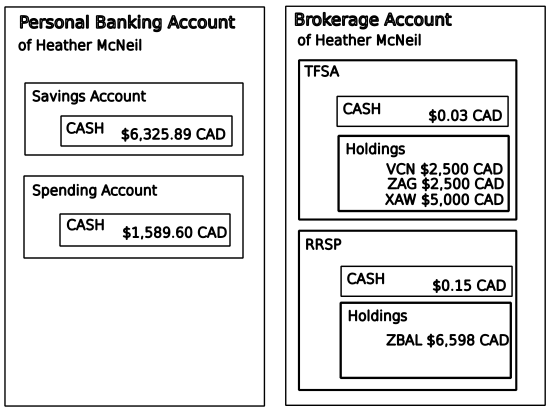
Deep Dive Note: When opening an investment account, you must specify which type you want. You cannot change the type of investment account after you’ve requested it, just like you cannot change your savings account into a chequing account. You would need to open the new chequing account, transfer your funds, and then close the savings account. Different types of investment accounts exist because each one has different tax advantage and rules for their contribution limits. You cannot turn a TFSA into an RRSP, but you might have a strategy to migrate money overtime from one to another. You can hold the same holdings inside your investment accounts. For example, you can own ZBAL inside your TFSA, RRSP, and FHSA.
Just like a bank account, you can have brokerage accounts at as many institutions as you like. If you don’t like the service you are getting at one provider, you can take your business to another provider. Just be prepared to pay admin fees when you leave.
Important: Brokerage fees vary across providers. Before opening a brokerage account, read the provider’s website to understand if they charge a flat fee per trade and if it’s a set amount when you buy products or if they have a percentage based fee when you sell products. You should also know if there is a minimum balance at which they reduce or waive certain fees.
My experience working with traditional banks is that they are still fairly paper driven, move slow, are prone to administrative hiccups, and you will have to call them to get support. The experience may not be smooth or user friendly. We used TD as our brokerage for most of our adult life. We switched to Wealthsimple a year ago and have found the user experience to be head and shoulders above working with a bank. Wealthsimple even paid for the admin fees TD charge to migrate our investment accounts.
Investment Accounts
There are two main categories of investment accounts. They are either a registered account or a non registered account. A registered account gives you a tax advantage while a non registered account does not. The type of tax advantage a registered account gives you is based on it’s type. Common registered account types are FHSA, TFSA or RRSP.
Regardless of the category and type of investment accounts, once you’ve opened your investment account, they all operate the same in relation to purchasing and selling investment products. They all include a cash portion and your holdings.
A non registered account will not provide you any tax refund today or any direct tax break in the future. In a non registered account, you purchase investments with money that you’ve already paid income taxes against. When you want to cash out your non registered investments, the growth (a.k.a capital gains) is reported as income on your income taxes. If you lose money when sell your investments, you report the loss on your income taxes. A loss reduces your taxable income.
Registered accounts (a.k.a tax advantaged investment accounts) have the same structure as your standard investment account. They have a cash component which you use to buy your investment products (a.k.a holdings). Registered accounts give you special advantages, either by reducing your taxable income now or by eliminating income taxes on future gains. All registered investment accounts are subject to tracking by the CRA for tax purposes; the brokerage is responsible for submitting reports about your contributions to the CRA.
Two of the biggest hurdles to getting started with investing is
1) knowing which type of registered account to invest in first and
2) deciding which investment products to buy.
Investment Account Types
| Account Type | Description | Requirements | Pros | Cons | How To Use |
|---|---|---|---|---|---|
| Non Registered Account | Contributions are after income tax dollars. You do not get a tax break | You must have a valid social insurance number (SIN) You must be 18 years of age or older. | You can invest your money in investment products. | No special tax advantages or tax refunds. | If you max out your contribution room on your tax-advantaged account types, your extra money must be invested through a non-registered account. |
| TFSA | Tax Free Savings Account Registered,Tax Advantaged Account Contributions are after income tax dollars. You do not get a tax break today, however growth within this account and all money withdrawn is never subject to income tax. | You must have a valid social insurance number (SIN) You must be 18 years of age or older You must only contribute up to your maximum contribution limit | Tax-Free growth and withdrawals forever Flexible for many goals due to a wide range of investment options Withdrawals create new contribution room in the following calendar year No max age Withdrawals don’t affect government benefits Annual contribution room carries forward No income requirement to contribute Estate Planning Benefits: If you designate your spouse as a “successor holder,” the TFSA can seamlessly transfer to them upon your death, maintaining its tax-free status. | Contributions are not tax-deductible Steer clear of over-contribution penalties There is no tax write off if you incur investment losses Be aware that foreign investments can be subject to withholding taxes from the foreign nation Your account is not protected from creditors (in most cases) It can be misused as a “Savings Account” only Potential for “Business Income” Scrutiny by the CRA if you trade inside it a lot (day trading) Possible to introduce complexity with multiple accounts across multiple institutions | A great fund for holding high growth investments (equity). If you believe your earning potential will significantly increase in future years or you are in a low tax bracket, focus on TFSA before RRSPs |
| RRSP | Registered Retirement Savings Plan Registered,Tax Advantaged Account Designed to help individuals save for retirement while offering significant tax advantages The underlying premise of an RRSP is that you contribute when you are in a higher tax bracket (during your working years) and withdraw when you are in a lower tax bracket (in retirement, when your income is typically lower). This can result in paying less overall tax on your savings. | You must be a resident of Canada You need a valid Social Insurance Number. You must have “earned income” to generate RRSP contribution room You must file a tax return Minimum Age: There is no minimum age to open an RRSP, as long as you have earned income and file a tax return. However, some financial institutions might have their own age of majority requirements to open certain investment accounts. Maximum Age: You can contribute to your RRSP up until December 31 of the year you turn 71. After this date, you can no longer contribute to your own RRSP, and you must convert it into a Registered Retirement Income Fund (RRIF), purchase an annuity, or withdraw the funds (which would be fully taxable) | Every dollar you contribute reduces your taxable income for the yearInvestments within your RRSP grow tax-free. You don’t pay any tax on the interest, dividends, or capital gains earned inside the plan until you withdraw the money.Potential for Lower Lifetime Tax RateSpousal RRSP OpportunitiesGenerally, funds held within an RRSP are protected from creditors in the event of bankruptcyHome Buyers’ Plan (HBP) allow you to withdraw up to $60,000 (as of 2024) from your RRSP to use as a down payment for a first home, tax-free, provided you repay the amount within 15 yearsLifelong Learning Plan (LLP): You can withdraw up to $10,000 per year, to a maximum of $20,000, to finance eligible full-time education or training for yourself or your spouse/common-law partner, tax-free, provided you repay the amount within 10 years.Contribution Room Carries Forward: If you don’t use all your available RRSP contribution room in a given year, it carries forward indefinitely, allowing you to catch up on contributions in future years. | All withdrawals from an RRSP (except for those under the HBP or LLP, which require repayment) are considered fully taxable income in the year they are withdrawn. This is the “tax deferral” part of the equation.Impact on Income-Tested Benefits: Withdrawals from an RRSP (and later, a RRIF) are considered income and can reduce your eligibility for income-tested government benefits in retirement, such as Old Age Security (OAS) and Guaranteed Income Supplement (GIS). This is a significant concern for lower-income retireesMandatory Conversion and Minimum Withdrawals: By December 31 of the year you turn 71, your RRSP must be converted into a Registered Retirement Income Fund (RRIF) or used to purchase an annuity. Once converted to a RRIF, you are required to withdraw a minimum amount each year, which is taxable, regardless of whether you need the income or not. These minimum withdrawal rates increase with age.Lost Contribution Room on Withdrawal: Unlike a TFSA, if you make a withdrawal from your RRSP (outside of the HBP or LLP), that contribution room is lost forever and does not get re-added in future years.Withholding Tax on Withdrawals: When you withdraw funds from an RRSP before it’s converted to a RRIF (and even from a RRIF beyond the minimum withdrawal), a withholding tax is applied at the time of withdrawal. While this is a pre-payment of taxes, it means you don’t get the full amount upfront.Less Flexible for Short-Term Goals: Because withdrawals are taxable and result in lost contribution room, RRSPs are generally not ideal for short-term savings goals where you might need access to your money before retirement.Tax Refund Management: While the tax deduction is a pro, if you don’t reinvest your tax refund back into your RRSP (or another savings vehicle), you are effectively losing out on some of the long-term benefits of the plan. Spending the refund diminishes the overall tax efficiency. | A great fund for long term retirement savings and for reducing your total income tax over your lifetime If you are focusing on equity investments in your TFSA to maximize growth, consider keeping stable investments, like bonds, in your RRSP If you believe you’re at the height of your earning potential and can use an RRSP to lower your tax bracket, prioritize RRSP contributions. Have the self discipline to always invest the annual tax refund. |
| RESP | Registered Education Savings Plan Registered,Tax Advantaged Account Designed to allow adults to save for the education of minors. | You and the minor must each have a valid social insurance number (SIN) You must be 18 years of age or older. | The Canadian government adds grants on top of money you’ve contributed annually. | Funds may only be used to pay for eligible education expense. If the beneficiary does not pursue post-secondary education, there may be limitations on accessing the funds. | A great way to grow money over time to help someone else pursue post secondary education. |
Investment Products
Investment products, referred to as your holdings, is the stuff that you buy inside your investment account. Ideally, it’s the stuff that pays you dividends and grows in value over time. Examples of investment products are ETFs (Exchange Traded Funds), Stocks, Bonds, Mutual Funds, and GICs (Government Income Certificates).
We will take a closer look at investment products in a future post. In the meantime, let me know where you are on the path to managing your investments. Do you already own investment accounts? Are they self-directed or managed by a provider? If you have investment accounts, do you know what you are holding in them?