
Investing ABCs: MER, the Silent Wealth Killer
Published: 2026-08-07
This Investing ABCs series is for anyone who wants to start investing, but doesn’t know the first thing about how to begin. You don’t need to read this series in order, but you should read and learn all the ABCs before venturing forth to buy investment products.
When taking control of your financial future through self-directed passive investing, your approach should be to eliminate expensive middleman fees, invest globally across all major markets, and grow your wealth over time.
It’s important to understand that even if you skip the traditional financial advisor and buy ETFs online for “free”, you are still paying an underlying fee.
Enter the Management Expense Ratio (MER). MER is an annual fee you must pay to own Exchange-Traded Funds (ETFs) or mutual funds. All ETF and mutual fund investment products include MER fees. MER is expressed as an annual percentage of the fund’s total assets under management. A “high” MER will be 2% (or higher!) while a “low” MER is around 0.10%.
Even a “high” MER might seem like a tiny fractional percentage on a fund fact sheet, so why should you care? In truth, MER is arguably the single most important variable under your direct control as a passive investor.
Understanding what MER is, how it works, and why it drastically impacts long-term wealth accumulation will make you a wiser investor and help you win the money game.
MER is a hidden fee
MER is a silent wealth killer and it’s critical that you give it careful attention when building your portfolio.
Instead of sending you an annual invoice, fund providers deduct this fee automatically from each fund’s assets behind the scenes. This makes MER invisible unless you actively look for it.
MER is composed of two components:
- Management Fee: The fee paid to the fund company to pay portfolio managers, analysts, and cover institutional administration.
- Operating Expenses & Taxes: Administrative overhead, legal, auditing, regulatory filing fees, and applicable taxes (such as GST/HST in Canada).
Out performance is Rare; Fees Are Guaranteed
Active fund managers charge higher fees because they claim they will beat market performance through stock picking or market timing. However, historical data busts this as a myth and a fairy tale. Decades of data demonstrates that 80% to 90% of actively managed funds fail at their quest to beat their benchmark over a 10 to 15 year horizon. No one owns a crystal ball, so eventually managers get it wrong, plus high fees drag down performance. You always pay MER fees, regardless of how well the fund performed.
Passive investing aims to match market performance at the absolute lowest cost possible. You are not trying to beat the market (that is gambling!) you just want to ride the wave of average market returns. According to this guy, over the last 50 years Canada has posted a 10.3% nominal return and US has posted over 13%. That’s pretty darn great! As a passive investor with index funds, you accept these market returns as the growth you should see in your portfolio.
The primary factor determining whether your net returns beat some other investor holding the exact same index is what you are losing to in fees. This is why, when selecting the investment products to buy for your portfolio, the closer you can get your MER to zero, the more you guarantee that you keep virtually all of a market’s underlying return.
Fund Fees Vary, Buyer Beware
Not all funds are created equal. Knowing what constitutes a “good” MER helps you evaluate investment options:
| Investment Type | Typical MER Range | What You Are Paying For |
| Broad Market Passive ETFs | 0.03% – 0.25% | Automated indexing tracking major benchmarks (e.g., S&P 500, Total World). |
| All-in-One Asset Allocation ETFs | 0.15% – 0.25% | Complete, auto-rebalancing multi-asset portfolios (stocks + bonds). |
| Robo-Advisor Portfolios | 0.40% – 0.70% | ETF fees plus automated platform management and digital advice. |
| Actively Managed Mutual Funds | 1.50% – 2.50%+ | Human management, marketing, dealer trailers, and active trading costs. |
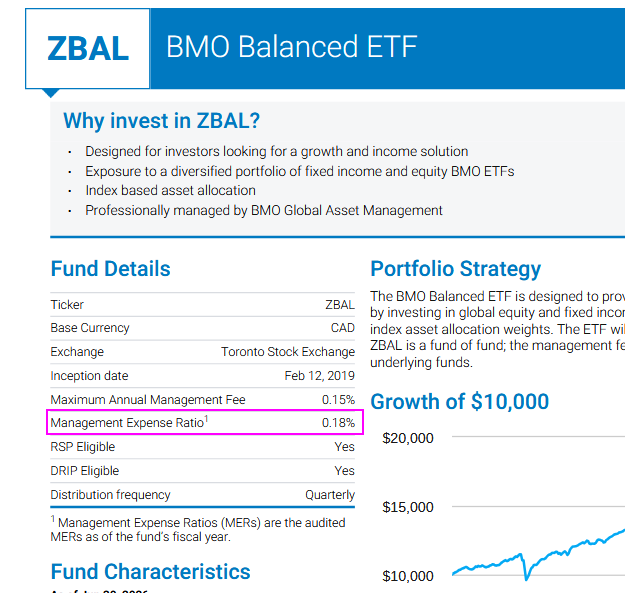
The MER for all funds can be found on their fact sheet. You can easily find the fact sheet for most funds be searching in an internet browser with the fund’s ticker symbol with the words “fact sheet”.
For example, check out the fact sheet for ZBAL here or search for it yourself with “ZBAL fact sheet”. Do you see where the MER is listed?
The Anti-Compounding Effect
To understand the true impact of MER, you should understand the double-edged sword of compounding. Just as compound interest accelerates wealth creation, compound investment fees accelerate wealth destruction.
When a fund charges a 2.00% MER, you are not simply losing 2% of your money that year; you lose the future growth that 2% would have generated for decades to come.
A Tale of Two Investors
Consider two investors, Maya and Liam. Both invest a lump sum of $100,000 into equity funds that achieve an average gross market return of 7% per year over 30 years.
- Maya chooses low-cost, self-directed passive indexing ETFs with an average MER of 0.10%.
- Liam stays in traditional, actively managed equity mutual funds with an MER of 2.00%.
Maya's Net Annual Return: 7.00% - 0.10% = 6.90%
Liam's Net Annual Return: 7.00% - 2.00% = 5.00%
Here is how their initial $100,000 grows over 30 years:
| Time Horizon | Maya (0.10% MER) | Liam (2.00% MER) | The “Fee Gap” Lost to Liam |
| 10 Years | $194,884 | $162,889 | $31,995 |
| 20 Years | $379,799 | $265,330 | $114,469 |
| 30 Years | $740,166 | $432,194 | $307,972 |
Don’t be a Liam
Despite starting with the exact same principal and achieving the exact same market performance before fees:
- Maya ends up with $740,166.
- Liam ends up with $432,194.
- Liam surrendered over $307,000—or roughly 41% of his potential final wealth—solely to fees.
A seemingly small 1.90% difference in annual fees compounded into a life-changing financial loss. For a self-directed investor, reducing your MER from 2.00% down to 0.10% effectively buys you years of additional retirement freedom.
Top 3 Takeaways for Self-Directed Investors
- MER is an Invisible Drain on Your Capital: Management Expense Ratios are subtracted daily behind the scenes before performance figures are reported. Check a fund’s fact sheet to know the exact percentage you are paying.
- Compound Fees Destroy Wealth Exponentially: A fee that sounds small on paper (like 1.5% to 2.0%) can consume over 30% to 40% of your long-term wealth accumulation due to lost opportunity costs and missed compound growth.
- Controlling Fees is Your Greatest Competitive Advantage: You cannot control global markets, inflation, or central bank interest rates. Controlling your MER by choosing broad-market, low-cost ETFs (targeting under 0.20% MER) is the single most reliable way to maximize your net investment returns.