
Investing ABCs: Growth Part 2 – But wait, there’s more!
Published: 2026-07-03
This is my third post in my foundational knowledge series for investing. This series is for anyone who wants to start investing, but doesn’t know the first thing about how to begin. You don’t need to read this series in order, but you should read and learn all the ABCs before venturing forth to buy investment products.
When you step into the world of investing, there is a fun perk that you can’t get anywhere else. That perk is called a dividend.
A dividend is a portion of a company’s profit paid out to its shareholders. Determined by the board of directors, they act as a reward for investing and are typically distributed on a regular schedule (e.g., quarterly or annually) in the form of cash (or additional stock). The promise of dividend payouts entices investors to buy and hold shares in the company.
I am always delighted by dividend payments. They are little bonus injections of cash that feel like bonus money. After switching to Wealthsimple almost a year ago, I receive email notifications each time I get a payout. Seeing those happy little notices appear in my inbox still hasn’t gotten old.
In reality though, these payments are not a surprise at all. I already know an estimated amount I should expect and the frequency in which they should arrive. But if you don’t get joy from the little things in life, than what’s the point of even living? Right?
Take a look at the ETF funds that we invest in, as an example. I’ll break down why we settled on these funds in a future post. For now, we’re going to look at their Dividend yield (payouts). The Annual Dividend Rate is how much you should expect your dividend payout to be, per share you own, over the year. Most funds pay out dividends more frequently than annually, so the annual amount gets portioned out over the course of the year. How often is the Frequency, which is also how often I get those fun emails from Wealthsimple ringing my “I just got paid” bell.
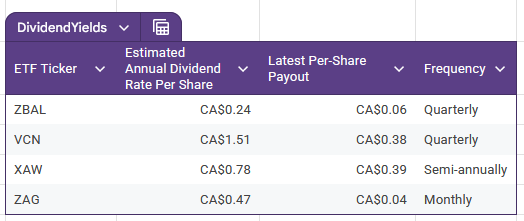
You can take this information and calculate the dividend payout, based on how many shares you own. Let’s assume we own 1000 shares of VCN.
1,000 shares of VCN x $1.51 CAD/share = $1,510 CAD annually, paid $380 quarterly
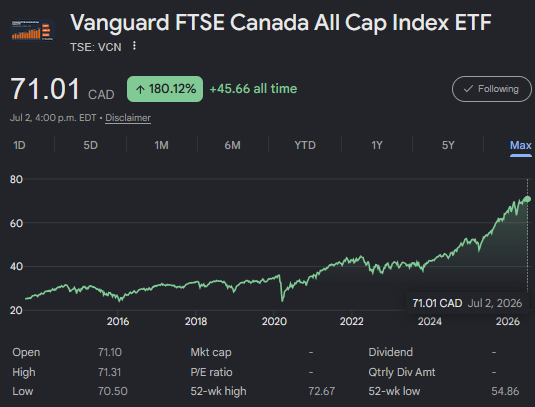
Note that dividends are above and beyond the growth I described in my last post Investing ABCs: Growth. Let’s look at the growth over time of the VCN fund. In 2013, one share was worth just over $25. Today, that same share is worth $71 . So, in addition to each share being worth more over time, you get dividend payouts along the way. The more shares you own, the bigger the dividend payout.
Smart investors take the free money they’ve earned through dividends and reinvest them. Most brokerages (the place online where you buy your investment products like ETFs, stocks, and bonds) offer you a feature called DRIP.
DRIP stands for Dividend ReInvestment Plan.
To set up a DRIP, you update your preferences in your brokerage account once to automatically purchase more shares with future dividend payouts. Remember that lovely curved growth chart I showed you in my last post? A DRIP is the same concept; your wealth over time gets a boosts because you are compounding your growth. You wealth curve will be steeper. When you use your dividends to by more shares, the increase in shares means a larger dividend payout next time. A larger dividend payout then allows you to buy more shares, increasing the total shares that you own, and you earn an even bigger dividend payout the next time, etc. etc. .
Some investors are considered Dividend Investors. Their portfolios aim to make steady passive income from dividend payouts, replacing the need for employment income. To be clear, that is not the path that we have chosen. As much as I love those little bonus payments, they are not our primary wealth building strategy. But every little boost counts towards growing our wealth.
Do you already own investments? Do you know if they pay dividends and what their yield and frequency is?