
Confidence
Published: 2026-09-25
It takes a certain amount of confidence to make big money decisions.
I recall discussing retiring early with my husband, who looked me square in the eyes and said “Just don’t make me become a Walmart greeter, k?”. By which he meant, make sure your plan is rock solid and we won’t screw our future selves.
Gulp. Cool, no pressure, right?

His fear was that our plan would fail and we would have to go to back to work doing something we hate. My fear was that we would live a life of austerity but then not save up enough fast enough to retire early in a significant way. I did not want to live a life restricted in my 30s and 40s only to realize I only shaved 5 years off of my retirement date.
A Progression of Planning
I’ve used different systems over the years to motivate and guide our big money decisions. Having a plan that is mapped out by way of a spreadsheet has been my guiding light and essential to achieving our money goals.
The Debt Busting Years
In our debt repayment years, I was obsessed with Microsoft Money. This product no longer exists, but it was fantastic! Not only did it track our budget, it graphed all our debt repayment schedules over time, making it easy to see at glance exactly when we would be debt free. It also let us run scenarios, like what would happen if we upped our mortgage payment by $50 a week.
Having the ability to run scenarios made it easy to build a plan with my husband. Seeing the impact from paying off debt faster in terms of saving time and interested charges was very motivating. We were happy to lock in a spending plan that got us to our goal faster.
Want to build your own debt busting plan? Check out my Debt Busting section on my Handy Links page for online tools to track and run scenarios on paying down debt. Drop me a comment if you try it and let me know your impression.
The Saving Years
After our debt was handled, we transitioned to our saving years. I built a simple spreadsheet to project at what age we would hit our “number”.
If you are into FIRE (Financial Independence, Retire Early), you might already have a “number” that you are working towards. In FIRE, your “number” is a target amount in savings (a.k.a your nest egg) that is big enough to to cover your daily expenses from your investment gains.
In our debt busting years, we followed the Life of Pie method, meaning we had been saving 10% along side paying down debt with at least 15% of our net income. This meant we had a small nest egg already accumulated. This was my “ground zero nest egg” and which become seed money for my spreadsheet calculation. I then mapped for every year how much we would have based on 7% investment growth with a monthly savings rate of $2250. Our safe drawdown rate is 4% of our nest egg. After setting up our base case, I copied the table and made versions that showed how much faster we would reach our number with a savings rate to $3000, $4000, etc.
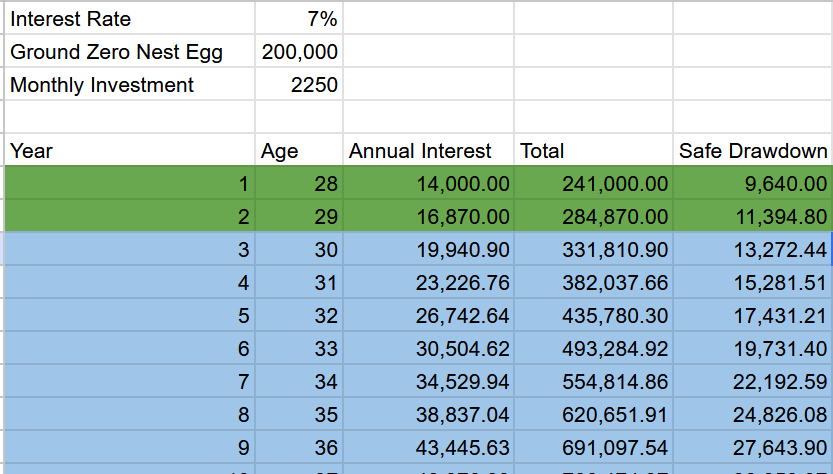
Seeing the year we should theoretically be able to leave our day jobs was very motivating! It still didn’t feel real, but we knew the numbers on the page couldn’t lie.
It’s worth noting that in our saving years, we adjusted the Life of Pie method and accelerated our savings rate, sometimes as high as 50% of our income. If you don’t care about retiring early, this is not something you need to worry about at all! Just follow the Life of Pie method, and you will be totally fine with a pretty fantastic life. But if you are FIRE curious, I highly recommend reading The Shockingly Simple Math Behind Early Retirement by Mr Money Mustache. This blog post changed my life! Then go ahead and devour the rest of his blog. It’s well worth the read!
Now a days there are much more sophisticated tools online that make my simple little spreadsheet look basic. If you are interested in trying some out, see an investment calculator called Smartasset, linked under my Handy Links under Investing, or the web app Projection Lab, linked under my Handy Links under Wealth Management. While these are very cool, you could also keep it basic like we did, and just build yourself a tidy little spreadsheet.
The FIRE Years
We are now in our FIRE years. We’ve retired early and now we need to manage and protect the nest egg so that it lasts into our traditional retirement years and beyond.
This is the probably the most nerve wracking phase. In order to pull the trigger and leave our day jobs, we REALLY needed to see the numbers mapped out.
To help us, about 3 or 4 years before we planned to retire at 45, I built an uber spreadsheet, which I will call our Projections spreadsheet. We still use it to this day to make big (and scary) money decisions.
Our Projections file maps out our annual income and expenses from the current year until we’re 95 years old. It also maps out our annual net worth, tracking assets and liabilities over time. Our expenses increase every year based on value for inflation, which we’ve set at 3%. Our investments grow annually based on a value for ROI (return on investment), which we’ve set at 7%. It also shows us the impact, over time, of drawing from our investment accounts, which will give us income now that we don’t have day jobs.
Our file is both simple and not simple, at the same time. It’s evolved heavily over the years, especially as we came closer to leaving our jobs. For us, it’s a guiding light that lets us know we’re gonna be okay. It’s also a tool that we call on when we have to make big life decisions. For example, when we returned to Canada, we used it decide where we could live and keep on budget. In this past year, we used it help us decide how much we could afford to spend on travel. We can’t account for everything in our monster of a spreadsheet, but we can get pretty darn close. That being said, FIRE is not for the faint of heart! If you want to FIRE, you need to know your numbers inside and out.
Bone Shaker
Last week we received some impactful news. Our tenant, who was renting out our “forever” home while we were in Australia, has given their notice. When we returned to Canada, we made a big life decision not to evict them immediately and continue renting while we spent time in another part of the country. Losing renters means that we are losing a revenue stream that helped offset some (not all) of the carrying costs for us to keep that property. In our dream scenario, our tenants would have stuck around for another year. With the big news, we need to re-assess our life plans going forward.
Queue the panic alarms? Actually, not at all. Sure, the news is a bit stressful, mostly as an interruption in the status quo of our lives. But we have a baseline plan, and now we just need to review and adjust accordingly. So we dusted off our trusty Projection spreadsheet and mapped out what this means for us financially, based on what we know today. And guess what? We should be okay. Our Projections have given us the confidence to know that we don’t need to rush into any panic based decisions. We will want to make some adjustments over the next 5 to 10 years and next year we won’t plan a big vacation like this year, but that doesn’t feel like a great sacrifice right now.
Confidence (Question Mark)
Where does confidence come from? To be clear, even with our spreadsheets and our life planning, it’s not all smooth sailing all the time. We still can get queasy stomachs about what the future will hold. But all we can do is make the best decisions we can with what we know today. That’s all any of us can do, really. For us, confidence comes from being organized, disciplined, and based on real numbers that make sense.
What’s Your Take?
Have you had to deal with a big financial change? Did you have a system in place? Were you able to lean on an emergency fund? Drop me a comment or an email, I would love to hear what you would do!