
Life of Pie: Future
Published: 2026-05-01
This is post #4 in my Life of Pie series. If you’ve new here, I recommend that you read my previous post Building Your Financial House, which gives you a high level picture of healthy finances, and then I’m Ready Now What?, which preps you for the posts in this series. I recommend that you jump back to those posts once you’re ready to begin making positive changes in your life!
Here are my previous posts in this series:
The Future slice, IMHO, is the best slice of all the slices! This one has the power to change your life for the better and in a really big way. Your Future slice includes your safety net (a.k.a. your emergency fund) and your investments, which is how you grow your money engine. Your money engine allows your future self, one day, to stop trading their time for money (a.k.a. working). In between saving for disasters and saving for financial independence, you might also choose to save for major expenses like a down payment on a house or post secondary education. Everything in this slice is about building a better future. How cool is that?
Some key concepts for success.
- Funding your future is not negotiable. Even if you have debt, you save. This is the path to a balanced financial life.
- Your savings are a monthly bill that you pay yourself. Automate it so that it comes out of your spending account the day after you get paid.
- Keep your Emergency Fund in a separate, no fee, high interest savings account. There are many to choose from, just do a quick search online.
- Never do anything with your savings that you don’t understand. That includes sending it to “some money guy” who “handles” all your investing for you.
- Money + Time is magic! Compound interest is the growth that you need in your life. If you are not putting money aside now, you are missing out in a major way.
Choose Your Level
This slice comes in beginner, normal, and advanced modes.
Beginner: If you have debt, your financial house is on fire, and prioritizing getting rid of it forever is critical. But setting up your Emergency Fund is also critical, as is putting money away now for your future self. Your strategy should be do a little of all these things, as they are all important. Once you are out of debt, you can contribute to your future in a more meaningful way. In Beginner Mode, your target for Future is 10%.
Reality Check: I want to add a note here for those who are struggling. If you can get your financial life in balance and your Life of Pie slices are relatively on target, then great! However, I’ve lived below the poverty line and I’ve had to survive on overdraft (so gross, I know!). I know that sometimes after covering the essentials, money can be impossibly tight. I urge you to do what you can, no mater how little. During our tightest times, we put a meager $20 a month away in our emergency fund. Savings is a muscle. Just like going to the gym, the most important thing is to show up and do what you can. Showing up for your future means putting something away every month. If it’s very small, your goal will be to increase that amount as your financial life improves. Focus on ways to reduce expenses and increase your income to get your Future slice up to at least beginner mode.
Normal: When you are debt free, you have the power to supercharge your future! You can now divert the 15% that would have gone to debt payments to yourself! Huzzah!
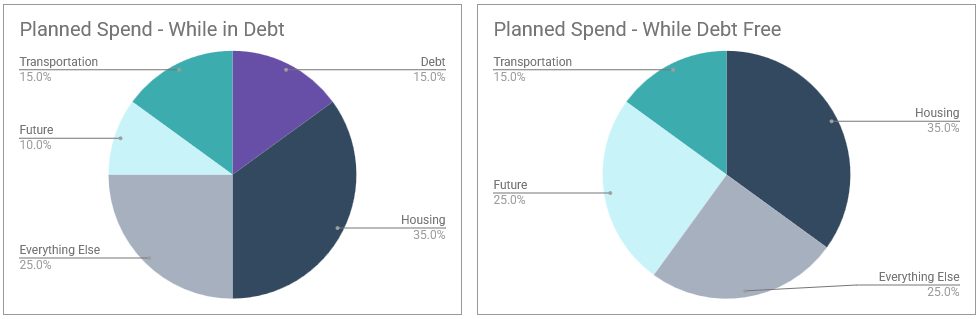
Advanced: Do you recall how I said in Life of Pie: Housing that “Life is squishy, and your pie will likely never be 100% perfect.”? Once you’ve got your financial life dialed in, you might explore increasing your Future slice to be even bigger! The bigger this slice, the faster you reach your goals. This is not required for a healthy financial life, but for me, understanding this option was a game changer and it allowed my husband and I to reach financial independence by the time we were each 45. If this sounds interesting to you, I encourage you to read the blog post that changed my life in a big way “The Shockingly Simple Math Behind Early Retirement” by Mr. Money Moustache. It’s his writings that educated me the most and opened my eyes to an alternative lifestyle that really resonated with my value system. In our most plush days, my husband and I would squirrel away around 60% of our income to Future (a.k.a our investments). The key is, in your working years you always save at least 10%-25%. However, as you win at life, you can choose to reduce other slices and put even more. You get to decide for yourself how much is enough.
Cool Story, Bro. Now What?
The deeper strategies on how to allocate your future savings warrants it’s own post. For now, you should accomplish three actions
- Update your spending plan based on whichever “mode” fits your life right now. If you are using the MWM Budget Tracker the beginner and normal modes are there by default.
- Setup a separate no fee, high interest, savings account for your emergency savings. If you don’t know or have investments, then just shove all your Future money into savings for now.
- Automate your savings. If you have a regular pay day, schedule a transfer to your savings account a day or two after it hits your spending account.
Now give yourself a high five and go play some video games! You did great things today.
If you enjoyed this post, please subscribe to the weekly MWM email.
Build Your Financial House
Published: 2026-03-08
If you want to build an awesome life, you need to build an awesome house. Financially speaking.
Let’s think about your financial house from a bird’s eye view. Let’s fly way way way up and then turn to peer down at the ground. Can you see your house? I can. It’s a beautifully carved marble building on a lush field of green and yellow. It’s sturdy and strong and secure. It’s built to last the ages. And it’s based on four pillars.
The pillars of your financial house are:
- A Spending Plan – Live within a spending plan that allocates a healthy balance of money for housing, transportation, life, future, and, if needed, debt busting.
- Emergency Savings – A multi layer safety net to protect yourself from unforeseen events that risk bringing down your financial house.
- Zero Debt – Debt is an anchor that drags you down. You need to bust all high interest consumer debt as quickly as you can. Save yourself!
- Investments – Buy a diversified portfolio – as much as you can afford, every month, without fail, into boring stuff that has low management fees. We’ll talk about knowing what you can afford in a future post!
These four focus areas are your building blocks for financial security.
Zooming out paints the picture of what you want and creates the blueprint of what you need. With your blueprint in hand, your next steps will be to zoom in and start building from your plan. In future posts, I’ll help you construct each pillar, methodically and systematically.
But, for now, don’t over think it! Enjoy the view and know that once all these pieces are in place, you will have put your financial house in order.
As a closing thought, let me mention that, on top of our four pillars, stands financial independence (FI). People reach FI when their investments provide more income than their projected expenses. If they accomplish this surplus before the generally accepted age of retirement, they can retire early (RE). This is the basis for FIRE, an extreme personal finance movement, which marries FI with RE. Online discussions concerning FIRE include big feelings and heated debates. The great news is that you don’t need to choose right now if you want to pursue FIRE. By building your financial house based on the pillars I’ve listed above, you’ve created a foundation for FIRE, should you ever want to pursue it! The only difference is that you would adjust your spending plan to focus more on the future to make investing a priority over spending.